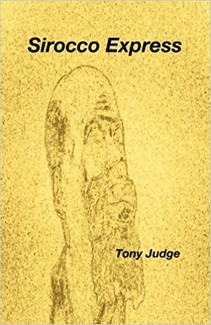
A young Nigerian man leaves his home in Lagos to travel across the desert to Europe, in company with people smugglers and fellow migrants.
Set mainly in 1999/2000, Sirocco Express tells of a young Nigerian student’s experiences on a journey from Lagos to London. But Adebayo is no backpacker on a gap year jaunt. He pays people smugglers to take him across the Sahara, and soon becomes immersed in a hidden world of illicit travel and savage exploitation.
Adebayo’s determination to retain his humanity, in spite of his increasing horror at the callousness of the traffickers, soon brings him into conflict with them. Although his plight may be unfamiliar to many in the Western world, his quixotic stance in the face of his many misadventures has a universal appeal. The people smuggling process, its victims and the motives of those who profit from it are described with stark realism. Adebayo emerges not as a passive victim of his choices, but as a resourceful pimpernel, who evades his persecutors and ultimately completes the journey on his own terms.
Excerpt
‘November 15th 1999.
We are now emerging from our long sojourn in the desert and, like sailors returning to land after many days at sea, our thoughts turn from mere survival to the possibilities that await us after landfall. The route that we have followed from our homeland across the desert to the Maghreb has been established for many centuries as a trade route for caravans bringing goods from West Africa. In the past, the trade was often in slaves: West Africans captured by Arab raiding parties and marched in chains across the vast breadth of the Sahara to trading centres in the north. I have read that in some cases half of all the captives died en-route, leaving a trail of grisly way markers for those that came after them. From the trading centres, the slaves were dispatched to their new masters along many routes that fanned out like the fronds of a date palm across the rest of the Maghreb and into Europe.
Seen in this context, my companions and I are simply the latest phase of a West African Diaspora – willing and compelled – that has existed since the days of the Arab conquest of North Africa and probably even before that. And we too have left our small way marker. I grieve for Kayin – I wish that we could have helped him before it was too late – and I pray that no one else is lost. Our drivers are cruel, hard men who place no value on our lives other than as a commodity to be exploited…’
Professional Reviews
The Lulu Book Review - Shannon Yarborough reviews Sirocco Express by Tony Judge
Posted on July 4, 2008 by shannonyarbrough (http://lulubookreview.com/2008/07/04/review-19-sirocco-express-by-tony-judge/)
Traveling to foreign countries is not a pleasure I’ve ever experienced myself, but I have always enjoyed reading about it. Christopher Isherwood and his writings about many trips to a war torn Germany remain at the top of the list of some of my favorite books. I can now add author Tony Judge to that list. When I began reading Tony’s book, Sirocco Express, I was immediately captivated by the author’s use of description. Here’s the very first line of the book:
The house lay so still and quiet that it seemed to be filled with cotton wool.
Lines like that in writing these days are very hard to come by. We write what we know, because that’s what we’ve been told to do, and we know so little. Authors like William Faulkner and poet Emily Dickinson or Robert Frost had a true craft for writing those descriptive, yet simple, images that stay with you long after you’ve finished reading. Judge indeed has that craft.
In the beginning, the reader is introduced to a young Nigerian boy named Adebayo who is perusing a copy of Treasure Island while waiting for the Reverend to arrive to tend to his ailing mother. I immediately became intrigued with the story because it has a sense of mystery to it. The young boy is dismissed from the room while the Reverend tends to his mother with prayer. The first chapter ends with a strange feeling to it as if something odd has happened between Adebayo’s father and the Reverend after reviving his mother. The author has done an excellent job of keeping you interested and wanting to know more.
The second chapter focuses on Adebayo being concerned about an article saying he shouldn’t read Conrad because of the way he depicts non-European characters. Adebayo’s father tells the boys he should judge for himself what he wants to read.
His father’s advice on “free will” quickly becomes an anthem for the young boy who has fallen in love with 19th century London thanks to one author by the name of Charles Dickens. During his first year of college, he becomes agitated with the possibility of his father losing his job and his family falling on hard times. For the dreamer in all of us, constantly pulled back into the realm of 9 to 5 jobs and a stack of bills that clog our dreams, Judge has penned some outstanding prose that is sure to inspire you to not give up:
When will you understand that you are invisible; that no one has the slightest interest in what you think, or feel or do? You are as a grain of dust on the hide of an elephant.
I was instantly reminded of a line from a book that has stuck with me about how we lose our audience when our parents are gone, there is no one else that really truly cares about us and the things we do. It’s a wake up call for our young protagonist who is determined to see the world, that until now, he’s only read about. But the journey to his destination is not an easy one, as Adebayo takes up traveling with people smugglers, armed only with a geography guidebook and his own journal. He is a reader, a writer-like many of us-stuck in an unforgiving reality with larger than life thoughts and dreams. We add to our own personal world through observation of new places and things, which is just what Adebayo sets out to do.
Sirocco Express is a brilliant tale of one man’s determination to fulfill his dreams. His journey echoes of the realization of how we let things stand in our way of achieving what we really want, even if it’s just to see a foreign place we’ve only read about. Adebayo constantly witnesses the oppression of his country and people during his quest, but he never gives up.
At only 189 pages, Judge’s book was a quick read but is packed with extensive research into Nigerian history and folklore, religion, and vivid geographical information that you will be Googling long after finishing this read. The author has labeled it as a “contemporary novel about migration,” but it is much more than that. It is a wholesome and heartfelt adventure that reminds me of the imaginative worlds and trips I discovered and fell in love with the first time I ever picked up a book.
'Coruscated Confabulations' is a collection of stories and experiences, most of which took place in prior decades. They are taken from or based upon real events, with a certain admixture of fictional embellishments.
High school student Kevin Borden has a secret and his name is Louis Lannegan. He also has an overbearing mother. A tale of coming out in the shadow of parents and friends. Award winning novella.
May I offer you a Round the World Cruise of a lifetime for the price of a novel?
Not only do the seas roll on but two romances,a death at sea, uncovered past lives, history uncovered in Brazil, caves in Australia, poetry in Senegal, the Lux Mundi