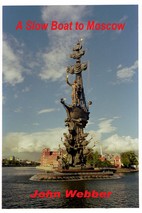
The story of an amazing journey by lakes and rivers from St Petersburg to Moscow.
In the first part of the book the author takes an intriguing river journey from St Petersburg to Moscow. The characters and incidents encountered, both on and off the boat make this a memorable voyage and a funny and sometimes touching story.
Descriptions of the places visited and portraits of the people met are inter-laced with tales of a love-struck barmaid, the Russian Mafia and a mysterious coffin.
Part two of the book sees a return to Moscow where we journey to a beautiful convent that Napoleon tried to blow up, Tolstoy's House and the birthplace of the Russian doll. There is also a rather unexpected meeting with a Tasmanian Catholic priest...
Webber’s book is a wonderfully uncomplicated narrative of two trips he took to the ‘new’ Russia. The first one neatly coincides with the beginning of Putin’s first term presidency, where he joins a group of other inquisitive tourists on a boat trip from St Petersburg, across Lake Lagoda, along the Svir river, through Karelia and Lake Onega, and then down the great Volga river until his eventual arrival in Moscow. Then, with that moreish feeling with which many of us who love Russia are all too familiar, Webber makes his return two years later, this time to Moscow, where he grapples with the challenges of being a foreigner in that huge capital city and explores some of what he missed the first time around.
Webber is a brilliantly and comically honest tourist and author. He admits to harbouring preconceptions and stereotypes about Russia and Russians, and demonstrates awareness that many of his readers will probably have similar ideas and when they arise, confronts them graciously, intertwining them seamlessly into his story. What ‘A Slow Boat to Moscow’ isn’t though, is a reinforcement of all ‘Russian’ stereotypes; rather it is a representation of the country which sometimes reinforces the image of Russia we have already constructed in the British consciousness. But he also paints an entirely new picture for us, by delving below the surface of the typical tourist adventure, acquainting us with ‘Russia’ through her people and providing us with a variety of vicarious experiences which can add to what we understand (or maybe what we don’t understand) about the country.
Welcomed into the country by the passport and visa officials who, he surmises, ‘were undoubtedly all called Boris’, Webber’s first tourist experience of Russia begins. Many of us can relate to those long, stomach-churning moments at the airport border control in front of the officials, whose ‘job is to take as long as possible to scrutinise each document and then very reluctantly let you in’, and with that feeling of relief when you can make it through to reclaim your baggage, and you’re in the country just waiting for your adventure to begin.
At this point the account splits into something of a dual-narrative; its readers are treated to charming descriptions of funny and awkward moments and happenings between the characters both on and off the boat, as well as having powerful and dynamic depictions of ‘Russia’ that the boat is moving through and of the places it stops off at along the way. The contrast of the vastness and foreignness of Russia and the, comparatively, insignificant details of the people around Webber, means the reader, follows a double-layered discourse, is engaged from start to finish. We meet tour guide Galina and her ‘infectious knack of spreading… enthusiasm’, as well as some of the tourist-hardened Russian crew members – barmaid Olga, ‘who rather re-formulated Webber’s opinion of what people called Olga are like’ and Yuliya, who causes a series of uncomfortable moments between Webber and herself. We also join in trying to solve the mystery of an unidentified coffin which boards and disembarks the vessel with no explanation, the presence of furtive ‘Sergei’, a ‘guest of the captain’, who temporarily joins the tour group, and is definitely ‘not from the KGB’…
The second part of the book documents Webber’s return to Moscow, independent of a tour party. Staying in a hotel with some questionable menu items, he recounts his few days spent in the city in the late summer of 2002. His return to the city allows for much more time to explore independently, and to see more of what he saw at a glance the last time. Throughout six chapters entitled ‘Apprehension’, ‘Navigation’, ‘Purification’, ‘Sensation’, ‘Communication’ and ‘Reflection’, Webber explores some of the ‘classic’ culture of Russia, making visits to Tolstoy’s Moscow house, the Novodevichy Convent and Cemetery and the Tretyakov Gallery, as well as going for a day to the Golden Ring town, Sergiev Posad. After this second part, which is rich in Russian culture readers are most familiar with, we are left with the feeling that Webber now departs Russia with some satisfaction that he has discovered enough for now, yet at the same time he expresses that he is assured that he still has reasons to return again.
This is the overwhelming sensation I had when I finished the book. Although I have lived in Moscow and travelled extensively to other parts of Russia, I know that there is always going to be something new to discover in other literary accounts, or when I go back myself. Similarly Webber knows he has not explored and discovered Russia in its entirety, leaving the way open for him, or another author, to continue the story. His discourse gives readers a taster of ‘Russia’ and can be understood as an introduction and a starting point or inspiration for further exploration, but now he is passing the baton onto the reader, for them to go and discover for themselves this country which still, over a decade later, holds so much mystery to it.
At the end of the day, this is the only way to do it properly. I spent one day exploring Russia with Webber and, although it was nothing short of fantastic, I know that the stresses of visa applications and flight bookings are well worth being able to see, smell, hear, feel and meet Russia for myself. Webber admits that he has been ‘stacking up reasons to come back’ to Russia, and I realise now that I have a similar stack of reasons, just awaiting more attention.
Expands beyond the safety of pages bound by predictability to explore and often confirm exciting creative possibilities. A shimmering collage of memoir, creative nonfiction, literary journalism, and dizzying flights into poetic observation, this is t
Perfect for fans of Bill Bryson, Elizabeth Gilbert, and Cheryl Strayed, this is more than a travelogue—it's a hilarious and heartfelt journey for anyone who has ever wondered: "Is this it?"
An account of adventures in Scandinavia that involved flying dragons, Russian and German submarines, old WW2 era battlefields, Finnish foxes (female kind), Finnish-Mexican cuisine and much more. Written for the most part with a light touch, it ends o