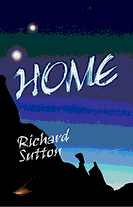
Human colonists escaping Earth's wars and drought, try to make a new home on a distant planet and get along with their new neighbors.
A thought provoking story in a scifi setting. Forty-two teachers, scientists, engineers and their children, have just completed a twelve year deep-space journey to escape the war and drought ravaged Earth. A carefully selected band of hardened survivors, they are to be colonists on the planet Nakis. Lying at the edge of the galaxy, it’s a new world that they hope will let them build a safe life together. Unfortunately, within two days, their ship, all their supplies, tools and technology are destroyed in an unforeseen melt-down of the crystalline core of their laser-driven vehicle.
Scrambling up to take shelter in a rough cave above the valley floor, those watching the melt-down find that survival will mean resurrecting the ancient technology and forgotten skills of their Paleolithic ancestors. If dodging the lurking predators isn’t hard enough, soon they discover the uninhabited planet they are marooned on, isn't exactly uninhabited. Nakis has not provided the home they had willingly traded their old lives for. They have been reduced to foraging for subsistence. No strength, no defenses and now: powerful, potential enemies waiting in the darkness.
If lasting peace with the native humanoid species eventually comes, it will not be without incidents that try their empathic hosts’ patience. Rigid, bunker-mentality and religious stubbornness prevails among many of the original mission founders and a growing anger emerges that may doom the human colony. But a breakthrough cooperative experience binds them all together in a completely unexpected way from a source no one considered. Will this illuminate their path to finally finding the home they had hoped for, or will it drive a deeper and darker wedge between them and the Naku?
Excerpt
Entry 3232.1.17
The last ones made it up only seconds before the core ignited. Ten souls, scrambling to lift a heavy steel storage container into the cave mouth. Two of my engineering staff remained behind with the last group up and it looked like they hadn’t been as lucky as the rest of us. Geoff had nasty red welts across both arms that would need immediate attention. Our systems analyst, Will, however was unconscious.
Two nurses ran to him and settled him into a pile of bedding and rags close to the rear wall of the cave. One had a wet compress, I watched as she wiped his dirty face, but Brian called out for everyone to get down and take shelter. The entire melt-down took barely four hours from the first alarm, so we had little time to evacuate everyone to a safe distance above our landing site before everything we knew – everything we had, disappeared in a suffocating blast of molten silicon, twisted metal and ash.
The cloud rushed out at us seconds after the shockwave hit, sending boulders rolling and trees tumbling. The cave filled with choking, black smoke.
Inside, those brave enough, tried to watch through the caustic gloom. As soon as the smoke cleared and they stopped coughing, they gathered at the cave mouth. They saw the remaining embers and pools of molten metallic slag slide into the ground. Dirt, sand and stone slid in behind to bury what was left beneath tons of debris. Only a shallow, singed depression remained on the valley floor, where a week ago, we’d arrived. We had been forty-two men, women and children, full of the excitement of a new home and the peaceful joy of knowing everyone that started out had survived the twelve-year journey, plus a few. Not now. Only fear lingered.
Next to me, my wife Erin and our three boys, Karl, Jimmy and Carson, knelt in one of the four openings in the stone wall. All tearful eyes followed the thin plumes of smoke still escaping from the sinkhole down below us. Their entire world had just changed forever. We’d all accepted the risks in coming, but none of us could have known how incredibly alone we’d been left, in one morning’s time. A new home, far from the fear and futility that we’d known all our lives had been too tempting to turn away from. But now?
Professional Reviews
Thoughtful Metaphor
Home" is a thoughtful metaphor about the phenomenon of immigration and the clash of different cultures. The author might have chosen to relate a story of Eastern Europeans immigrating to America during the 19th Century. Instead, his story takes place in the far future, with pilgrims from a depleted Earth traveling to a new planet. They are welcomed and helped by some of the natives, but despised by others. The discovery of a common DNA leads inevitably to inter-species romance with equally inevitable stresses and trials. Somehow people make do and survive. This is not a Star Wars tale, with ray guns and interplanetary blasters. Rather, it is a story of quiet struggles within, to come to grips with our own natures. A unique accomplishment. Author Steve Bartholomew
Home is Where You're Stranded
I expected the plot to focus on stranded humans fighting for their lives against alien predators as they try to find a way back home to earth. That's not exactly the case. While surviving the "jungle" is part of it, the main conflict seems to be between earth traditions versus alien traditions. The aliens are very human in some respects, but in other ways not. At its heart, this story is applicable to any time/any place. It's about learning to understand those who may very different from you and finding common ground. It's not hard core science fiction, but it's thought-provoking. The prose are straight forward, easy to read, and I like that.
Amazon Review by Jack Flash
Richard Sutton's Home
I thoroughly enjoyed this novel. It is a fast-paced tale of planetary colonists facing an enormity of woes in a hostile environment that threatens their very survival. From the first page to the last, the characters and plot speed you toward the finish, always uncertain until the end, throughout which the earthlings must resort to their ancient survival techniques. A futuristic, science fiction story, HOME is actually a recreation of earth's early civilization, and how our primitive forefathers and mothers coped. We recommend it highly. Amazon Review by S. Sarfeh
The twenty-five novellas presented in The Psychic Dimension (560 pages) are works of pure fiction. The stories’ themes deal with paranormal and psychic experiences. Any character resemblance to any living person on planet Earth in this work is purely
Strange bones found on a storm-swept Florida beach take a couple into the sub-Atlantic base of a secret government lab. Transgenic global preparation is threatening to erupt in the devil's triangle with supernatural forces.
Ninety-Nine Novellas (1,600 book pages) is a collection of 99 popular Jay Dubya novellas and the book is the companion work of Ninety-Nine Novellas, Part II.