Category: History Publisher: PublishAmerica
ISBN-10: 1588516342
Type: Non-Fiction
Pages: 194
Copyright: Jan 1 2002
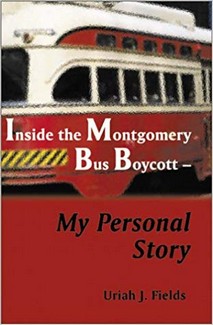
The full and true story about the Montgomery Bus Boycott told by Uriah J. Fields, the original secretary of the Montgomery Improvement Association that spearheaded the bus boycott, tells an insider's story about the historical Montgomery Bus Boycott that launched the modern Civil Rights movement.
Only an insider who felt the pulse and shared the collective agony of those boycotting buses in Montgomery can give an eye-witness account of the Montgomery Bus Boycott. "Inside the Montgomery Bus Boycott - My Personal Story" is that account. After the arrest of Rosa Parks who refused to give her bus seat to a white man, Uriah J. Fields, Martin Luther King, Jr., Ralph David Abernathy, Edgar D. Nixon and fourteen other persons founded the Montgomery Improvement Association to spearhead a bus boycott. Fields was the original secretary of the MIA. African Americans ended the 382-day long bus boycott and returned to riding integrated buses after the U.S. Supreme Court ruled that Alabama's segregation laws were unconstitutonal. What happened during the boycott and in the early day of bus desegregation that included die-hard segregationists bombing of four churches and two parsonages in the wee hours of the morning of January 10, 1957 is the matter of this book. Fields was the pastor of one of those bombed churches that was rebuilt under his leadership.
The Montgomery Bus Boycott contributed substantially to desegregating the South, passage of the Voting Rights Bill and opening houses that gave African Americans access to fair housing in the North and in the South, equal employment opportunities and affirmative action.
To order of your copy of "Inside the Montgomery Bus Boycott - My Personal Story" by Uriah J. Fields, please send your check or money order in the amount of $19.95, plus $3.00 for shipping charges (total of $22.95) payable to:
U. J. Fields
P. O. Box 4770
Charlottesville, VA 22905
The author will autograph your book of his book, if requested.
Excerpt
"Martin Luther King, Jr., offered his resignation to the MIA board. He expressed the view that someone else among us could lead the organization better than he. He spoke of the value of shared term leadershp. At the time, King had only served as president of the MIA for seven weeks, which probably seemed to him like seven years. Frankly, I didn't feel that anyone else in that room wanted to be president of the MIA any more than Rev. Bennett had wanted to be president on the day King was elected to that office. Most board members were concerned that if King resigned, it would show that there was a split in the leadership which would give white people the impression that King no longer had the confidence of black people. We repeat here two statements that were made by Rev. S.S. Seay and Rev. A. W. Wilson during that meeting. After referring to King as the Moses of the people of Montgomery, with tears in his eyes, Seay said, "You are young and well-trained in the spirit. I will drink my portion of this cup, but you can drink of it deeper." Wilson said, "Brother King, I would like to see the boycott continue but if you resign as president we should end the boycott immediately." After most board members pleaded with King to remain the president of the MIA a quietness fell upon us. Ronald Young made a motion that was seconded by Rev. H. H. Hubbard affirming our full confidence in Dr. King and his leadershsip as president of the MIA. The motion was unanimously approved. King expressed his thanks for our confidence in him and promised to continue to serve as the MIA president." (p. 80).
Massive Desegregtion. King's leadershp contributed immensely in bringing about more integration in thirteen years than had been secured in all the years America had existed as a sovereign nation. Many of the inequities that Americans of African descent experienced before King's assault on the American system of segregation and racial discrimination have been eliminated or greatly reduced: in public transportation, employment and education. African Americans now have access to public facilities such as restaurants and hotels and open housing. They have the right to vote. These things can be attribited to King's leadership. Most significantly, his leadership helped to changed the way laws would be supportive of black people. Simply put, they would make it possible for a black person to go to court and win when he had been the victim of racial discrimination. This is not to say that all the inequities and exclusions black people faced before King's assault on desegregation have disappeared. And since his death, some achievements made during his life have been lost or eroded. Many schools have become resegregated, affrmative action has been all but eliminated and black men, especially young back men,are currently being imprisoned on a scale not heretofore heard of, accounting for Amerian holding the dubious distinction of being the world's number one jailer. But thanks to King's leadership, blacks are enjoying more of the opportunities and privileges of citizenshp than ever before." (p. 170)
A Viconian Cycle/ Babylonian Captivity Memory Silence Re-Founding of Southern history out of Dublin GA and the KBPS7 Trial. In psychology this is a Wounded Pride case.