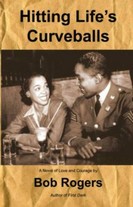
Young 1940's couple shows uncommon love and courage during adversity.
Will Wallace, Jr., like his father, meets adversity with courage. In his native North Carolina, Will is a 1943 baseball star. He fights against America’s apartheid in baseball by accepting an invitation to play on an all-white team. Soon, the Ku Klux Klan decides to teach Will and the community a lesson in the status quo and attacks Will’s home. In the ensuing battle, Will suffers catastrophic losses.
The mother of his high school sweetheart, Dena, disapproves of their romance and declares Will to be beneath their social status. Dena, also tenacious and a member of the second ever coed class at nearby Johnson C. Smith University, loves Will and defies her mother.
Meanwhile, his father’s friend, a former Atlanta Crackers baseball player, devises for Will a clever escape from Klan pursuit and hides him in the US Army. In her letters, Dena urges her soldier to follow the writings of Langston Hughes whose newspaper columns and books inspire Will to stand up for his dignity and fight for the right to fight Hitler’s war machine. Will’s 366th Infantry Regiment’s first mission in Italy is keeping the pilots and planes of the 99th Fighter Squadron (Tuskegee Airmen) safe from enemy saboteurs while on the ground between aerial sorties. When Will's wish to fight the Germans is fulfilled, he finds himself in intense combat that leaves him with flagging hope he will live to see Dena again.
Excerpt
Chapter 1
Jason crumpled, like a dropped rag doll. Face-first, he fell on Broad Street’s sidewalk. The crowd gasped. Several spectators rushed to his side. The softball-size lump of shiny black coal that struck Big Jason’s right temple lay next to his outstretched white hand. Blood trickled from his nose. Big Jason lay still and grew pale as the crowd pressed in for a closer look.
The sky was overcast that Friday afternoon and a cold wind blew from the mountains in the west. As the ides of March 1943 approached, winter was refusing to let spring take matters over early in North Carolina’s central piedmont region. An early spring would have been fine with Judge Stevens. Oakton had seen its first purple crocuses and was impatiently waiting for daffodils. The forsythia bush at the foot of General Joe Johnston’s statute on Oakton’s town square had but a handful of blossoms.
By the time that ancient forsythia bush would cover itself with yellow blossoms; baseball would compete with the docket for the top of Judge William T. Stevens’ mind. His playing days with the Atlanta Crackers were never far from his thoughts. He opened one of his dirty second-floor office windows for a better view of the town square.
In the confused moments that followed, Judge Stevens saw Cliff Thompson leap to his feet and scramble around the corner and run down the alley as if a ghost was hot on his heels. There was Lil’ Will Wallace tapping his mule’s reins on her back. Judge Stevens couldn’t hear him, but Lil’ Will’s lips mouthed, “Git up.” The mule pulled the rickety old green wagon over the pavement behind the crowd of white people gawking at Jason and away from Broad Street toward the road to Lenoir. The wagon’s faded red wheels and spokes would pause momentarily in each pothole and then lurch forward. The mule’s pace was about the same as that of the people window shopping on Broad Street. Lil’ Will’s pa, Big Will, followed in a large new red wagon pulled by four mules. Judge Stevens could see that Big Will had positioned his rig so that anyone from the crowd looking in their direction would not notice the two burlap bags of coal among the supplies in Lil’ Will’s wagon.
“Did you see that?”
“See what?”
Judge Stevens was waving his hands. “Well, come closer – quickly.” He put his head out the window and peered toward the road to Lenoir.
The mayor walked between Judge Stevens’ desk and his hand-made mahogany credenza. “Bill, I can’t see a damn thing but you in the window.”
Judge Stevens was so excited that he hit his head on the raised window as he drew it back inside. “Ouch! Dammit! Andy, I’m sorry you missed it. I know this is gonnna make us a winner in Denver.” The judge was still rubbing his head and smoothing his silver hair.
“Whatever has gotten into you? What did you see out there to put you in such an all-fired frenzy? All I see is a crowd milling around that boy on the sidewalk. Why is he sitting on his tush?”
“Andy, I’ve never seen the like. Big Jason, was giving poor Cliff a trashing and a crowd gathered. At six feet and a half, Jason was taller than anybody else on the street. Nobody, and I mean nobody, was trying to stop ’im.”
“Yep, he’s tall. My Dan tells me he’s the meanest kid in town.”
“Well, lemme tell you. That colored Wallace boy was driving his pa’s wagon down Broad. He took a look at the fracas and stopped his mule over there by that mailbox on the corner of the square. You shoulda seen’im. He reached back and pulled a big lump of coal out of a bag behind him and, without moving from his seat, threw it and hit Jason in the head. Knocked Jason out cold.”
“You mean to tell me he threw it from all the way over there? Why, that’s more’n a hundred feet!”
“If that boy can hit a baseball anything like his pa could, he’s our answer for catcher when we go to Denver this year.”
“But he’s a nigger. Are you outta your mind? And, besides, why aren’t you calling the sheriff – Mr. Officer of the Court? Didn’t you see the nigger assault Jason?”
“Yeah, so what if he’s colored? We played colored teams in the tournament last year and in ‘41. As I recall, they stole bases any damn time they felt like it and beat our asses handily. Oh, and, no, I ain’t calling the sheriff. Jason deserves what he got and more.
“Andy, don’t you remember? Our poor Jimmy never threw out one of those base runners.”
“But playing against a colored team is bad enough and that’s mighty different from having one of them play on our team. You know our boys won’t stand for it.”
“Even if it means not winning that Denver Post Baseball Tournament prize money – and the fame we need for Oakton?”
“Bill, you know our town. It won’t fly.”
“Andy, level with me. You don’t like my idea, do you?”
The mayor dropped his head and suddenly found the tops of his well-shined brown wingtips to be very interesting.
“Andy, we go way back. I know you never had any truck with niggers. You can tell me straight out.”
“Alright. No, I don’t like your idea. I know I wouldn’t play with’em. So I wouldn’t ask our boys to do something I wouldn’t do. ”
“Not for the prize money? Not for the bigger prize of making this town that no one ever heard of a place to visit and invest in? That’ll help you fill up your hotel – bring vacationers to these hills...”
Cardinal County was not a tourist attraction. It was said that the county had more than a hundred different species of trees and right now there were buds on most of them. The little town of Oakton was the county seat and sat near the middle of the county. Cardinal County had sharecropper cotton farms here and there. Corn was grown in quantity, but consumed mostly by families and their livestock. The big industry was furniture manufacturing. The trees of Cardinal County kept the furniture makers supplied with wood and loggers and craftsmen employed. Oakton was functional. It had one of what most towns would have: one general store, a gas station, an ice house, a shoe store, a clothing store, a hardware store, and one hotel.
Andy thought for a moment, slowly rubbing his chin. “Bill, we’ll just have to find another way.”
Judge William Stevens closed his window. “Okay. I’ll see you at the Chamber meeting next week.”
Mayor Andy Mitchell left without another word.
Professional Reviews
evolution of a remarkable man
“In Hitting Life’s Curveballs, we witness the evolution of a remarkable man. Will is a gentle, polite, somewhat awkward, and unlettered country boy who is armed with a phenomenal baseball talent. Under the tutelage of a wise and caring father, and with the steadfast love of a beautiful girl, he emerges to become a brilliant soldier and a solid figure of a man….
Bob Rogers’ story is peppered with memories of days in the old south during the forties; hog butchering, chicken feeding, cooking on wood burning stoves and making do…. Great dialogue makes the characters believable. Descriptive passages flow beautifully and captivate. The story is convincingly told through a series of conflicts that widen as new ones open. The love story is tender and appeals to the romantic in all of us. Hope for Will’s survival at home and in the military, and for his reunion with Dena propels us through the book. A great read.”
__Barbara P. Grainger, English teacher
a beautiful love story
“Readers will find Hitting Life’s Curveballs both a beautiful love story as well as a walk through the times of World War II…. Will, the main character is a lumberjack and an amateur baseball player. Dena, the girl that he falls in love with, has struggles with her own mother, in that she doesn’t feel like Will is an appropriate choice in a boyfriend….
Personally, I loved the way that Bob Rogers wove the works of Langston Hughes into this book. Dena sends articles to Will from the Chicago Defender and the reading that Will does brings him out of his “small world” in North Carolina and eventually helps him to find his mission in life…. Author Bob Rogers has done a beautiful job of weaving a love story within a war story. Readers will be captivated by Will and feel his struggles as he proceeds through life and the many decisions he has to make as he determines his personal mission in life, while serving the mission his country has called him to do in World War II.”
__Joyce M. Gilmour, Military Writers’ Society of America
historical fiction at its finest
“Hitting Life’s Curveballs represents historical fiction at its finest. Author Bob Rogers skillfully conveys the irony of a country that combats racism abroad while simultaneously promoting the most insidious form of racism within its own borders. Will and Dena calls to mind such satires as Joseph Heller’s Catch 22 as protagonist Will Wallace confronts one form of institutionalized insanity after another. In the end, love and baseball conquer all, a one-two punch you won’t want to miss.”
__ Shelley Kirilenko, author, The Blue Kimono
A delightfully rare Historical Novel. 85% a biography of a spy, musician, mother and her neice trapped behind German lines in World War I. This background led to a diplomatic post in World War II. Aged 92, Vera disclosed her past life one year before
Based on the memoirs of a Pearl Harbor survivor. Letters from two pen pals take the reader on a journey into the past, a past where nightmares came true, and when hatred reigned.
Third Book in Five Book Series - Southern Swallow - a tale of 12th Century China. Li K'ai-men becomes entangled in an intrigue that becomes his undoing.