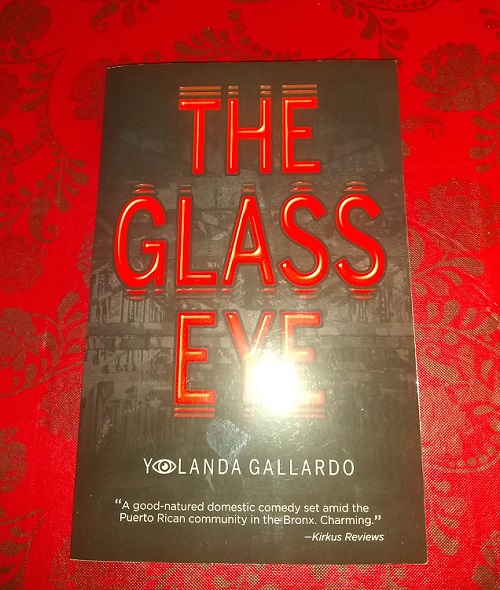
Category: Drama Publisher: Arte Publico Press
Type: Fiction
Pages: 158
Copyright: 2019
Price: $11.96 (eBook)
The subject matter mixes deadly serious themes with outrageous behaviors.
Professional Reviews
Tragedy Tomorrow, Black Humor Tonight
Yolanda Gallardo’s The Glass Eye comes with a twisty uniqueness for reading in plague-time. The subject-matter mixes deadly serious themes with outrageous behaviors amid an authorial tour-de-force of dark optimism.
The opening two paragraphs have a reader rolling on the floor at the absurdity of events laid out with the wry expressiveness of high satire. A one-eyed woman named Doña Amada, an unnamed husband, a dismembered Sancha on the side named Sarah roaming the earth. Paragraph two is all about la Sarah.
“Sarah sightings have been reported as far away as New Orleans during Mardi Gras, where an old neighbor saw her throwing beads to the revelers from a balcony. Others saw the ghost of Sarah at George Washington’s headquarters in White Plains, occupying his chair while trying on his very tall boots; at the Westchester kennel dog show she caused many doggie accidents; at Saint Peter and Paul’s church where her likeness has been seen in photographs, posing angelically next to the statue of the Madonna. The sighting most gossiped about is the one at Yonkers Raceway, where she was seen running down the stretch in competition with the horses for first place.”
Colorful characters populate the neighborhood and get mixed up with the familia. There are lots of relationships to track. Antonia and Pepiton, they run a bodega and own the upstairs duplex. The sexy son wins the neighborhood bruja’s daughter, evicting the upstairs gente. The witch Doña Esperanza, and her daughter, Amada occupy a second axis of action. Carlotta, Gloria, Che, toothless Coco who marries Sarah and they have a son.
There’s trouble ahead in domestic hilarity that’s not funny at all, no matter how the author can’t help herself putting it.
“As he scanned the room for anything of importance he may have missed, he could feel the string of tiny beads that Sarah had placed around his neck for good luck tighten, break and scatter all over the linoleum. Scooping up as many as he could gather into the bag, he tossed it out the window. He who had known so little joy in life, followed the bag out of the window, down into the dirty alleyway below, and he was ultimately released from his pain.”
Here's this poor guy, Coco, a figure of ridicule with a hot wife and loving son. In a flash he realizes his son resembles the sexy Alberto who’s married to Amada, and, tossing out mementoes of his faithless wife, tosses himself out the window, too.
Amada’s glass eye happens in a scissors accident with ominous overtones. Why the mother displays anxiety that an older sibling has scissors near the baby isn’t addressed, but that undercurrent leads to Amada tripping and gouging out her eye. Losing the eye grows her reputation for prescience, like leaving the glass marble to watch the kids at breakfast. Her husband’s that other kid’s father and this bruja’s daughter doesn’t see that. One might wonder if the author savages the character for her turning a blind eye.
It’s funny and grotesque. The literary tactic of dismantling characters puts Gallardo in league with Nathanael West and Katherine Dunn, though Amada’s amputation isn’t nearly as extreme as those found in A Cool Million or Geek Love. Another subtle move is introducing Doña Esperanza, la bruja, in chapter thirteen. Not only the magic number, but the sly reference to the bruja’s powers includes finding a missing child. A hundred pages later, a missing child wraps up the story of the dismembered Sarah.
The Glass Eye is fun but it’s not all games. Gallardo’s narrative of Sarah’s murder offers keen psychological insight into a broken woman while the author offhandedly drops in a crucial plot development about Sarah’s character and the illegitimate son. More than this, the author has a bit of fun suggesting a supernatural agent, fantasy realism, in Sarah’s murder. Wrapping up the theme of marriage, infidelity, abandoned children closes the book with a feeling of, if not relentless optimism, a flexible pragmatism that despite chaos, things work out.
That tidy bundle of an ending doesn’t come easily, and that’s one reason to escape from plague-time for an hour or two with The Glass Eye’s deceptively serious-as-hell story with its laugh-out-loud, laugh-but-this-is-dreadful, just laugh attitudes. Yolanda Gallardo’s crafted a Bronx tale that not only passes the time but leaves the reader impressed to find so much in what started out as situation comedy.
Kirkus Review
A good-natured domestic comedy set amid the Puerto Rican community in the Bronx. "Doña Amada could see more through her one eye than most people could see with two," begins Gallardo's trim debut. "She could see the past and she could see the future, but the present was left to the bright shiny marble that had replaced her eye, torn from its socket by her husband's jealous mistress." And so begins the story of Amada and her passively philandering husband, Alberto, always the Lothario of the neighborhood and the apple of his doting parents' eyes. And the story of Alberto's parents, Don Pepitón and Doña Antonia, who disapproved of their son's union from the start—in part Amada is a rival for Alberto's affections, and in pa rt because everyone knows that Amada's mother, Doña Esperanza, is a witch. As the interfamily saga continues, we get to know Pepitón's brother Pedro, who runs a gas station, and his other brother, Che, and Alberto's vengeful paramour, Sarah—the one who will, years later, be responsible for Amada's missing eye—and Sarah's mother Doña María, a Pentecostal gossip. Everyone knows everyone, and there is a story about everyone; every relationship has a history, and Gallardo playfully recounts them all. There is no shortage of action here—the novel is vibrating with birth and death and tragedy—and yet there is a certain shapelessness to the novel; instead of a story arc, Gallardo offers a story seismograph, a steady stream of momentous action without a central weight. This, of course, is exactly the tempo of familial lore, with its histories and diversions—every story needs a different story first, for context—but the downside here is that it prevents the novel from gaining much momentum. Charming, if not especially deep.
David Smith
5.0 out of 5 starsHilarious and affecting portrayal of Latino community in the Bronx
November 7, 2019
Format: Paperback
Wonderful, amusing, and affecting portrayal of Latino community in the Bronx. Exaggerated characters resonate with authenticity and individuality. Multiple smiles on almost every page, and laugh out loud character conflicts and individual compromises as the story proceeds through community and family reconciliations of differences and life changing events.
Rovella is a beautiful woman with a cold heart whom blames herself for an unfortunate old family secret that is literally ruining her life. This secret impedes a gorgeous woman from having happiness in her childhood, and throughout her life. Dark sec
A page-turning novel about a relationship between best friends that is interrupted because of betrayal , deceit, sexual promiscuity and pregnancy happens!