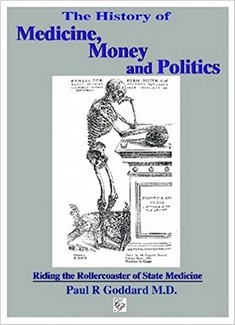
Category: History Publisher: Clinical Press Ltd
ISBN-10: 1854570501
Type: Non-Fiction
Pages: 267
Copyright: August 2008
ISBN-13: 9781854570505
A controversial history of State Medicine detailing the background to the National Health Service of the United Kingdom and comparing British healthcare with healthcare systems around the World.
Professional Reviews
Review for the Ulster Medical Journal by Dr Barry Kelly, Deputy Editor
The History of Medicine, Money and Politics, (Riding the Rollercoaster of State Medicine) by Paul Goddard
This work essentially represents two parts of a whole. Part one is a medical chronology and the reader is taken on an odyssey, as we chart the evolution of medicine from prehistoric times, through the ancient world, the middle ages and into our modern world. Goddard writes with impressive authority and reveals a deep love for learning, not just about medicine, but civilization. The author also invites us to consider the huge intellectual contributions of the Roman, Greek, Chinese and Islamic worlds.
Part one of the book concludes with a consideration of medicine in the Early Modern Period, the genesis of the National Health Service and that most audacious scheme, the Welfare State. Goddard reminds us how difficult it is for contemporary citizens to imagine health care prior to its inception. Interestingly, he invites comparison with the legal system “when only the rich and poor have access to the courts,” to remind us what the rest of us, with poor health, faced before 1948.
Part two charts the time course of the National Health Service, or as Professor Goddard entitles it, “The Decline of the National Health Service.” In great detail, Harold Shipman, the Bristol Cardiac Scandal and the Organ Retention investigation are all considered. Professor Goddard. A working consultant in Bristol at the time, was well placed to appreciate the misery and suffering that these events created, both within and without the medical community.
It is clear that Goddard is not a dispassionate bystander in all this. Passionate is what he is. The second section pulsates with moral outrage and righteous indignation. His other conviction is that of patient advocacy. The author feels that permeating our physicianly core is duty to our patients. Their advocacy is our responsibility.
A younger readership, reared on tall skinny lattes, MP3 players and fashion credibility, will recoil at the description of numbing on call rotas, crippling visceral fatigue and cynical fiscal exploitation. Older readers will remember, shudder and sob quietly.
It is to Professor Goddard’s great credit that he does not trade on his international reputation as a radiologist, or a pioneer of Magnetic Resonance Imaging. In fact, his specialty is rarely alluded to. Instead he is everyman’s Virgil, guiding the reader through a medical timeline.
To paraphrase Clive James, Paul Goddard’s book affirms the truism that some of us are different from the rest of us. But so are the rest of us. This book will be of great interest to many: students beginning, and practitioners enjoying or enduring their practice. It is also likely to be relevant to medical historians, as it charts one particular small step for mankind.
The Borderline Anti-Memory PastBook asks questions a diary does not ask and raises the questions to dialectics and answers them in a way a memory work does not answer questions.
Experience the early 20th century in Michigan's Upper Peninsula through the artistic camera lens of J.W. Nara, one of the Copper Country's earliest professional photographers. This collection of historic photos brings the "Copper Boom" era back to li