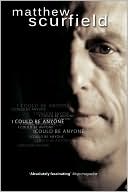
Alternatively contemplative and raucous, I Could Be Anyone takes us into the writer's experiences of growing up in a rigidly academic town and his involvement with seminal radical artists of the decade including Pink Floyd's creator, Syd Barrett. Scurfield describes and accentuates the feelings of isolation and disenfranchisement caused by the rigid conformity of major institutions. Walking home in his neighbourhood as a child past houses owned by the crème of academic society, Scurfield recalls the "inaccessibility and unfriendliness" of these castles of the literati; behind closed doors there lay a complex cycle of "academic one-upmanship"; an exclusive club which glorified those who could and subtly ostracised those who could not. From someone who has spent much of their life in the outside lane, we get taken behind the mask for an inside look at yoga, acting, dyslexia and education in the psychological sense.
Born into a bohemian family of outstanding scholars and great engineers, whose legacy shines on in the halls and corridors of Cambridge University, only to enter the ignorance and brutality of the state school system in the fifties,to be shamed and spat out as one of life's failures. Stumbling into the heaven and hell of the sixties crash pad: London, The Arts Lab, Anti University, LSD and Paris. Running from the past, always just a beat ahead of the fall. Constantly on the cusp of the extraordinary changes which took place in the theatre in those decades of influence, from Richard Eyre to Steven Berkoff and Complicité; glimmers of new possibilities; close encounters with the fledgling Pink Floyd, BKS Iyengar, RD Laing and other movers-and-shakers from the sixties and seventies.
This rite of passage looks at how easy it is to lose a life to fear and yet somehow leaves us with the reality of a simple resolution.
Excerpt
1964 saw the first Habitat store open in Chelsea; Nelson Mandela is sentenced to life imprisonment in South Africa; thousands upon thousands of troops were sent into Vietnam to knock out the Red Peril; plans for The World Trade Centre are announced and a record breaking seventy three million viewers tuned in to watch The Beatles on the Ed Sullivan show. Television is still broadcast in black and white and BBC 2 is to make its first screenings, giving the viewers a record breaking three channels. The Labour Party wins the election by a narrow victory, ending 13 years of Conservative rule and Harold Wilson becomes Prime Minister.
Barrow-in-Furness might just as well have been on the other side of the moon. To get there in those days you had to travel to Crewe and spend the night on a desolate station bench before venturing further north the next day.
My frazzled brain was spinning off in all its sixteen year old directions, every which way but here! The further out into the world I went, the fiercer the cold. Like rivulets of water running their course on a frantic journey toward winter, my mind began to freeze up inside until eventually it became difficult to see any logic at all. My intuition was telling me I should break the ice, try to dissolve it, melt it any way I can, but I just couldn’t get a handle on how.
Time on the train gave me a lot of space to reflect, which I hadn’t had in ages, if ever. I started to become more aware of just how lost I really was. Staring out into the middle distance; looking for that elusive logic. My state of affairs just didn’t add up.
The old fashioned railway carriages, the ones with a corridor and compartments where watercolour paintings of quaint holiday locations were framed in unison above the plush seats, heaved their way up to Cumbria and came to a grinding halt. For a moment, it seemed like I was the only passenger in the whole world. I caught myself and managed to push the journey into some kind of proportional perspective.
Cambridge had left me with a bitter and sweet pill to swallow. I may have felt engulfed by a void of invisible fears, but that prestigious university town where I was brought up, had gotten smaller, and in retrospect was beginning to seem like a trap, where the intellect weaves a web to catch the fly. Where my family fitted into all this remained a quandary; after all weren’t they seated at the head of the table with the other demigods of Cambridge?
When I ended up with my own company, I was constantly thrown back into a state of mind which left me with a ‘why should I bother and what’s the point’ syndrome. So much energy, so much grief, all for some illusory concept, just words, signifying, much ado about nothing.
There weren't any hideaways anymore unless you count sleeping and drug taking as a way of hiding, which my common sense was still together enough to tell me was a physiological short term solution to a long-term problem.
Eventually we began to weave our way along the coast at a Sunday pace. The weight of my thoughts filled me with eternity and pushed me into a heavy sleep.
Inevitably the train arrived at its destination but I didn’t. The daze of the trip, along with an acute sense of tiredness, had me traipsing the wet grey cobbled streets of Barrow in bewilderment. The back to back housing grew severe in prospect. As I began to wonder what the fuck I was doing there the theatre loomed into sight. Built as it was in red brick, it seemed to stand alone on land that wasn’t too far away from being like a bomb sight.
The only door open from the outside of the theatre led down to an old scene dock, where Bob Dylan’s Chimes of Freedom was filling the silence. The troubadour’s voice was coming from a battered radio hanging among sawdust covered cobwebs, above a tidy tool bench, which was placed squarely against a heavily painted wall, chipped and worn from years of use. On first glance the rest of this space, which was full of ghosts from past productions, seemed chaotic, but gradually my practical eye brought it into some focus. The old canvas flats from previous shows were stacked according to size against one wall, while an enormous rostrum heaving with pillars and props another. Almost as an afterthought, a mortise machine, a lathe and some well-used hand tools sat, ready for work, near the wide double doors that gave the only opening to the daylight outside.
Through the looking glass
"I Could Be Anyone documents the writer's involvement with radical artists including Pink Floyd's creator Syd Barrett"
The explosive, psychedelic counter-culture of the 1960s, epitomised by Pink Floyd's revolutionary light installations, burns bright in actor Matthew Scurfield's autobiography I Could Be Anyone. Cambridge bred, Scurfield moved to Gozo to write and publish his first book, having been on the Maltese islands previously filming Sweeney 2in 1973, Byron in 2003 and, more recently, A different Loyalty with Sharon Stone and Rupert Everett.
Alternatively contemplative and raucous, I Could Be Anyone documents the writer's experiences growing up in the rigidly academic town and his involvement with seminal radical artists of the decade including the Floyd's creator, Syd Barrett. While so doing, Scurfield describes and accentuates the feelings of isolation and disenfranchisement caused by the rigid conformity attitudes of major institutions.
Walking home as a child past houses owned by the creme of academic society, Scurfield recalls the "inaccessibility and unfriendliness" of these castles of the literati; behind closed doors there lay a complex cycle of "academic one-upmanship"; a cruel, socially exclusive club which glorified those who could and ostracised those who could not.
Scurfield's debilitating dyslexia ensured he was cast-off as a failure and highlighted the deficiency of the school system in recognising and adequately attuning to the problem. The book describes how the ruling establishment drummed in the feelings of worthlessness, inadequacy and alienation felt by many of the protagonists, through its ceaseless, slanted perceptions; yet, Scurfield claims that shutting the door on any dialogue was “was an opportunity to begin the dance.
The hedonism of the 1960’s betrayed desperation to overcome this sense of estrangement. Scurfield's brother, Ponji, "caught up in the unending treadmill of what other people thought of his character", was the most tragic victim.
Having embraced the inclusive attitudes of Eastern mysticism and Buddhism, he wanted to convince others around him of the truth as he saw it. The ill- fated attempt saw him deteriorate and "glimmers of a sadder picture in his" eyes became evident. His conviction in the renunciation of the physical self to reach divine heights did not persuade those close to him and his attempt to prove his point only resulted in rejection, anguish and ultimately his suicide.
The acid-dropping, marijuana smoking, subversive generation blossomed on these walls of the disillusioned. According to Scurfield, the infamous Syd Barrett, a friend from his Cambridge days, also suffered a similar embitterment; Syd shunned the superficial success enjoyed by the Floyd, hating the glib, one- dimensional and frivolous commerciality of the business. This, he says "seemed to add an increasing disassociation that was starting to separate him from the ones he loved".
Scurfield's saving grace seems to have been the theatre, where he found a "home away from home". Yet this too seems to be tinged with his endless desire to fit in and to please his parents. His first performance, in the John Webster play The White Devil with the then still undergraduates, Michael Pennington and Richard Eyre, is enshrined in his memory due to his mother's reaction, who was "thrilled at the way my first proper appearance on the stage had worked out and thus, above everything else, fulfilled a dream."
Throughout, Scurfield's distinctive narrative voice reflects on events with deep insight, enlightening and inspiring. While warning readers of the subjectivity of his account, he is, nonetheless, unashamedly honest, even at points embarrassingly so. Moreover, the dramatic storytelling and the elegiac tone employed at points is reminiscent of a tragedy in which each character's fatal flaws contribute to their rise and eventual fall.
For some, there was no rebound from the depths. Yet for Scurfield, salvation from self-destruction allowed him to reflect on and enrich his life with what he had learnt and in so doing, enrich ours too.
A book for every Muslim and everyone wishing to know about their way of life. The Diary of the Camp Manager at Mundihar following the South Asian Earthquake - October 2005. An account of life after the Earthquake in one of the largest of the 161 camp
This book is a collection of short stories that depict events in Author's life while she lived in Romania, then in Greece, and last in America. It's a beautiful and very sincere account of a young woman's life and comming to age.