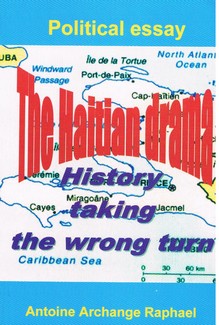
Category: Political Science Publisher: Lulu.com
ISBN-10: 1105451518
Type: Non-Fiction
Pages: 412
Copyright: March 19, 2010
ISBN-13: 9781105451515
Haiti, like any country in distress, needs a politico-socio-economic philosophy to pull itself from standstill and be on the road to self-determination. Thus, in a way, Haiti chronic crisis is just a human tragedy.
The author has awareness of the classical explanations on the drama, based on a negative colonial heritage, the economical underdevelopment resulting from erroneous conceptions and lousy practices, and foreign nations’ interference in the country’s internal affairs. These explanations, instead of clarifying the drama, rather fulfill the role of a way out. Contrary to what many think, “The Haitian drama, history taking the wrong turn » rather describes any community in distress, which will find itself in a dead end situation like this West Indian nation. This kind of predicament has retained Socrates and Plato’s attention, who, in The Republic and The Laws, have taken a human collectivity as a whole, a body with a head and other parts. Evidently, the head sets the tone to the rest of the body. However, when the former falls sick, the latter suffer from its malaise. In other words, this essay concerns the role of elite in a nation development. When the elite believe in their promethean and genuine role to play in the bosom of the nation, such nation becomes like a healthy being with the platonic image of a sound mind in a sound body. However, when the elite sink into corrupt, disingenuousness, unjustified coercion and abuses, the nation looks exactly like a body with no mind or a body with a sicken head. From this point on, the collectivity will meet with failure. If there is no remedy, this collectivity will swell the ranks of those communities that maintain a deep-rooted crisis in their bosom, going from one generation to another
Excerpt
In other words, traditions are past values we intend to keep against all comers; however, they often stand more in the way of plan implementation than they are helpful.
In many countries, the conservatives have been advocating a rigid social parallelism: wealthy remain wealthy; poor remain poor. They don’t encourage social transfers. They are for the implementation and the imposition of traditional moral values, whether they respond or not to an ever-changing social needs. This is a recipe for disaster, suffering, injustice and unresolved conflicts. On the one hand, you have the self-proclaimed bearers of values; on the other hand, you have those, from the masses and other social layers, who want to move up in the politico-economic ladder.
Even societies considered viable and dynamic sleep at the edge of a plausible disaster because of the persistence and preservation of harmful traditions in their bosom.
Indeed the country of Lincoln, for example, has two old deadly traditions: racism and carrying of weapons. The former dates back to the time of slavery; the second, to the time of cowboys who used to settle their disputes by shooting one another.
Of course, Americans of goodwill have attempted to reduce the carrying of weapons, but many other fellow citizens claim that any ban on weapon carrying would be an infringe¬ment on their right ensured by the constitution. This is an excuse for enjoying such a deadly tradition. A constitution should correspond to a fixed document, made of steel. Even if we don’t need to squash it altogether, we can amend it. In fact, for other reasons, the American legislative body has amended the US Constitution or opened to criticism. An instance of this nature has just occurred. Some American senators and congressional representatives have shown willingness to bring an amendment to the constitution concerning marriage, with a view to protecting this institution in its primordial nature; yet, many of these lawmakers have been reluctant to welcome an amendment regarding the carrying of weapons, which is by far deadlier than same sex marriage.
If marriage corresponds first to the getting together of two hearts in love, the homosexuals and the lesbians have been de facto married; and their intimacy will go on whether the law accepts their legal marriage or not. However, if a tradition, expressly condoned by a constitution, happens to be deadly or harmful to the society it serves, we should either ban or modify to make it gradually harmless.
Similarly, in the US, people have taken issue on the existence unpleasant practices (including racial injustice), as if a constitution can’t be amended to stop outmoded traditions from holding the country back and engendering the lives of its inhabitants.
Anyway, the American influential groups, wishing those traditions to stay, allow them to continue to spread death, hatred, injustice, propensity to crimes and all the unfortunate consequences they entail. Because of such situation, homicides turn more and more commonplace, making the U.S.A., one of the most dangerous countries to live in, in spite of its wealth. This is so unfortunate.
Thus, the Haitian militant elite must assume the heavy task to operate that break, as a whole or in part, between the past and the present. It’s a titanic work the implementation of which will facilitate the solution of innumerable problems that have balked us from the birth of the nation.
chapter 13, page 244
Want to review or comment on this book?
Need a FREE Reader Membership?
Reviews for "The Haitian Drama, history taking the wrong turn"
The meaning of
«The Haitian drama, history taking the wrong turn »
An essay by Antoine Archange Raphael
The author is aware of the classical explanations for the drama: a negative colonial heritage, the economical underdevelopment resulting from erroneous conceptions and lousy practices, and foreign nations’ interference in the country’s internal affairs.
These explanations, instead of clarifying the drama, rather fulfill the role of a way out.
Contrary to what many think, « The Haitian drama, history taking the wrong turn » rather describes any community in distress, which will find itself in a dead end situation like this West Indian nation.
This kind of predicament has retained Socrates and Plato’s attention, who, in The Republic and The Laws, have taken any human collectivity for a whole, a body with a head and other parts.
However, the head sets the tone to the rest of the body. When the former is sick, the latter suffer from its malaise.
In other words, this essay concerns the role of elite in a nation development.
When the elite are genuine, promethean, the nation becomes like a healthy being with the platonic image of a sound mind in a sound body. However, when the elite are corrupt, disingenuous, the nation looks exactly like a body with no mind or a body with a sicken head.
From this point on, the collectivity will meet with failure.
If there is no remedy, this collectivity will swell the ranks of those communities that maintain a deep-rooted crisis in their bosom, going from one generation to another.
Of course, whether we take into consideration the so-called primitive societies or the modern ones, they are the centers of constant effervescence, conscious or unconscious changes.
What is the nature of these changes?
Are they identical or even similar?
As for the author, we should classify these changes into two categories.
A first category describes what depends solely on the action of time and pure nature.
A second category betrays an evident and deliberate attempt to change things around.
The communities, in which only passive changes occur, give the impression of remaining still. The author calls them cold-blooded communities.
Consequently, warm-blooded communities, in the author’s perspective, are those that transcend this kind of de facto, passive situation, this type of mechanical change. They lose patience over the slow process of temporal evolution. They give the impression to go over time, to seek passionately to meet the future headlong and work wonders, despite the difficulties imposed by an apparent natural order of things.
In the case of Haiti, the author has also detected the drawback caused by the persistence of traditions in this country, and a strong tendency to keep the past in the mainstream living.
As for me, mankind would do better to minimize the recourse to traditions. For these belong to the past, while mankind needs are actual, pressing. How can we solve nowadays problems with past action recipes?
These traditions, since they belong to the past, to remain actual, active in our present generation, are bound to create unfortunate and dangerous situations. The most compelling proof is that, even a great nation like the US is weighed down with the burden of two dangerous traditions: racism (a consequence of slavery) and the carrying arms (a survival of cowboys’ lifestyle).
These two traditions take away from a greater blossoming of this nation and prevent it from being a paradise for its inhabitants and the rest of the world.
Note: This book and its French version may be obtained by visiting: www.lulu.com. or Amazon, Barenes & Noble and many other vendors in close relation with lulu industries.