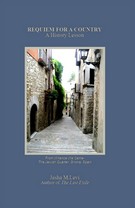
Requiem for a Country is an easy reading selection to bring to the beach or savor
in front of a fire. At the same time, it is an informative annotated book a history
teacher or professor would assign to stimulate research and discussion in a course
on Eastern Europe, Cold War, racial laws in Italy and other topics related to WWII.
During the period the author was a foreign editor of Borba from 1946-53, he wrote
several books in his native Serbo-Croatian. The Last Exile, a 2009 memoir, was his
first title written in English. His second one, Requiem for a Country, completed on
his 90th birthday, is about the dissolution of what used to be a harmonious coexistence of multiethnic people of Yugoslavia, as well as about the destruction of Sephardic life in Bosnia and the survival of Jews in Italy during the Holocaust..
A civilian internee of World War II, a fugitive in Rome from 1941-44, a partisan, and
a member of Tito’s Yugoslav army, the author fought in the war against the German
occupation of Yugoslavia. After the war, as a foreign editor of the Belgrade daily, Borba, he covered the 1946 Paris Peace Conference, the 1948 Tito-Stalin rift, and the 1951 Panmunjom talks to end the Korean war. In 1956, as a UN and US correspondent, he resigned over Tito's refusal to support the Hungarian Revolution, sought and was granted political asylum in the US.