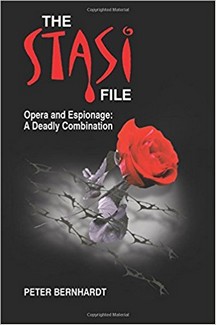
An American lawyer and his Italian lover from Berlin student days, now a budding opera diva, are drawn into an assassination plot by a Stasi General, desperate to prevent the collapse of the East German police state after the fall of the Berlin Wall.
Dust from the demolished Berlin Wall has barely settled, the East German police state is teetering on the edge of collapse, and Stasi General Holger Frantz will stop at nothing to save it. Caught in his intrigue are two unlikely heroes: American lawyer Rolf Keller, recently divorced, fresh off the bottle, and mysteriously dispatched by his senior law partner to coordinate document drops by a defecting Stasi agent, and aspiring opera diva Sylvia Mazzoni, Rolf's former lover who has been coerced into acting as courier.
After the scheme goes fatally awry, the reluctant recruits uncover an assassination plot designed to thwart the unification of East and West Germany. In the crosshairs of rival intelligence services and with a professional Stasi killer hot on their heels, Sylvia and Rolf resist the urge to run for their lives, and risk everything to stop the assassins.
Professional Reviews
Britain's Random House
This historic novel introduced me to a topic I was surprisingly unfamiliar with. The history of the Red Army Faction is an uncommon background to a story. Cleanly woven into the fall of the Berlin wall and the start of Germany’s new future, I found it rich and engaging, even in only the first few chapters of the story.
All three starting points, in East Germany, West Germany and in the US, offer the reader a huge amount of detail to start the plot off. I am often wary of such approach as too much detail up front can often lead to reader overload, or at the least a sense of the author handing everything on a plate. But in this case it walks the line between them very carefully.
There are two scenes that particularly drew my attention. The first, with Silvia in the Park, and the second with Rolf going to visit the senior partner.
Silva’s attack in the park comes completely out of the blue. I was just taking in the details of the previous paragraphs and starting to place where and when the story is set, when the assault by the RAF member started. While the section only lasts a few paragraphs I could feel my heart racing at the sudden change of pace. This is a good technique to engage the reader. This then set my interest at a higher level for the rest of the piece.
One suggestion here might be to lighten slightly the details before the attack. Not by much as it was all well written. It would just ensure that a browsing reader could be engaged slightly quicker.
The second scene was Rolfs. Here the first sentence changes the scene well, while skilfully keeping a semblance of pace from the Park scene. It also manages to quickly capture the essence of Rolf’s outlook. A view which is expanded upon as we are introduced to Mr Stein. The following exchange would be worthy of any great court room drama and quickly reveals the real Rolf.
The third scene with Dobnik, while less enjoyable for me than the first two, is equally well handled. It has a distinctly darker theme and highlights the different shades with which the author paints the scenes. Using this colouring to hint at three different worlds that would eventually collide as the story progresses.
I think this is a Stirling effort that I enjoyed reading. With a small amount of effort to engage the reader as soon as possible, this could be even better! Congratulations to the Author for getting to the Top Ten, a worthy achievement indeed!
She was quite capable of taking care of herself...She appreciated everything he was doing for her and the Grandmothers Four, but she needed his help, not for him to take over.