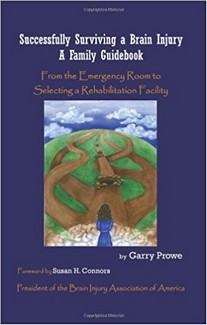
Someone you love has suffered a brain injury. The doctors can not yet make a prognosis. Every brain injury is unique and unpredictable, they say. You have been told to hope for the best, but prepare for the worst. What do you do now? Successfully Surviving a Brain Injury is an easy-to-read guidebook for families suddenly thrust into the painful and confusing world of brain injury. It teaches readers the basics of brain trauma. It guides them step-by-step through the recovery process. It provides the practical information they need to handle the insurance, financial, legal, emotional, family, and personal issues that accompany a brain injury. It also describes the wide range of impairments caused by brain trauma and the factors that influence how well someone recovers. This book, though, is not only a practical and essential roadmap to a successful recovery, it also is an inspirational story of how one couple overcame profound changes in their relationship and created a fulfilling new life. Susan H. Connors, the President of the Brain Injury Association of America wrote the foreword to Successfully Surviving a Brain Injury.
Someone you love has suffered a brain injury.
You face a maze of urgent, complicated, and time-consuming medical, insurance, financial, legal, family, and personal issues. You have so many questions and you’re not sure where to turn for help. This book—which is based upon the experiences of hundreds of people living with a brain injury, their families, and the medical professionals who treat them—will answer many of your questions. It will teach you:
The basics of brain injury and the recovery and rehabilitation processes
The wide range of impairments caused by a brain injury
Ways to make this stressful and exhausting time easier for you and your family
What you need to know about health insurance and disability pay
How a case manager and an attorney can help you
The factors that influence how well someone recovers from a brain injury
How to access the wide range of resources available to the families of brain injury survivors
“A brain injury is a devastating, life-altering experience for the patient and the family. As a trauma surgeon for the last thirty years, I see distraught families desperate for comprehensive and easy-to-read information about what the future holds. Successfully Surviving a Brain Injury answers most of their questions in a compassionate and thorough manner. This book is a must read for everyone who wants to confront, understand, and overcome the challenges of living with a brain injury.”
Lawrence Lottenberg, M.D. Associate Professor of Surgery and Anesthesiology, Trauma Medical Director, University of Florida College of Medicine
All profits from this book will be donated to organizations that support brain injury survivors in the U.S. and Canada.
$17.95
Brain Injury Success Books, GainesvilleFlorida
Excerpt
Introduction
You are reading this book because someone you love has suffered a brain injury. The form, extent, and consequences of the damage are yet unknown. Her doctors are unable to make a prognosis. "Every brain injury is unique and unpredictable," they say. "It will be months before we know for sure." A hospital social worker has advised you to hope for the best, but prepare for the worst.
This news is incomprehensible. What does the social worker mean by "the worst”? What must you do to “be prepared”? When will your spouse emerge from her coma? How badly will she be impaired by her brain injury? How soon will her doctors speak with some certainty? How will this misfortune impact your family and your future?
In 1997, I was in your place. My wife, Jessica, suffered a serious brain injury in an automobile accident. Like you, I was relieved to hear that she would survive her near-death experience. Like you, I was devastated to learn that she would acquire any number of lifelong impairments. And, like you, I had many questions and few answers. "Only time will tell," her doctors repeated over and over. Confusion, panic, grief, and fatigue were my constant companions every hour of every day for weeks.
I longed for some cause to be hopeful. I had to believe that survivors of traumas like Jessica’s recover well. I craved examples of people with serious brain injuries living full and happy lives.
You should be comforted to know that people do recover successfully from a brain injury, and neither a miracle nor a superhuman effort is required. Jessica and countless others are living proof of this. Despite her considerable disabilities, my wife has created a new life that is full of love and joy, challenges and rewards, family and friends.
To Succeed, You Must Change Your Mind
First and foremost, you must understand that a successful recovery from a serious brain injury is not a full recovery. All but a handful of charmed survivors spend the rest of their lives challenged—mildly, moderately, or severely—by their brain injury.
These challenges—by themselves—do not make for an unsuccessful recovery. Success is cut short when the inevitable impairments caused by a serious brain injury are denied or not accommodated by both the survivor and those around her.
The single most important element to achieving a successful recovery is a clear understanding of your goal. Jessica's car crash caused irreparable damage to her brain. She was transformed in many ways. To succeed in her recovery, Jessica needed to “change her mind.” She needed to acknowledge and learn to live with her new deficits. She needed to alter the way she viewed herself. She needed to adjust her life goals.
A successful recovery also demands that the people surrounding the survivor be understanding, compassionate, and accommodating. They must change the way they view her. They must learn how their survivor has been impaired, and how they can work with her to compensate for these new deficits. They must strive to understand—without frustration, anger, or resentment—that the unwelcome transformations in their survivor are symptoms of her brain injury, not conscious choices or failures of character.
This is far from easy. The other day, for example, more than eleven years after Jessica’s accident, I doubted her efforts as we paid the monthly bills. I was eager to complete that chore and return to writing this book. When Jessica asked for basic instruction in revising spreadsheets on our computer—for the one-thousandth time—my frustration overwhelmed my reason. I unjustly and robustly accused her of laziness. But Jessica wasn't negligent. She couldn’t recall how to work with spreadsheets because her brain injury has compromised both her memory and her ability to grasp new information.
Jessica's recovery is successful—in no small part—because we accepted the unwelcome reality that she was transformed forever by her brain injury. Without this acknowledgment, Jessica and I would have had unreasonable goals. Expecting a person with a serious brain injury to return to her previous self is a sure-fire path to failure.
To achieve a successful recovery, you must “change your mind.”
Mild, Moderate, and Severe Brain Injuries
There are three levels of brain injury: mild, moderate, and severe. Mild injuries are by far the most common. They cover a broad range of outcomes. The majority are, indeed, mild. They usually are shaken off and rarely given a second thought. Some mild injuries, however, are cruelly mislabeled. A mild brain injury can leave someone so infirmed, she is unable to return to work or school, or live independently. Multiple mild injuries—such as the concussions endured by boxers and football players—can result in considerable cumulative brain damage.
At the other extreme is a subset of severe brain injuries called catastrophic. Survivors of catastrophic trauma are either in a vegetative state or so impaired they are unable to set goals for themselves to achieve a better recovery or to improve the quality of their lives.
In this book, I address the injuries that fall between these two extremes: the mildest of the mild and the catastrophic. For the sake of simplicity, I call them “serious brain injuries.”
Warning: These labels are easily misinterpreted. If one is said to have a mild brain injury, people may expect a complete recovery. If she is diagnosed with a severe injury, people may expect little improvement. Both assumptions are premature, often inaccurate, and potentially harmful to the survivor’s recovery. Jessica’s brain injury is severe. Yet, she has made considerable progress in her rehabilitation and recovery. She now enjoys a full life and enhances the lives of those around her.
Every Brain Injury Is Unique …
Every brain injury varies in the type, location, and extent of the damage suffered. Consequently, each survivor acquires a unique mix of symptoms. One person, for example, may need a cane to compensate for her shaky balance and the patience of others to comprehend her slurred speech. A second survivor may display no physical complaints, but explodes with anger when asked to take out the garbage. She also strikes up long, one-sided conversations with strangers. A third person may be unable to find the right word in conversation and becomes agitated in public places. She just wants to be left alone to play video games in her room. A fourth survivor may display no outward signs of an injury, but has subtle lapses of concentration and information processing, which only those closest to her can recognize.
But the Stages of Recovery Are the Same
While each survivor is affected uniquely by her brain injury, all strive toward the same milestones of recovery. They are the ten levels of the Rancho Los Amigos Scale of Cognitive Functioning. The Rancho Scale is commonly used to describe the condition of a brain injury patient. It begins at Level 1, when the survivor is in a deep coma. It ends at Level 10, when she is acting independently, purposefully, and appropriately. Please don’t be intimidated by the awkward title of this handy tool. Soon, you will be as familiar with the ten levels of the Rancho Scale as you are with the symptoms of the common cold.
It is important to recognize that the road to recovery often has detours and dead ends. Some survivors progress quickly. Others advance a level or two, then regress before advancing again. Many fail to move beyond a certain level. How your survivor works her way through the Rancho levels cannot be predicted. This uncertainty is one of the agonies of brain injury.
Jessica traveled through the Rancho levels in textbook fashion. Consequently, our story may provide a roadmap of the journey you are about to take through the bewildering world of brain injury.
Benefiting from the Experiences of Many
As I tell our story, I examine my actions over the past eleven years from a more informed perspective. Throughout Jessica’s recovery and rehabilitation, I often felt as though I were barely hanging in there, certainly not succeeding. As I look back, I frequently wonder, "Why didn't I think of that?” or "Why didn't somebody tell me that?"
My experiences—while instructive—are the experiences of just one caregiver. To better understand how survivors and their family members overcome the challenges of recovering from a brain injury and creating a fulfilling new life, I assembled a panel of brain injury veterans. The members of this panel include more than 150 people living with a brain injury, 110 family caregivers, and forty medical professionals. I posed countless questions to these brain injury experts and benefited enormously from their generous participation.
Absorbing and acting upon the information and advice I have compiled in this book will make your efforts to support your survivor more effective.
I also hope that this book will inspire you to persevere when you are overwhelmed and disheartened by the many obstacles you will encounter on the road to a successful recovery.
Helping your survivor recover successfully may be the most rewarding job of your life.
Seven Reasons to Be Encouraged
First, brain injuries are far more common than you may imagine. Medical professionals often call brain injury a “silent epidemic.” According to the Centers for Disease Control and Prevention, 1.4 million Americans sustain a traumatic brain injury each year. The Journal of Head Trauma Rehabilitation reports that an estimated 3.17 million Americans live with a long-term disability related to a traumatic brain injury.
These figures do not include the many other causes of brain injury, such as heart attack, stroke, aneurysm, tumor, infection, substance abuse, near-drowning, and electrical shock. Each year, far more cases of brain injury occur than those of breast cancer, multiple sclerosis, spinal cord injury, and HIV/AIDS combined.
Second, the wars in Iraq and Afghanistan have placed brain injury on the front page of newspapers and magazines. As many as one in six combatants in these conflicts suffer brain trauma. These often gravely wounded warriors provide the medical world added motivation to develop more effective protocols and rehabilitative therapies to treat brain injury.
Third, recent research has discovered that the injured brain has the adaptability to reorganize itself to compensate for the damaged areas. This remarkable ability is known as plasticity. In practical terms, plasticity enables survivors to recover—via intensive therapy—some of the abilities lost to their injury.
Fourth, developments in stem cell research also are heartening. Theoretically, stem cells can be transplanted into an injured portion of the brain and then regenerate into the type of cells that have been destroyed. While the harvesting of stem cells from embryos is controversial, new stem cell sources—bone marrow, blood from placentas, skin, and non-viable embryos—are being studied.
Fifth, innovations in a relatively new field of therapy—cognitive rehabilitation—are producing promising results in restoring not only a survivor’s ability to concentrate, remember, and solve problems, but also her capacity to reenter the community and to enjoy a more satisfying life.
Sixth, new technologies, such as voice recognition computer software and sophisticated electronic devices, designed to help busy people everywhere perform their daily activities faster and better, also are helping the disabled live more independent lives.
Finally, there are many organizations ready to guide you and your survivor toward a more successful recovery. From the Brain Injury Association of America (800-444-6443 & www.biausa.org) and its state affiliates to federal, state, and local government agencies; community support groups; and peer mentors; experienced and knowledgeable people are waiting for your call.
Professional Reviews
Pacific Book Review, Gary Sorkin
Garry Prowe does an "Over the Top" reference guide for families who have had the unfortunate need to quickly learn the ramifications surrounding a brain injury. He brings a terse and at times outline method of instructional information to the reader. Cleverly he alternates the chapters (odd & even) between expert essays on various topics with exploits of his own experiences convalescing his wife's brain injury after an automobile accident. The combination of instruction and firsthand experience is truly a necessary and comforting source of information for families in need of expert advice.
In a form of an educational reference, Successfully Surviving a Brain Injury: A Family Guidebook brings the term "Survival" to both the victim and their family. All must learn to cope with the various devastating disabilities suffered by the patient, and healing comes through understanding. Some interesting comments Garry Prowe makes regarding the naturally occurring healing capabilities of the human body provides an inspirational message sent out to all readers.
This book is perhaps the finest resource of specific information needed to cope with brain injury incidents. It is a must read and should be a prescribed Rx by all neurologists. Garry Prowe includes as appendices a Glossary of Terms, Index, State Brain Injury Association contact phone numbers, along with other suggested reading. All profits from this book are donated to organizations that support brain injury survivors in the U.S. and Canada.
Midwest Book Review
Brain injuries are life changing things. Successfully Surviving a Brain Injury, A Family Guide Book: From the Emergency Room to Selecting a Rehabilitation Facility is a guide for those helping a family member or close friend facing a brain injury. Outlining the many symptoms and challenges that go along with a brain injury. Written to help caretakers understand the many nuances, and what one can do to help, Successfully Surviving a Brain Injury is a strongly recommended read for anyone dealing with another's brain trauma.
Apex Reviews
Your beloved grandmother suddenly suffers a debilitating stroke...your son is inadvertently struck in the head at recess, rendering him unconscious...your wife is involved in a horrible car accident, leaving her with a serious concussion...in either case, the brain has suffered significant damage, but without a clear prognosis of what the future holds for them, exactly how do you prepare for what lies ahead for those that you love?
Throughout the pages of Successfully Surviving a Brain Injury, author Garry Prowe provides a comprehensive breakdown of all the resources, advice, and general guidance you'll need if ever confronted with any of the aforementioned scenarios. A detailed guidebook with a wealth of helpful information, Successfully Surviving a Brain Injury effectively serves as the singular authority on the financial, legal, emotional, and familial ramifications of what lies ahead for those having to deal with such injuries over the course of their lives. Touching on everything from what to ask doctors to dealing with health insurance companies to picking the best long-term caregiver, Prowe's informative volume is a welcome step-by-step manual on the importance of being prepared for the worst, even while hoping for the best.
For anyone who's ever struggled to navigate through the often devastating wake of sudden traumatic injury, Successfully Surviving any Brain Injury is a highly recommended guide to being fully prepared for any eventuality. Kudos to Prowe for sharing such invaluable insight for the ultimate health and well-being of his fellow man.
Re-Release! No longer back-listed. Return to the Olde Ways. The hustle and bustle of modern day life has brought many of us to a quick fix attitude.This book is for those of you who are fed up; have looked at your life and your loved ones and realize
Re-Release! No longer back-listed. Return to the Olde Ways. The hustle and bustle of modern day life has brought many of us to a quick fix attitude.This book is for those of you who are fed up; have looked at your life and your loved ones and realize