Coming-of-age novel about a guitar player in a rock band who faces a personal crisis and must make a difficult choice.
Charlie Sinclair, guitar player for the Boston-based rock band Pistonhead, is having a terrible week. Charlie's day job at Evergreen Software is being outsourced to Puerto Rico. His apartment is overrun with mice. The girl he loves is unattainable. His best friend, the lead singer of the band, is spiraling downwards into drug abuse. His apartment is full of mice and his old girlfriend wants to dig her claws into him again. His mother has a new boyfriend and the guys from his old neighborhood hate him because they think he's successful. The band's audiences revel in violence.
When things couldn't get any worse, a tragedy forces Charlie to make a life-changing decision and take a bold step into the future.
This breakout novel, filled with gritty realism and dark humor, paints a picture of a rock musician’s life that is both poignant and inspiring. The concert scenes are exhilarating and the depiction of the grinding world of the assembly line is wrenching in its unblinking clarity. This is no rock-and-roll jet-set platinum-record romp; this is the real life of artists who struggle to get to the top of the local rock heap. Their limousines are subway cars and their private jets are late-night taxicabs from grungy nightclubs.
Charlie thinks he knows what it means to be successful, but his view of the world is challenged. How do you define success? The answer may surprise you.
Excerpt
"Hey Charlie! We can't find Rips. We've got to do something." Sock Boy's voice had an urgent edge.
Charlie left the hand dryer running and quickly followed the roadie back through the crowd to the metal door next to the stage. They went up the stairs and entered the dressing room.
Dino was standing by the table. He took a bite of a cheesesteak sub and wiped his mouth with his sleeve. "I took a walk around the parking lot," he said. "Couldn't find him. Don't the Dust Twins have a blue van? I didn't see it."
The dressing room door opened. Jason, the owner of the Big Ditch Club, leaned into the room, keeping his emerald-ringed hand on the doorknob. "You guys going to do a show tonight, or just stand around?"
"Just give us a second, Jason. We're almost ready," said Dino.
Jason looked around the room with a frown. "Do you understand that I'm paying for a show, and if I don't get a show, I'm going to be unhappy? You're twenty minutes late. I don't care if you have to go out and play kazoos. Two minutes and you're on, or else." He paused for a moment and then sharply closed the door.
"Man, this is ridiculous," Charlie said bitterly. "We're screwed if Rip doesn't come back. I cannot believe that we let him out of here."
"What are we going to do if he doesn't show up?" Fritz asked.
"What do you mean?" Charlie replied. During the past year Rip had become increasingly less concerned with professional conventions such as show times, but the idea that Rip was too stoned to remember that he had to perform was difficult for Charlie to accept.
"Just what I said," Fritz repeated. "What if he's not going to show up?"
Charlie thought for a moment. Then he said decisively, "Well, we got five hundred people out there who expect us to put on a show. We got a club owner who's going to break our legs if we don't. So, we go out there and do a show. We just tell the audience that Rip is sick and we start playing. I can sing a couple of the songs and we can stretch them out. Try to give these people something for their money."
Fritz snorted derisively. "Oh, come on, that's not going to work. People come to see us because they expect to hear what they know. They buy the CD and they have expectations. No offense, Charlie, but hearing Rip sing the songs is a pretty reasonable expectation."
He placed his bass guitar on its metal stand. "Besides, we're not the kind of band that has members come and go. We depend on each other. Like it or not, if one person screws up then we're all sunk. I say we cancel this show, give the audience their money back, and kiss Jason's ass so that he doesn't bust our heads. Get the Untouchables to go back on again. Either way we're screwed, so we might as well keep our image intact. We're not a jam band."
Charlie turned to the drummer. "What do you say, Matt?"
Matt gave a wry smile. "I think he's going to be here. But, just for argument's sake, if something happened, I guess I'd want to go out there. We're a club band, you know? We've got to deliver every time, regardless. We could play instrumentals. I don't know - I don't want to think about it."
They sat in paralyzed silence and listened to the relentless thump of the house music.
Professional Reviews
Gloucester Daily Times
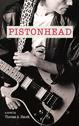
A troubled man looks away as he holds his Fender Telecaster close to his leather jacket with rolled up sleeves. The image is a common one in the rock star world: A shredding lead guitarist posing for a book cover that will tell about his life's journey as a member of the rich and famous.
Careful though, one must remember not to judge a book by its cover.
Thomas Hauck, a Gloucester resident, has a new novel, "Pistonhead," that tells the unfamiliar story of a guy living in Boston, playing guitar in a rock band and keeping a day job to pay the bills. Hauck drew from his own experiences as a guitarist in two Boston-based bands - Ball and Pivot, and The Atlantics - during the 1980s.
"There's no limousines, there's no groupies; the story is quite different," Hauck said. "It's a story I know something about, from my own background, and I wanted to provide readers with an alternative to the typical rock star nonfiction, where the story lines tend to be similar.
"The genre is kind of defined by these established rock stars," he said. "There's really nothing of the story about the thousands of artists and writers and actors who struggle day to day, still have day jobs, are not successful, and are at the bottom of the heap. Those aren't told very often."
Hauck spent 15 years as a musician and songwriter after graduating from Tufts University and also worked as an actor on stage and in various independent films and television programs. Now, Hauck is a professional freelance writer and the editor of Renaissance Magazine, which is published every other month to detail the happenings of area Renaissance fairs. He earned a master's degree from Endicott College in 2004, around the time he started writing the book. He worked on it on and off for years before he finally self-published it this spring.
"I submitted a manuscript to various agents and publishers and was rejected, but I came to the conclusion that in the publishing industry, there's no market for this book," Hauck said.
He might be on to something; 2008 was the first year where there were more books created and self-published than books released by publishing companies, according to Hauck.
The story is about a week in the life of Charlie Sinclair as he juggles his day job as a factory worker and his night job as a guitarist. He deals with the heavy drug use of a band mate and a poor living situation, and finally comes upon a tragedy that forces him into a life-changing decision.
"I think 'Pistonhead' is very succinct and doesn't waste your time and doesn't bore you," Hauck said. "I spent the last couple years refining it and cutting out some stuff. There's no filler."
Don't expect "Pistonhead" to be the end of Hauck's literary work either. He's already finished a book of short stories and poems that is going to come out later this summer, a horror novel about a vampire evangelist and a spy novel about a secret agent who does battle with an international crime ring - sort of like an American James Bond, he said.
All of those are "in the can," he said, waiting for the right time to be published through Hauck's own service, Something.Hot Communications in Gloucester. In the meantime, he said he's happy to see "Pistonhead" out there, even if it doesn't make a splash on the New York Times' best-seller list.
"Whatever happens, happens," he said. "If five years from now or 10 years from now, the book still has people buying it now and then, then I'll feel as if I have succeeded."
A Progressive on the Prairie
Although I don't watch the show, the concept behind American Idol strikes me as a microcosm of music in America today. The general auditions attract tens of thousands each year, a few hundred might get to audition for the judges, a couple dozen might be semifinalists and the show then winnows them out with some going home quickly, others becoming household names and a very few actually becoming stars.
Increase the initial number of those auditioning exponentially and you're starting to scratch the surface of music and musicians in the real world. Drawing on his years as a performing rock musician and songwriter in the Boston area, Thomas A. Hauck gives readers a chance to go beyond that surface in his novel Pistonhead.
Using one week in the life of rock guitarist Charlie Sinclair, Pistonhead explores the world of performing musicians are good - or lucky - enough to perhaps make the level analogous to those who actually get to perform before the Idol judges. Even if you've managed to hook up with a few others to form a creative and professional unit, you're still spending nights playing in clubs where most people are more interested in drinking than listening to your music. Some audiences may be hostile and even the opportunity to open for other "name" acts doesn't mean anyone's really there to hear you perform. On top of all that, you still have to get up the next morning and go to a "real" job so you can make ends meet. That's exactly where Sinclair, the 24-year-old lead guitarist in the fictional Boston-based rock band Pistonhead, finds himself.
Sinclair loves music and has the dream of the band making it someday. Yet his best friend, Jack "Rip" Taylor, who also happens to be the band's lead singer and co-writes with Sinclair, seems to have picked up a drug habit and, along with it, the company of shady characters. He's working on as an assembly line supervisor through a temp agency and his work team is comprised of behavioral health patients in a rehab facility. Rumor has it, though, that the jobs will soon be off-shored. These and an assortment of personal issues we all face come to a head during the week Hauck uses to focus the story, forcing Sinclair to look and see inside himself and his music.
Hauck's background gives Pistonhead a realistic flavor, not only from the struggles of keeping a band alive and moving forward but what goes through a musician's head while performing. The book also provides a taste of the grind second- and third-tier musicians experience. There is the tediousness of the assembly line pitted, the obstacles of trying to get a break in today's music industry and the question of whether at some point the costs outweigh the exhilaration of playing music. Yet Hauck also seems to carry his attention to detail into less important matters. For example, we have a paragraph on the etymology of ergonomics and its history as a field of study. We often get specific accounts of how Sinclair gets from point A to point B, including not only the train lines he uses on a trip but whether, after leaving the train, he walks "two blocks up" one street or "ten minutes down" another.
Hauck also throws in occasional tastes of irony, some obvious and others a bit more subtle. There is, for example, a scene in which Sinclair has to go to an emergency room for a foot injury after struggling with Rip's drug issues. While Sinclair is trying to prevent those issues from tearing the band apart, the television in the emergency room shows a prescription drug ad where pills danced around and "happy senior citizens frolicked in a field of daisies."
Pistonhead could well be cast as a converse of literary nonfiction. While it is a novel, it is undoubtedly based on Hauck's own experiences, thereby giving it a quasi-documentary feel. Even if it does wrap a couple things up just a bit too easily due to its compressed time frame, at just 175 pages the book is a compact look into the dedicated pursuit of an avocation you'll never see on so-called reality television.
Just as life during the pandemic was color-coded with different hues representing different levels of danger, life in its aftermath has become shaded in similar ways. As a self-styled “Seeker of Beauty with Beauty,” (borrowing from a quote by W.E.B.
Major League ballplayer Justin Moore is kidnapped from his own ballpark and transported to a foreign land. It might take high-level international negotiations to free him. Or maybe he will take matters into his own hands.