The Mathis family continue their saga from "Lydia". Family tradedies and hardships plague them, but Lydia's eternal optimism carries them through.
Billy Harp continues his family saga of the Mathis family, their struggles and hardship they endure
with Scrabblin’, his second novel. Faith, family ties and love see them through the hard times they meet
along the way.
The age of innocence was fast coming to an end in 1913 along the Indian River. Conglomerate farmers and foreign money investors were buying up every scrap of land they could, including worthless swamp land, for pennies in order to sell it for top dollar to foreign intruders looking for paradise. On top of all this, World War I was ominously lurking in the foreseeable future. Truck farmers were being squeezed out to make way for what they saw as predators of their livelihood.
Melvin and Lydia’s family were one of the few who continued to fight for their way of life.
Sometimes their only profit was from the guava orchard. By 1920, after the death of a child and brother,
the devastation caused by WWI, and a produce market that had bottomed out, Melvin decided to move
the family to Eagle Bay, just south of Okeechobee. Because big farming corporations had not yet
infiltrated this part of the state, he hoped to renew their farming business. This required learning new
farming methods and planting different crops. After eight years of mediocre or failed crops and enduring
the horrors of the ’26 hurricane, the ’28 hurricane which destroyed their home, was the last straw for
Melvin and Lydia. They moved back to Quay which had been re-named Winter Beach.
From the frying pan into the fire, they soon faced more challenges, including bean blight, the stock
market crash, and the death of their son. Would the family survive these onslaughts? Would Melvin and
Lydia’s eternal optimism fail them? Where would they turn when everything seemed to be against
them?
Excerpt
A golden glow accented the black silhouette of the mangroves that lined the east side of the river. The stars that usually hung down around the shoulders of the inky black velvet sky had already retreated with the coming of dawn. A thick low-lying cloud of fog blanketed the river. There wasn't a breath of air. There wasn't one hum from the usual hordes of mosquitoes. Not a single hoarse cackle from an angry heron staking out his territory for his breakfast broke the silence. There were no calls from a mockingbird or jay, or mullet jumping and splashing. All you could hear was the rhythmic sound of the oars as Melvin dug them into the glassy black water. As he rowed across Oyster Cut toward Quay Dock, he breathed out frosty puffs of air as his seemingly bodiless head floated in the blanket of low-lying fog. His rowing and direction came automatically as his mind was filled with thoughts of the past twenty-four hours. He borrowed a horse from Samuel and Martha and then rode quickly to the Quay cemetery where he found a nice spot and dug a large hole in the sugar white sand.
Black clad figures followed the wagon, bearing the simple wooden coffin north past Edward's house about half a mile. Then they went due west over the railroad tracks and up a long graded dirt path to the cemetery.
An outsider might have thought that Lydia's conduct at the graveside showed her to be void of grief and emotion, for her countenance had been peaceful and serene. As the congregation sang her favorite hymn, she turned her closed eyes toward heaven with a slight smile. The reason for her serene nature had begun to take shape yesterday, after she had bathed the lifeless body of her baby boy and prepared him for burial. She had held him close for a long time, realizing that this was the last time that she would perform these menial tasks for him. At that time, Lydia felt a grief that only a mother that has lost a child could understand-a grief that would transcend time into eternity.
"February 9th," she thought. "Six more days and he would've been a year old."
Last night as she heard the lonesome whistle of the midnight train in the far distance, she had come to terms with the philosophy that she had been taught since birth. This was the same doctrine that her husband preached every sermon, and the same ideal that would shape the rest of her life. Somewhere back at the beginning of time, a master plan had been put into place. At that time, it had been determined that Bartow would be allowed a little less than a year on this earth. That was it-pure and simple. There was absolutely nothing that she, Lydia, nor anyone else for that matter, could have done to change that fact. So there was no guilt, no blame, no could'ves or should'ves. There was only the strength in the belief that "what will be, will be." So it was that Lydia sat at Bartow's funeral looking so serene.
A novel about a family during World War II, set on the homefront in Springield, Mass., and in the South Pacific. The book focuses on four characters and how their lives were affected and changed during the war years.
Encountering danger, romance, heartache and tragedy, Catherine Merit strives to fit into a world filled with prejudice, hatred and violence where she is forced to kill a man in order to save herself. Third book of the Indignities Series.
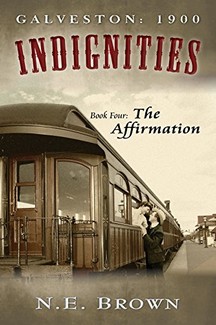
Fleeing from a scorned past,Catherine Merit struggles with her failing medical practice and a rich man's obsession of her.Book Four in the Indignities Series