Category: Political Science Publisher: Central Park Communications
ISBN-10: 1452499829
Type: Non-Fiction
Pages: 348
Copyright: April 5, 2012
ISBN-13: 9781452499826
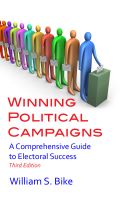
Winning Political Campaigns: A Comprehensive Guide to Electoral Success, Third Edition, is a how-to e-book providing information on everything a candidate, campaign worker, or activist needs to know to conduct a political race.
Winning Political Campaigns is available on Smashwords at http://www.smashwords.com/books/view/149191 and Amazon.com at http://www.amazon.com/Winning-Political-Campaigns-Comprehensive-ebook/dp/B007U7C31K/ref=sr_1_2?ie=UTF8&qid=1334443628&sr=8-2.
The two previous Denali Press print editions of Winning Political Campaigns were highly acclaimed. "From a practical, political operations standpoint, it is the best book out, yet," said reviewer Hank Landa of Political Book Reviews.
Winning Political Campaigns "provides essential tools, practical pointers, and valuable advice about running campaigns successfully," writes Fran Ulmer, former Lieutenant Governor of Alaska.
Covering everything from advertising to building alliances, proper business practices, campaign literature, candidate behavior, media, voter contact, debating, fundraising, strategy, and more, Winning Political Campaigns is extremely thorough and detailed, yet easy to use. Real-life examples are drawn not only form the political world, but from the worlds of sport, higher education, history, and more.
Innovations by the Obama and Tea Party campaigns, the Citizens United Supreme Court decision on fundraising, the Lisa Murkowski write-in campaign for U.S. Senator, new uses for social media and digital advertising in campaigns, and much more state-of-the-science information and campaign innovations that have become part of the scene since the last edition, are included. They make the third edition of Winning Political Campaigns a must for candidates and staff for campaigns at any level.
Particularly useful are appendices including a sample itinerary for a political event, an event planning checklist, resource organizations expert on various issues, media terms, a sample news release and direct mail piece, and more.
One reason the book is so comprehensive is because few other authors can combine Bike’s background of having been a candidate, officeholder, political worker and volunteer, journalist, historian, public relations officer, publications director, government employee, fundraiser, and budget director.
Previous editions of Winning Political Campaigns have not only been used by campaigns, but as textbooks for college and university courses at Harvard University and other institutions of higher learning.
"At a time when a majority of Americans do not participate in the political process, a process with deep impact on the lives of every American…Bill Bike is waging a campaign for involvement—meaningful involvement," said Congressman Danny K. Davis of Illinois. "Winning Political Campaigns is designed to enable ordinary citizens to take back their government, to be heard, to win. It is a timely and useful book and we welcome it."
"Let the telegenic beltway pundits propound ponderous theories on the state of democracy in the U.S.," wrote Booklist magazine. "Chicago communications consultant Bike offers the view from the trenches… Bike offers well-organized, very detailed advice on virtually every subject a candidate’s support team should consider…."
For more information, contact Central Park Communications at (773) 229-0024 or
How did a mention of Omar Sharif and Martina Navratilova ruin the image of a legislator? Why did voters decide than an elected official putting two of his girlfriends on the public payroll was funny instead of a scandal? How did an online video help elect a Democrat as governor in a Republican-leaning state?
The answers are in the third edition of Winning Political Campaigns: A Comprehensive Guide to Electoral Success, a how-to e-book providing information on everything a candidate, campaign worker, or activist needs to know to conduct a political race.
Winning Political Campaigns was written by William S. Bike, an award winning journalist, public relations professional, and political pundit who has appeared on many radio and television broadcasts, including CNN. See
Excerpt
When doing print, broadcast, billboard, internet, e-mail, social media, or direct mail advertising, do not provide a litany of stances on arcane issues. It is much more important to make a lifestyle connection between the candidate and the citizen. Voters cast ballots for people they perceive to be like them and who appear to understand their lives.
Although there are aspects of Barack Obama’s background that definitely place him outside the “regular guy” category (undergraduate degree from Columbia University, law degree from Harvard), he has many more attributes to which people can directly relate. In the 21st century, many Americans grew up in single-parent homes, with a parent who had to work too much and who did not have enough health insurance; so did Obama. In 2008, many Americans were facing financial difficulties; so did Obama growing up, and as an adult he lived in a community, the South Side of Chicago, in which people have faced financial problems for decades. Obama and his staff played down his differences and played up those commonalities, and people could relate.
Contrast Obama with his opponent John McCain, who has been a millionaire for years and could not even keep track of how many houses he owned while many Americans were in danger of losing theirs. McCain flatly stated “the fundamentals of our economy are strong” as people were losing their jobs and their savings. Although Americans had generally liked McCain for years, the 2008 campaign made them decide he did not understand them and they could not relate to him.
People also vote for candidates who oppose the same things they oppose and who, once elected, will defend them against the opposition.
Learning all you can about the potential voters is vital (see also Polling and Strategy-Targeting). If you do not know the people to whom you are sending your message, you are wasting your time.
Ads that entertain and are funny and clever are better than ones that are completely boring, but straightforward messages still do better than entertainment for every office except perhaps the presidency, for which certain segments of the population get most of their information from late night comedians. Messages should not be preachy, academic, or condescending, however.
If you team comes up with what it thinks is a good advertising slogan, do a Google search on it to make sure it doesn’t have negative connotations. The Hillary Clinton team of 2008 thought they had a good one in “Ready from Day One to be a great president”—except that essentially was George H.W. Bush’s slogan in 1988. Bush was not a candidate with whom the Clinton team needed to associate.
Most electoral contests have low profiles; if you are running for the local school board, the New York Times is not going to cover it. Therefore, your best media advertising bet is the small local outlet, such as the community newspaper, the cable TV station, and targeted websites and social media.
Do not waste your scare advertising resources on an outlet that does not reach your target audience. In 1991, a Chicago aldermanic candidate spent tens of thousands of dollars buying commercial time on Chicagoland’s major television stations; about 99% of the viewers lived in areas in which they could not vote for him. His opponent spent a few hundred dollars on a full-page ad in the monthly community newspaper, and won.
Advertising efforts should be integrated. Do all ads have a similar look and get similar messages across, or do the campaign’s billboards look nothing like the direct mail, which looks nothing like the print ads, which looks nothing like the web page?
Also, remember to place the candidate’s ballot-punch or line number (if appropriate) on all your advertising. In her successful run for mayor of Chicago in 1979, Jane Byrne’s simple slogan of “Punch Ten” helped put her in office. It elected almost the entire Democratic ticket in Cook County in 1996, causing the Republican-dominated Illinois State Legislature to eliminate single-punch straight-ticket voting shortly theireafter.
Ideally, an advertising campaign should rely on multiple media. If you use only one form of adverting (television, print, internet, “gimmes”), you miss all of the voters who do not see that particular medium.
The campaign should develop some short, snappy position statements, no longer than three sentences of five words each (you do not want your advertising to be too complicated). Put them in all your advertising efforts, and hit the voters with them over and over again.
If a print, broadcast, billboard, website, or other advertising outlet contacts the campaign to solicit advertising, make a decision in a few days and let the ad salesperson know the answer either way; do not string him or her along. Salespeople are used to being turned down. At a newspaper I worked for, whenever the ad salesperson called a particular candidate, that candidate would tell the salesperson to fax him information and then claim he never received it. He did not want to advertise, but was trying to spare the ad salesperson’s feelings by avoiding saying “no.” The salesperson shared with the editorial staff the opinion that the candidate was not too smart, and his opponent receive the paper’s endorsement.
Another candidate declined placing an ad in a publication I worked for and then called back a couple of times to apologize. This was odd enough, but then he had the gall to ask the ad salesman what he thought of a rival newspaper in which he was going to advertise. Think of the impression you will create before you act.
Think of the competition, too. Whatever the type of your advertisement, it is not just competing with your opponent’s ad; it is competing with all the ads for toothpaste, dog food, financial services, and whatever else is fighting for a little piece of the voter’s attention. So your ad has to look good.
Keep in mind that most political advertising is required to identify the source of its funding. In federal and some local elections, ads require the candidate to say “I approved this message”—the idea being that candidates would cut down on negative campaigning if they had to be personally involved in a negative message. You can see how well that worked, but the rule still is in force.
Professional Reviews
From Booklist
Let the telegenic beltway pundits propound ponderous theories on the state of democracy in the U.S. Chicago communications consultant Bike offers the view from the trenches, from advertising and alliances through campaigning to fund-raising and on to strategizing and the "zenith" (i.e., what to do after election day). Bike offers well-organized, very detailed advice on virtually every subject a candidate's support team should consider; for example, the section "Campaign Literature" covers color, layout, mailing, technology, message, printing, type, photos, direct mail, and sample ballots, and "Grooming" includes advice on hairstyles, clothing, and jewelry. Bike's style is conversational and features lively anecdotes illustrating the success or failure of specific approaches; 15 appendixes include checklists, summaries of relevant laws, resource guides, a media glossary, and a sample news release and direct-mail piece. Certain to be useful to potential candidates. Mary Carroll
Concise, Comprehensive, and Specific
By mrjones@niia.net
Mr. Bike's book will save you and your candidate hours of discussion with his clear advice and many checklists. The sections on budgeting and planning are the most useful and best written. The only complaint I have is that most of the examples are of Chicago politics, which is obviously not a bit like other cities' politics, though Mr. Bike is very engaging in drawing much from his personal experience. A few hours spent with this easy-to-read book will steer you around campaigning pitfalls and provide the guidance and information necessary to get a campaign off the ground quickly and run it effeciently.
Designed for Novice Campaigners
By Midwest Book Review
Now in an expanded and updated second edition, William Bike's Winning Political Campaigns is the definitive "how to" handbook for planning, organizing and implementing a successful campaign for elective office. Designed for novice campaigners, there is a wealth of information that would benefit even the more experienced campaign worker. This new edition is enhanced with political ideas, tactics, strategies and advice gleaned from the experiences of the Jesse Ventura, Hillary Clinton, and George W. Bush campaigns. If you are involved in any elective office political campaign at any level, read William Bike's Winning Political Campaigns.