|
Amazon
Category:
Spirituality
ISBN-10: 189495338X
Type: Non-Fiction
Copyright: 2005
ISBN-13: 9781894953382
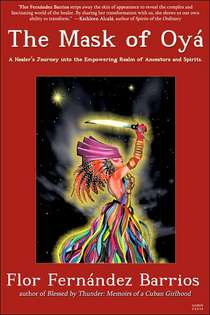
Fernandez Barrios presents us with the gift of her spiritual wisdom, learned over a lifetime of deep and conscious practice. -- Faith Conlon, co-editor of A Woman Alone and Go Your Own Way: Women Travel the World Solo
Flor Fernandez Barrios continues her story of personal growth that she began in Blessed by Thunder, with this new book, recounting her education and experiences as a psychotherapist and spiritual healer. She blends traditional methods (taught to her by her grandmother and by a wise Yucatan curandero) with modern psychology practices to bring balanced, hopeful methods of treatment for those in her care. "The Mask of Oya" is a profound, thoughtful journey that will remain with the reader. Dr Fernandez Barrios' gentle, sympathetic discourse is reflective of her healing spirit, and her calm, matter-of-fact narration gives her an authenticity difficult to question.
Excerpt
ONE
The Mask of Oyá
IN THE YEARS following my arrival in America, I was less than proud to be Cuban. I call that time the dark phase of my development, when I would have gladly have exchanged my dark hazel eyes for a pair of blue ones. As a fifteen-year-old, I was plagued by a desire to turn my black hair into blonde. Dyeing my hair would not have disguised my origins because, unlike many of my Hispanic friends who were lucky enough to have a fair complexion, I had skin that was brown. The innocent but intrusive inquiry, “Where are you from?” made me feel separate and different from the rest of the White world.
I detested being the only Latina in my biology class at Morningside High in Inglewood, California, surrounded by Anglo-Saxon teens wearing cool clothes. I was sure their bell-bottomed pants came from expensive stores; mine were from K-mart. Tired of my constant rejections of her creative and a lá moda pieces, my poor mother had given up sewing clothes for me. While the garments she made were as good, if not better, than those sold at the boutiques in town, they were one more reminder of the financial and class limitations that made me different from other teenagers I knew in high school.
My height had never been an issue in my life, but now I was a midget among the giant Americans. Mr. Long, the biology
9
teacher, an ex-football player, six feet tall with wide shoulders, never missed an opportunity to remind me how short I was. Not only was my stature a source of annoyance to him, but the size of my brain as well. After I received two consecutive As on the weekly exams, Mr. Long called me into his office. Bluntly, he accused me of cheating. At first, I thought it was a joke, but with a serious face, Mr. Long told me he did not believe it was possible for me to get As, given that I spoke so little English. I was furious!
For the rest of the semester, Mr. Long sat by my side on examination days. On every single occasion I proved his suspicions wrong with my outstanding performance. At the end, the report card he handed me became a trophy of my triumph, but deep inside, his prejudice left some scars. From then on, I walked into my classes armed against the racism of the teachers. My challenge was to become invisible among the Whites. That way, I thought, they would leave me alone to do my work in peace.
My invisibility, of course, was only the product of my imagination. The reality was that no matter how hard I tried to disguise my ethnicity, my heavy accent was stubborn and defiant. Even when I pronounced words in the proper way, my intonation of the phrases, sweet as molasses, gave away my Cuban identity. I learned to joke about my accent. I ignored the candid corrections of my mispronunciations. I moved inside the cocoon of my denial and I kept Cuba behind the Communist curtain so to speak.
Then, in 1980, when I was twenty-five and working on a doctorate degree in psychology, the unexpected occurred. Grandmother Patricia, the curandera whom I wrote about in Blessed by Thunder, announced her impending visit to the United States. Of course, I was excited about seeing her again. I loved my grandmother. I was her favorite grandchild! But news of her visit threw me into a maelstrom of anxiety.
I was torn between my memories of the woman I had left in Cuba and the reality of my present life. Back home, my
1- The Mask of Oyá
grandmother was an authority, a well-respected healer, someone I had loved and admired. In my mind, the images of Grandmother in her healing room, surrounded by candles and the statues of her favorite saints, were like old pictures that hung on the walls of my past. But where in the context of my acquired American culture was there space for the old woman’s traditions? I wasn’t sure I knew how to relate to her without revealing my feelings and fears about what I believed were superstitious rituals.
Acquainted with the material in my science books, I found the reappearance of Grandmother Patricia and her spirits a big threat. For years I had managed to keep her in the basement of my consciousness, not an easy task. Grandmother Patricia was stubborn and she had a personal investment in my future career. In her curandera tradition, I was the one who had been chosen at birth by the spirits to carry on the flaming torch of her healing practice. When I left Cuba in 1970, my grandmother’s dream and my early apprenticeship came to a halt.
Ten years in exile, away from her and from my homeland, was more than enough to create a deep wedge between us. At the forced labor camps in Cuba, I poured out my anger and sadness about a lost childhood. My voice had found a way in the poetry that I wrote late at night. A woman now, I had been changed by my experiences in this country. The process of assimilation began that second when I stepped onto the soil of this land of freedom. For a young woman, who originated in a small town under the oppressive dictatorship of Fidel Castro, being able to express thoughts and opinions freed the rebellious adolescent within. I was no longer my grandmother’s little Negrita, as she used to call me.
In America, I could speak without having to worry about getting thrown in jail. I could do anything I wanted to do, go places, buy books, learn new technology. I was thrilled when I took my first driving lesson and more so when I drove my own car. That became a symbol of my own personal freedom, not just from Castro but from the repressive Cuban culture. I did not want to be part of a tradition where women are expected to
The Mask of Oyá - 1give
up their personal dreams for the good of the family. I knew Grandmother Patricia was not going to be happy about this. Even though she had worked as a curandera, family always came first. She was a proud homemaker whose house was spotless. The kitchen was a sanctuary because, to her, a nurturing meal was more than well put-together recipes. Food preparation required the proper state of mind: One must feel relaxed and in good spirits.
As a woman, Grandmother had strong ideas, as most Cubans do, about proper appearance. Before she went out, she dressed in clean clothes, neatly combed her hair, and powdered her face. For her, the right presentation was key to success and respect. But also, besides the superficial, was her profound belief in the spiritual world. When I was a child, she used to tell me: “Negrita, death happens not when the body dies but when the spirit leaves. Some people are dead and they don’t even know it. They walk around like empty shells.”
As a curandera, Grandmother knew about the deep communion between humans and the realm of spirits. She relied on this connection to bring forth the healing forces of the universe and the ancient wisdom of the ancestors. Her allies were many—the medicinal herbs from her garden, the spirits who lived in the quiet corners, the saints to whom she lighted candles every day. She had absolute trust in the messages given to her via her dreams. Intuition, rather than intellect, was the navigational skill she depended upon. She lived a simple existence, tending to her home, her garden and those who came for healing.
In contrast to my grandmother, I rejected the notion of becoming a housewife. I did not want to be like the women in my family. To me, they were old-fashioned! In the book of my life, they were past history. I was more interested in having a career, being successful and traveling around the world. As for Grandmother’s dream of my becoming a curandera, I did not picture myself as a practitioner of folk medicine. I had joined the Americans in their belief that all those spirits and herbs were
1- The Mask of Oyá
useless. In my new way of looking at health and healing, modern medicine was the answer.
When Grandmother finally arrived in Los Angeles, I was disheartened by her fragile and aged appearance. Skinny and wrinkled, she was a shadow of the woman I had left in Cuba. Only her dark brown eyes sparkled with the light of her wisdom. But as days went by, I soon discovered the spirited old Patricia of my childhood. She took charge of my parents’ household. She ordered everyone around as she used to do in Cuba. Again, the old woman became the strong matriarch.
The scrutinizing gaze of Grandmother Patricia was sharp. She did not miss details when it came to family conflicts. From the moment of her arrival, Grandmother was quick to notice the gap that now separated us and made us feel like strangers, even when we were in the same room. She could easily read into our emotions, but she always waited for the right moment to bring up her observations.
“Teresa,” Grandmother said, and I knew she was upset anytime she called me by my middle name. “What’s happened to you? I don’t recognize you.”
All of a sudden, the sunny California morning turned dark. For days I had avoided this moment, but my astute abuela had waited patiently for the right time when we would be alone. And there we were, seated across from each other in my mother’s kitchen. The penetrating eyes of Grandmother were fixed on me as she waited for me to say something. I shriveled inside.
“Grandmother, I’m the same person but older.”
“No, Teresa! I’m not talking about age.” Grandmother knew I was evading her. “You’re not my Negrita. You know this old woman can see beyond your looks. There is darkness in your soul. You are ashamed of your family and of yourself!” Grandmother hit the table with her fist. “What is wrong with you?”
Grandmother got up from her chair and poured herself some coffee from the pot, brewing on top of the stove. She did not offer me any, but I was too afraid to say anything. She
The Mask of Oyá - 1came
back to the table. As I watched her sip the coffee, I waited for the next round of questions. In all honesty, I didn’t have answers.
“Maybe you have changed so much that you don’t even know yourself,” she continued. “That shame is no good. It’s killing your spirit. Let me tell you, Teresa, those Americans are not better than you, and no matter what you do, you’ll never be one of them.”
“I’m proud of being Cuban!” I said in my defense.
“Don’t lie, Negrita. I have been watching you. I’m not a dumb old woman. I’ve seen how embarrassed you look when we are out in public. The other day you asked your father not to talk so loud. Well, Cubans are boisterous! But that’s only minor. Like the Americans, you are a liberated woman who lives in her own apartment, who eats those jamburguesas and frozen meals. You’re too busy to cook. You don’t even bother to iron your clothes. Is that the American look? Well, I feel sorry for you.”
I knew it was a waste of time to explain to Grandmother how in this country, women don’t have time to live life the way women do in Cuba. In the past, I’d had that same battle with my mother, who had managed to keep her house immaculate, cook three meals a day and work a forty-hour job in a factory. It had been fruitless for me to argue with my mother and now it was so with my grandmother. Out of respect for her age, I let her lecture me. Deep inside, I was disturbed at the loss of our connection. As a child, I had seen Grandmother Patricia as an authority I trusted and admired. But now, all I could see in front of me was an antiquated woman. And that made me very sad.
Apart from giving what I used to call her neurotic lectures, Grandmother worked hard on reopening the link to our hearts. As a skillful storyteller, she took me back to the world of my childhood, to the richness of the moments, not forgotten, but simply buried in the dark soil of my psyche. Patiently, she brought back the little Negrita in me, the playful child, still innocent and curious about life, who enjoyed listening to Patricia for hours.
1- The Mask of Oyá
Once more, Grandmother reminded me of the night of my birth. The roar of thunder announced my entrance into this world. With tears in her eyes, Grandmother told me how the lights went out, leaving the small town’s hospital in total darkness. The doctor did not think I would survive, but she knew I would, because thunder was a powerful omen and a sign that I was to become her apprentice in the curanderismo tradition.
What happened to us? I was supposed to follow in a tradition of women healers. But when I left Cuba, the link to the chain appeared to have been severed. But was it? The question itself became a challenge for me to dig into the darkness of my soul. This was the beginning of a journey I had not anticipated. The presence of Grandmother with her pertinent questions swept me into confusion. Over and over, she asked, “What has become of you? Why are you so changed?” At first, I was annoyed with her insistent reminder of alterations I couldn’t see. Then, after a while, I found myself wondering about her words. Who was I before? In what ways was I different from the person Grandmother knew?
Where to begin? How does one confront the vast and complicated essence of a concept such as destiny? If I was indeed meant to be her successor, I would think the great choreographer of our lives would have managed to at least keep us together in the same place. But no, we were oceans apart. I was no longer the girl to whom Grandmother used to talk about herbs, the girl she had allowed to participate as a witness and as a helper in her healing practices. I had been changed into a young woman with a vision of the world that was turning White and American.
Occasionally, when nostalgia visited me, I would daydream about my grandparents’ farm. I could see myself galloping on the back of my horse Almendro. I could hear the voice of Carmen, my Afro-Cuban nanny, calling me from the kitchen, “Niña, come and help me peel these plantains.” I had images of my Grandmother Petra and me picking guavas for marmalade. I heard the raspy voice of Graciela as she told stories to all of
The Mask of Oyá - 1us
children in the neighborhood. Cabaiguán, the town where I grew up, was a vague picture that became brighter as I recalled the warm nights of the summer. Cuba became a tiny point on the map of my life. It was too painful to think about all my losses, about all those left behind, and therefore I learned to keep Cuba inside a compartment in my heart.
I was aware to some degree of my choice to stay on the margins, detached from the pain and grief I felt every time I thought of Cuba. Instead, I learned to keep my attention on the future. Education became the key to freedom. I became a recluse behind the pages of my science books and a prisoner of my own denial. I chose the path of least resistance where I lived, pretending to ignore those parts of myself that constantly threatened to come to the surface—the girl who left Cuba and who wanted so desperately to find a new home amid the American melting pot.
Grandmother Patricia made me aware of a deeper connection I had forgotten. She was the old ceiba tree deeply rooted in the traditions and spirit that many generations have followed with passion, wisdom and humility. Every day, Grandmother observed and listened to signs and messages from spirits unseen to others, but not to her. Her daily existence was colored with supernatural and mystical appearances of guides who communicated to her the proper daily preparations of food, about prayers and even energies affecting the house and family. I came to realize how much my grandmother’s life was a constant meditation that required alertness and intuitive skills.
To the old lady, everything had meaning, from the army of ants in the backyard to the single leaf that fell on her shoulder. “That leaf is the touch of God,” she might say. She held the leaf in her hand, searching for a weather prediction: “This winter is going to be a mild one.” Surprised, I waited for her to say more, but her words were always to the point. She never said more than was needed.
During her visit to Los Angeles, Grandmother became the personification of the deity Oyá, the one who represents the
1- The Mask of Oyá
wind that blows, not just across the surface of the earth, but through the psyche, disrupting stagnation and resistance to change and growth. Grandmother became the archetype of the spiritual winds that linked the realm of the ancestors with Earth. She became my connection to the elders in my family and to the source of ancient wisdom.
One evening before Grandmother’s return to Cuba, she sat at the kitchen table at my parents’ home. She lit her little cigar. I sat across from her and waited with anticipation for more stories of my childhood. Instead, Grandmother surprised me with a different kind of tale.
“Negrita, last night, I had a dream.”
“Yes, Grandmother,” I said with apprehension.
“Oyá spoke to me about you.”
“Yes,” I repeated as I tried to remember what I knew about this orisha [spirit].
“Don’t you know about Oyá? She is the messenger between the ancestors and us. In my dream, she told me that you had forgotten about your ancestors. That’s bad, Negrita! We must remember and honor those who have gone before us. Otherwise, we become lost souls.”
Grandmother’s eyes were like sparks from a flaming fire. I could tell that it was not only Oyá who was mad at me. I braced myself.
“Let me tell you, Negrita, you don’t want to anger Oyá. She is unpredictable. She brings chaos as she walks. She is the heart of hurricanes and tornadoes. And when she comes, you can bet she’ll teach us about humbleness and death.” Grandmother looked at me, making sure I was paying attention. “Death and wind are mysteries. Both are invisible fuerzas poderosas [powerful forces] one must respect. When Oyá comes to pay us a visit, she doesn’t waste any time. She has a lot to do. One of her jobs is to stand at the doorway between life and death. From there, Oyá midwifes the souls of the dead into the invisible place of the ancestors.”
Grandmother paused to relight her little cigar and to order
The Mask of Oyá - 1me
to make some Cuban coffee. Grandmother, as a good Cuban, drank sweet cafecitos throughout the day and night, even right before she went to bed. I was always amazed by how she didn’t lose sleep.
“Negrita, let me tell you a tale I heard from my friend Chucha.”
“Who is Chucha?”
“She is my Santera friend and a daughter of Oyá.”
“I don’t remember her. Did I meet her when I was a child?”
“No. That’s not important. Listen. Oyá is like a boat that travels back and forth from the land of the ancestors and the Earth. When Oyá visits this world, she first comes to the forest. There she becomes a deer. Then she changes into a woman, so that she can go to the market and sell her multicolored cloth. During one of Oyá’s trips to the market she was spotted by Changó, the deity of thunder and lightning. Changó fell in love with Oyá at first sight. He tried hard to get her attention, but Oyá ignored him and went about her business selling cloth. When she was done, she left the market and headed back to the forest.
“Changó, who by this time was unable to keep his eyes away from the beautiful woman, followed her into the forest. Changó was surprised when he saw Oyá put on the skin of deer and change into an animal. Filled with curiosity, Changó returned to the forest a few days later. From his hiding place, he saw how Oyá changed herself back into a woman. Changó waited until Oyá left for the market and he stole her deerskin. Later that day when Oyá returned to her home in the forest, she found her deer dress was gone. Oyá was mad and she was worried, because without her deerskin, she couldn’t stay in the wild. So when Changó came around again, she agreed to become his wife.
“Of course, Oyá’s problems didn’t end there. Changó had two other wives: Oshún and Oba, who immediately disliked her. They were jealous and wanted to make Oyá leave the house. They called Oyá a rude and savage beast. Unhappy, Oyá
1- The Mask of Oyá
searched for her deerskin until she found it inside Changó’s bag. Without wasting any time, Oyá took it and ran to the forest.
“When Changó returned home that day, he was so stricken with sadness that he went looking for Oyá. In the forest, he found a deer with two strong horns. The deer stared at Changó with defiance, ready for battle. Changó lifted his bow and arrow. He was ready to kill the animal when he recognized the deer, and instead of letting go of the killer arrow, he kneeled down and offered the deer a plate of bean cakes. Oyá was so moved by Changó’s kindness that she removed the horns from her head and gave them to Changó. From that moment on, any time Changó was lonely for Oyá, he used the horns to call her spirit.”
Grandmother finished her coffee, and reaching out to me, took my hand into hers. Grandmother had strong hands with long fingers. I studied the sunspots of the skin—a galaxy of brown spots that extended up her thin arms.
“Negrita, you must remember this story. Think about it after I’ve gone back to Cuba.” Grandmother’s face was solemn.
“Sure, Grandmother, I will, but why? Why Oyá?”
“I see in your eyes that the time away from your home and from us has changed you into an Oyá without her deerskin. Oyá without her deerskin was lost in the forest of the world, and so are you. You need to touch inside your heart and find your own deerskin. But don’t let this old woman tell you what to do. I know what you’re thinking—why in the world would you need a deerskin in this city of concrete?”
“No, Grandmother, I—”
“Negrita, listen to me. There is great wisdom in this tale. When Changó and Oyá join hands inside our hearts, one is blessed with their strength and their courage. Changó has been by your side from that moment when you were born. He has been your companion. As a warrior orisha, Changó has guided you through difficult times. Like a good and protective father, Changó has guarded your spirit and taught you how to use his sword and his ax.
“Both Changó and Oyá are your allies. When called to be the
The Mask of Oyá - 1warrior,
Changó becomes the spirit of lightning. But without Oyá, Changó’s power would die, because his thunderbolt is spawned by the wind of Oyá. They need each other.” The old woman paused and her brown eyes filled with tears.
“Negrita,” she said tenderly, “I always knew your life was not going to be an easy one.”
“Why, Grandmother?”
“The life of a curandera is full of challenges. We face a great deal of testing from our helpers in the spirit world. They want to make sure we are strong. Most healers are loners in their walk on this earth.”
“Are you a loner?” I asked.
“Yes I am. But—I am not alone,” she said firmly. I detected a tinge of sadness in her words. Then Grandmother quickly changed the subject, leaving me to figure out the rest at a later time. “Both Changó and Oyá will continue walking with you. During the next phase of your life, as you mature into a woman, Oyá will be your teacher.” Grandmother gazed into my eyes, as if she were in search of my soul. “Be careful with her, Negrita! Her rage and dark sense of humor are deadly as a tornado. When she comes, she sweeps everything away.”
The words of my grandmother echoed deep inside my heart. How could I trust that I would be prepared for such a meeting with the dark and mysterious orisha? As if she had read my fears, the old woman said, “Don’t worry, Negrita. Whatever situation brings her to you, she always appears in a swirl of confusion and darkness, so that she won’t be seen. There is no way to prepare for such a moment. You just trust that behind her dark cloth there is a promise for good to happen.”
A few hours before Grandmother Patricia returned to Cuba, we sat at the kitchen table in my parents’ home. This time, she spoke to me about the “place of no return,” where the souls of the dead go, from which they may be called back spiritually to bless the living. She said, “Negrita, when I’m gone to that place, you won’t be alone. I’ll be there in the company of your Grandfather Victor, and of my own parents and grandparents
2- The Mask of Oyá
and their parents. We will be watching you. So, mi niña, if you ever need our help just call on us.”
Grandmother’s last words created other questions. Aware of how little time we had to be together, I hurried to ask: “Where is this place of no return?”
“Some say that it is an island that Oyá hides behind her dark cloth. Oyá is the only one who knows the secret ways to move back and forth between life and death. She keeps that place invisible to us living creatures.”
“Would I be able to see you when you’re gone? Would Oyá let you talk to me?”
Grandmother bobbed her head. Then she moved closer and hugged me. She held me in her arms. For a moment I became the little girl who used to sit on her lap. I could feel this was a good-bye hug. Grandmother was not just returning home to Cuba. Soon, she would be going home to the place of no return. I wrapped my arms around her fragile body. I wanted to protect my beloved abuelita from the grip of the fierce deity Oyá.
The concept of Oyá and her black cloth stayed with me long after Grandmother Patricia returned to Cuba. Like Oyá, the old lady disappeared behind the cloth that protected my cherished island of Cuba. Even though I never saw her again, the essence of her teachings tore to shreds the fabric of my social, emotional, psychological, and spiritual realities.
Since my arrival in the United States, I had lived in denial of the spirit world. I had rejected my early childhood memories of the spiritual practices of my Grandmother Patricia and of the Afro-Cuban traditions my nanny Carmen shared with me. To me, their beliefs were superstitions. In order to succeed, I became comfortable in a structure that negated the supernatural. I had focused on education and social conformity, obliterating intuition and the metaphysical domains from my life. I became adept at surviving in a patriarchal world that insisted on materialistic success. I gained the skills that allowed me to move through the bureaucratic maze of the educational system, where getting good grades was just one hoop among the many one
The Mask of Oyá - 2had
to jump through. For that part of my journey, Changó, as my grandmother said, had been an excellent guide, teaching me about the linear pathways of male dominance, where logic and intellect reign above all. I became a well-armed warrior, ready to shoot my arrows in self-defense.
Grandmother, as usual, had been able to see into my future. She knew that I would become restless with the limitations of patriarchy and its linear structure. She wanted to remind me of the female counterpart of the warrior, Oyá, the one who, with her fierceness, carries the mystery and transformational forces of the wind, combined with the intuition of a wild and primal energy. Oyá is a businesswoman at the market and is a deer in the forest.
Grandmother knew that it was important to leave me a tale that would help me find my place in this world. The mythology of Oyá was the perfect gift. Like Oyá, I was a ferryboat constantly crossing back and forth between two cultures. Oyá, as a creature of many colors, embraces the essence of transformation. Not death herself, Oyá uses her dark cloth to protect the spirit of the one who has just died. Protected by the darkness of her cloth, Oyá sneaks away, taking with her the soul of the dead. Oyá is not life, but she carries those who come back from the ancestral land. Dressed in Oyá’s multicolored mask, they enter this world through the red cloth or stream leading into the womb of a new mother.
Grandmother had foreseen my need for information I could use in my work. Oyá and Changó would teach me and guide me in her absence. Oyá would ease the flow of souls into and out of my office when, years later, I became a therapist. The old curandera had the common sense to see across the boundaries of cultures. In her trip to Los Angeles, she had prepared me with spiritual tools to bring forth the same healing energy she had called upon in her practice in Cuba. The context was different, but what I learned after many years of reflection was that there was no need for altars and for candles. Inside the modern ambience of my office space lived the world of Oyá
2- The Mask of Oyá
with her invisible winds of transformation.
The process of healing is a journey that requires a willingness to cross the threshold of death. Old patterns of behaviors, ill aspects of the self, unhealthy relationships and attitudes must die to give place to the birth of the new and healthy. The role of therapists is similar to that of Oyá. We are constantly navigating the waters of the unconscious in search of connections. From the shadows of the past, ancestors become alive and speak their wisdom.
The dark cloth of Oyá allows the therapist to move in and out of the client’s subconscious unnoticed. Any trace of fear on the client’s part could heighten resistance and increase defenses against change. Hiding behind the death mask, the therapist works her way into the underworld of the mind in search of the lost soul. Like Oyá, the therapist must swirl through narrow labyrinths and sweep the dusty corners of the psyche. Finally, the anticipated moment arrives and the new self is pulled from inside the birth canal. Dressed in the vibrant color of life, the client opens his eyes to a world of unlimited possibilities and growth.
The Mask of Oyá - 2
|