
Amazon
Amazon
Bookdepository
Category:
Action/Thriller
Publisher: Roman Books
ISBN-10: 9383868155
Type: Fiction
Pages: 266
ISBN-13: 9789383868155
Price: $14.95 (eBook)
A delicious mixture of reality and fantasy, spiced with copious amounts of humour.
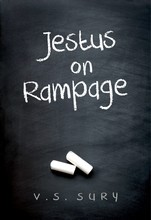
Synopsis: - Jestus, aka Professor Bagus Bagliochus Bagdenborg is a colourful personality; he is a composite of a hundred facets. He changes his behaviour (and his names) at the drop of a hat, rather at the turn of each page. He is simply unbeatable, either in a physical confrontation or in an argument. His main weapon is ‘fentologic’, which, he claims, is what is created when logic is ground to the finest, fento dimensions – the way matter displays new characteristics when it is ground to nanoparticles. The power of his fentology is to be seen and tasted to be believed, especially when spiced up with the professor’s unique brand of outlandish humour. Two sagas from his innumerable escapades are presented in this humour-laden novel.
Saga I, Chapters 1 through 8
Professor Bagdenborg arrives at the NG University on horseback, with the grand vision of “Emancipation of Science”. He proceeds to do it with zeal and zest, to the great discomfiture of his colleagues and the administrative staffs, some of whom naturally become his enemies. The students, on the other hand become his fans – which aggravates his colleagues even more. Bagus/ (Jestus/Bagdenborg/Bagliostro/Baglighetti etc) blithely romps along the university generating hilarious, unbelievable phenomena. Samples of his unique talent:-
He converts his horse into a car. (“It is a ‘convertible’, you see,” he explains to his bewildered colleague.) He plays chess by dowsing over the chessboard! (Simple, if you know fentology.) Throw dimes in the air, and they always land heads up. Fentologic reveals that it is due the special effect of the ‘Fortnight of the Waxing Moon’. A computer, programmed to generate random numbers keeps on spewing highly ordered sequence of numbers, stubbornly refusing to obey the commands of the operators. Know how to cross the zebra-lines across a road? Bagdenborg shows how to do it properly – he rides on a zebra (yeah, the animal) across the zebra line! While playing billiards, Bagdenborg uses the cue as a sword; it will pierce through the ball and the tabletop. One of his enemies discovers to his horror that the table-tennis ball can actually turn into an egg, and splash all over him. And so on and so on, many weird things happen whenever Professor Bagdenborg is around. All due to the courtesy of his ‘fentology’.
He bamboozles his students (“his dear children”) with his lectures on how to emancipate Science. The students follow him whole-heartedly. Given the choice to listen to academic lectures on science or to follow “fentology”, the students bunk classes. They start playing ‘fento’ games outside, in the open fields.
That is the last straw for the Administrative Office. They decide to pack off the erratic professor. Then they discover that their office computer has lost all data on him. In its place, they find a guy named, Jestus. Finally, the authorities manage to shunt out the maverick professor.
Not yet. Because, in a last ditch effort to teach fentology to his students (“my dear children”) Bagdenborg returns to the campus as a gorilla! The gorilla-cum-professor pleads with the management to accept him back; he wants to teach his dear students, who love him so much. Gorilla’s offer is rejected; he goes back dejected.
Saga II Chapters 1 through 3
The Society of Rationalists hates Jestus/Bagdenborg because he is propagating ‘fentologic’ which stands for everything opposite to its ideology. They dub fentologic as a virus; they call him The Menace. They set about confronting him.
They send Zee Von, their best operator to tackle Jestus. Alas, Jestus gives him a treatment of panchakarma of Indian fame. Zee Von is converted to fentology. He throws a paper arrow back at his old fellow-members!
Chapters 4, 5 and 6:- Next, the president of the Society sends Wagermann to the enemy territory. Wagermann, being clever, sets a honey-trap for Jestus/Bagdenborg, the famous apsara, oh, we mean Op Sarah. Jestus swallows the bait hook, line and sinker. The only problem is that he digests it. Op Sarah too becomes a convert.
Chapters 7,8,9 :- Next in line to tackle Jestus is villain (sorry dear villain; it is Will Laigne) who hires the hulk, Battering Ram to beat Jestus into pulp. Ferocious Bat discovers that Jestus was his elder brother in one incarnation. He has a complete change of heart. He returns and socks Will Laigne, his handler on the jaw. The mission is bust – just like Will’s jaw. The rationalists dubbed fentology as a virus. Tue; the punch that Will Laigne received, incubates like a virus and spreads into the midst of the Rationalists. They start fighting among themselves, as if possessed. Rock Van, the most intelligent and loyal member of the Rationalist Society knocks down all the members; does not spare even the venerable old president. The members quit the Society, except for the last loyal member, Emmar Rod.A.
Chapters 10,11,12 :- Undeterred, President Norse Simmon, followed by Emmar Rod, meets Jestus at his den for the final confrontation. Jestus/Bagdenborg, through ‘fentology’ claims that the Rationalist themselves are just a figment of his imagination. More than that – he swears that they are only a product of his dream! Norse Simmon challenges him. Jestus proceeds to take out a ludicrous piece of laptop made out of cardboard! In that cardboard, he goes on to create a virtual world wherein the main building of the Rationalists (their war room, as they called it) is dismantled like a pack of cards. The broken pieces of the building fly away into the sky. Unfortunately, Emmar Rod who was witnessing the video gets emotionally involved, and enters into that virtual world. He too is swept away into outer space! Norse Simmon, the president alone is all that is left of the Rationalist Society. Yet, the indefatigable president taunts Jestus that he is still alive, and so, is real, not a fantasy created in the dream of Jestus. The answer Jestus gives is very subtle, and can only be revealed at the end of the saga. Jestus too dissolves himself inside the screen of the cardboard laptop!
Having nothing else to do, Norse Simmon returns to his office of The Rationalist Society. There is no building. Only the bald site remains, covered with verdant grass and a lush growth of shrubs. The only answer that Norse Simmon can get is reflected in the blank gaze of a black goat grazing in the middle of the field.
Excerpt
Hi Jinx at the University
“When I arrived at the NG University last year, it was situated at three hundred kilometres east of California,” professor Bagdenborg announced. His colleague was not amused; his nose had turned up a few millimetres, in the pure air of the campus. When the professor made the same statement in the classroom, an irrepressible voice had asked in a deadpan voice, after a very brief period of amused silence, “Where is it situated, now, sir?” Allowing the barely audible wave of titters to subside, professor Bagdenborg had replied in a dignified tone, “The co-ordinates of its three dimensions have remained constant. That of time, the fourth dimension, has changed, naturally.” The class broke into laughter.
On that day, when the fourth coordinate had not changed, Bagdenborg had arrived at the portals of the NG University, sitting ramrod-straight on the sturdy back of a magnificent steed. He surveyed the whole campus from there for a brief period, and then majestically rode inside, on a slow trot. The looks he received varied from amusement to bemusement to bewilderment.
Bagdenborg had come to join the Science department of the University as a professor. After a few days, his colleagues and his students had come to accept the horse-riding professor. When one colleague asked the professor why did not use a car, Bagdenborg had replied, “Yes, of course, I started my journey to this place in a car. But when I saw the scenic beauty all around this place, I decided a steed would fit better, and so I converted my car into a horse.” The colleague agreed with the first part of the professor’s statement, though with a bit of personal reservation. But he flinched in pain at the use the words, “converted my car into a horse”.
“What was the make of your vehicle?” he asked, with a thin veil of sarcasm, as if he too was interested in purchasing a car that could be converted into a horse.
“Equus,” said professor Bagdenborg, as if it was much obvious.
“I have not heard of any such make.”
“There is always a first time. It was a convertible, see. Besides, it is beside me, as you can see.” The professor patted the sinewy neck of the stallion. The animal neighed discretely, agreeing with him. Needless to say, Bagdenborg had made his first enemy in the campus.
Bagus Bagdenborg was tall, lean and lanky. He was mostly made of bones and joints and minimal amount of flesh. His clothes were made of costly material, and his tailor had utilised all the technique of his craft. Yet, Bagus could not be described as being dressed. His clothes just hung on him, as on a frame, and seemed to refuse to be a part of him. The professor too, seemed to refuse to be a part of either the clothing or his skeleton; he moved about as if he was in no way connected with them. While he walked, he walked slowly, lifting each foot up deliberately, as if his boots were stuck to an invisible layer of gum on the road. Another colleague had remarked, “Mister Bagus, you seem to be moving inside a very heavy, dense fluid.”
Bagus Bagdenborg said, “You are correct. The air around me is very dense indeed.”
The surprised man replied, “How can it be, professor? The NGU is far from cities, and we are surrounded by hills, forests and gardens. It is on record that the atmosphere here is completely free from pollution, and we are proud of that.”
Bagdenborg stretched his lean long arm and pointed a small based rectangular structure, nearby.
“Look at that silo. Would you agree if I say that it is thirty feet high?”
“Well, almost,” replied the puzzled man.
“If it is completely filled up with water, let us say, what would be the weight of that water?”
The colleague was from the linguistic department. He said, his puzzlement continuing, “I cannot tell it off the cuff. But I would say that the weight of that quantity of water would be enormous.”
“Yes, it would be about fourteen point seven pounds weighing down on every square inch of area. And, that, exactly is the pressure that the air around me is exerting on me constantly. That pressure can drive water up yonder silo to a height of thirty feet.”
The colleague, though not a science student, remembered his forgotten school days’ physics. He was irritated that the wily newcomer was using wicked and crooked logic. He could not help protesting.
“But that can happen only if there is a vacuum inside the silo. Likewise, your body can be crushed due to air pressure, only if there is complete vacuum inside you.”
Bagus Bagdenborg aka Lucid Laffenstein aka Jestus Jesticus exhaled deeply, subtlely shrugging off his helplessness if the other man could not such a simple proposition.
“I am totally empty inside, and my body is ultrasensitive.”
The conversation was closed as if a huge steel door had dropped down between them. Bagus had made a second enemy among his colleagues. A criss-cross warning label, ‘eccentric’, was permanently stamped on his name, that day. (Ecks, for short.)
The letters, NG of the University stood for, “Next Generation”. The campus presented a wide forefront. Bagdenborg’s forehead too presented a wide forefront; it was large, compared to the rest of his face. The NGU had a long history. Bagus too appeared to be very old. His face was marked with innumerable folds and cuts – resembling those roads, walks, footpaths, promenades that abounded inside the campus. The Administrative Building and the Science Office building stood out among all other structures in the campus. The two eyes, blazing under the bushy, grey eyebrows were the first to attract the attention when one looked at Bagdenborg.
When one looked at the NG University, without having a prior knowledge of its geographical location, the university exuded a peculiar aura. It presented no clues to pinpoint its position. It could have been in England, or USA, Australia, or India. The architecture incorporated the East, West and Japanese styles. The students dressed in indescribable ways, and they came from all overthe world. Bagdenborg presented a similar picture. His forehead offered an Indian grandeur. His eyes were Red Indian flames. But the slant and folds of the lids pointed towards Tokyo. The nose was a direct import/implant from Plato. The skeleton was Nordic. You could have called him Bagnius, Bagston, Baginsky, Bagnagandhi or Bagimura and he would have responded naturally and instantly to that name, in the appropriate language. Student Hayakawa had been pleasantly surprised when Bagnimura opened a conversation with him in Japanese, and had sustained it for over an hour. Student Rama Sastry had been thunderstruck when Bagus Bagnihotri greeted him in pure Sanskrit. He had discussed many times, various topics in Sanskrit literature (itself, being a vast ocean), and had been surprised by the breadth and depth of Bagnihotri’s knowledge. The cut and drape of Bagdenborg’s suit suggested that it clearly belonged to Washington. Some of his colleagues had seen him in Scottish kilts at his quarter in the Resident Block. He had been seen, on occasions, wearing the Indian dhoti, and at times, a kimono.
When asked about his place of origin, Bagliardi had laconically replied.
“Here, there. Anywhere. In fact, all over there.”
That had earned him a third member for the opposition. The nickname, Ecks, was now in bold font. They could have checked his passport, of course, or easier still, they could have a peek at the computers at the main office. Why should the old goat hide the information? No point in it. Old goat, an eccentric old goat indeed. Because, when a fourth colleague had casually asked him his age, the withered, weather-beaten Crazy Horse had answered in clipped sentences.
“I age less and less. I am ageless. Sixty years ago, my age was zero. Hundred years ago, it was minus forty. My age varies according to the weather. And in different countries. May go up or come down. It is in a quantum state.” The colleague, being more tolerant than the others, did not depart abruptly; he tactfully changed the topic.
His apparent eccentricity was evident to the staff selection committee at the first interview itself. But they had taken him in, because of his outstanding academic qualifications. There were letters of high praise from prestigious institutions (Switzerland, France, Germany, UK) which had conferred doctorates on him. He had published a considerable number of original articles in many international science journals. The committee therefore agreed unanimously that the NGU would profit by the presence of professor Bagdenborg. (Aged forty-five, his certificates stated, though he looked old enough to be sixty-five or beyond.) Birth certificates could be forged, they were aware. But, they had checked and crosschecked his academic credentials thoroughly. Moreover, the fluent and authoritative way in which he had conversed with them on the latest developments in modern physics had impressed them. That was that.
That was that and much more. The much more part of it would unfold gradually in the coming days. But at that time, who could have ever thought how much was much more? The peaceful, innocent, weathered face and the old-world-gentleman demeanour of Professor Bagus Bagdenborg had successfully concealed the enormous amount of disruption he going to cause in the campus.
*
Professor Bagdenborg was conducting his first class at the Next Generation University. The class had full attendance. Bagus began, his voice ringing out deep, rich and resonant. The students were startled, because they had not expected that this tall, lean, emaciated old man’s voice could be so power-packed. More than that, they felt his voice was pouring out of concealed speakers from all sides of the classroom.
“Good day, friends.” A pause; and then, “Don’t worry; I am not going to repeat it every day.”
The classroom broke into laughter.
“I am to teach you science. Science is built on a solid foundation of experimentation and logic. I have my own reservations on logic, which we will explore preliminarily.
“My name, as many of you know already, I am afraid, is Bagus Bagdenborg today. I have been greeted with many names: Baginsky, Bagnimura, Bag-Ashanti, Baglopez, Bagenverma, Baglialdi...and so on. You can call me by whatever name you fancy.”
A wave of titters rose and fell.
Sander Shan, a student raised his hand and said, “That is funny.”, and half a second later, Jane from LA remarked firmly, “Also a bit illogical.”
Bagniström chuckled and replied, “I was hoping somebody would say that. I said I would talk on logic, remember? This was my gambit to lead you into deeper waters.”
The students were immediately alert. The atmosphere had changed subtly. A few students felt as if the professor had grown taller. He was lean and tall, they had noticed, as he entered the room. But now, he seemed to have grown taller by six inches. Was that an illusion, by a change in lighting? Those seated at the back felt as if dancing waves of light and shadows were marching behind the professor. Glenda, who was sitting in the front row, was interested in the New Age philosophy, though she had taken science as her major subject. (A strange combination, her boyfriend had taunted.) She felt as if a strange energy field was emanating from the professor. She could almost sense it around her solar plexus.
Meanwhile, the professor was expounding.
“Logic, as most of you, and especially the aspiring scientists among you hold, is the crown of mental faculties. But it is a crown of thorns. Logic is bound by chains created by itself. However long and flexible the chains may be, logic cannot break free from its shackles. Logic can never know anything that exists beyond it; something which is totally new.”
A hand shot up among the students.
“Yes, mister Anthony?”
A small tingle went through the spine of Anthony. How could the professor, a newcomer – and this being his first class – know his name? He hesitated for a brief second, but proceeded.
“But sir, consider the vast advance we have made in the past two thousand years. The knowledge we have accumulated in the fields of science and technology is immense.”
Bagus Bagliochus smiled.
“All knowledge is redundant, I assure you. One of these days I am going to throw the Incompleteness Theorem of Gödel at you. For now, consider a small basic corner. You learnt, no doubt quite many theorems in geometry, and solved hundreds and hundreds of raiders and lemmas while you studied in your school. All those voluminous bulk of equations rest on a few axioms proposed by Euclid. The thousands of equations and formulae in trigonometry are nothing but a rearrangement, new relations among the fundamental propositions. It is likewise, in all other branches of science. In fact, I warn you to be prepared; I am going to give you all an assignment on this very topic in the near future.”
Other voices too, rose in protest. Heated arguments flew across the desks. Bagus Bagdenborg listened patiently to each of the protesters, and gave incisive replies, tackling the questions from unexpected angles. This went on for some time and, as the students were calming down Bagden concluded.
“Friends, we have a lot time to discuss these things in detail. In fact, we have a whole thrilling one year ahead of us. Now, time is up, I am afraid. But we will take this up when we meet again the day after tomorrow. Allow me to cap up what I said on logic. As opposed to the logical, there is the non-logical. Note, I said, non-logical, not, illogical, because the word, illogical still carries a faint malodour of the word, logical. The non-logical is free from all restraints. And, take this, my theorem; the Bagden Bagden theorem. When there is a fight between logic and non-logic, non-logic invariably wins.” Bagdenborg laughed heartily, and continued to sustain for long – a longer time than was appropriate.
The students were puzzled. Some were outraged. The very atmosphere in the classroom had changed. Amidst the din of exchanges, faint but discernible sounds of knelling bells were heard. A hush fell over the hall. Before the students recovered, the professor had somehow glided out of the classroom.
|