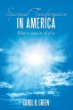
The United States is undergoing a period of change. As the Information Age moves on, people’s ideas of religion, God and spirituality shift with increasing frequency. The question becomes; shifting towards what? In her new book Spiritual Transformation in America: What it Means to All of Us author Carol B. Green examines the data regarding the spiritual trends in the U.S. in an effort to understand these trends and answer some very poignant questions. Special attention is given to shifts in religious and spiritual affiliation, oberservance and practices. Go to www.carolbgreen.com for more information.
While there have been multiple studies of religion in the U.S., until now there are some important follow-up questions that have not been asked. Just what do we believe when we say that they believe in God? What do we believe about Heaven? How does God fit into our lives? Just as we accept that we are a nation made up of diverse peoples from different cultures, perhaps we should question if our basic religious and spiritual images are equally diverse. Spiritual Transformation in America searches for answers using reputable surveys, by reviewing books, essays, speeches, as well as interviews with appropriate parties. The goal of Spiritual Transformation in America is to better understand just what it is that Americans believe, and how these beliefs impact life in America.
With conversation rather than rhetoric, and hard data rather than posturing, Spiritual Transformation in America peels away the layers to present a rational examination of the state of spirituality in modern America as well as present possible insights on where it may be headed in the future.
Excerpt
The term "conventional wisdom" describes ideas that are generally accepted as true. It also implies that many of the ideas that are accepted as true are untested. Under closer scrutiny, they don't always hold up. Let's not forget that prior to Columbus, the conventional wisdom was that the world was flat. Until Copernicus (1473-1543) and Galileo (1564-1642), the conventional wisdom was that the Earth was the center of the Universe. It is important to note that the new vision of the Universe that Nicolaus Copernicus presented for scientific consideration purportedly met with disfavor from the Catholic Church. In Copernicus' day, the Catholic Church was the ultimate arbiter in these matters. In addition, Copernicus and Galileo lived during the period of the Inquisition. The fact that their views opposed official church doctrine put them in grave personal danger. For those unfamiliar with the Inquisition, it was a formal tribunal or investigation conducted by the Roman Catholic Church during the period of 1232-1820. Its purpose was to discover and suppress heresy or acts against sanctioned church doctrine. This is likely the reason that Copernicus' research was only released shortly before his death. It is said that he was on his deathbed when he was given a published copy of his work.
Galileo's experience was much the same. Galileo's work was suppressed under the leadership of Pope Gregory XV; it wasn't until after 1610, when Galileo began publicly supporting Copernicus' thesis which placed the sun at the center of the Universe. In 1615 Galileo was denounced to the Roman Inquisition. At that time he was cleared of any offence. Nevertheless, the Catholic Church condemned the theory as "false and contrary to scripture." Galileo was warned to abandon his discovery, which he promised to do. When Pope Gregory XV died and he was replaced with Pope Urban VIII, Galileo was confident that his work would be accepted by the Church, as Pope Urban VIII was trained as a mathematician. Things didn't work out the way he anticipated. When Galileo later defended his views in his most famous work, Dialogue Concerning the Two Chief Systems in the World, the office of the Inquisition threatened Galileo with torture and possible death if he didn't recant his proposition that the Earth revolved around the sun. The Church reacted quickly to the publication of Galileo's book. Within five months Galileo was tried by the Inquisition, and found "vehemently suspect of heresy." To save himself, Galileo offered the famous recantation of his work. He was forced to spend the rest of his life under house arrest. Additionally, he agreed to a negotiation that allowed him to continue his work on the Copernican theory so long as he treated it as a hypothesis. It is quite possible that the reason the Church reacted so strongly to his work was that they not only felt threatened by the findings, key decision makers in the Church believed that the concept of God's omnipotence was threatened by Galileo's work. There was also a concern that Galileo's theory would destroy ethics and morality as defined by the Church. When reviewing the Church's position in the context of the lifetime of Galileo, it is possible to conclude that the Church was not motivated by evil motives. Church decision makers possibly believed that they were protecting the population from an evil that might damage their definition of moral behavior.
Professional Reviews
Scene Magazine
Scene Magazine January 2011
Section: Literary Scene
This month’s second featured title, Spiritual Transformation in America, was written by another Sarasota resident - Carol B. Green. (AuthorHouse 2010, $18.99). The book is in response to what she perceives as major shifts taking place in affiliation, observance, and practices of religion in the U.S. We’re becoming more open to new ideas and different dimensions of spirituality, she claims. For example, more than 40% of Americans, no longer follow the religion they were brought up in, and religions are now using technology to reinvent services.
Whether you’re a frequent church-goer, or not, many will appreciate this book’s insight into the various facets of the U.S. religious community. Which church has the greatest rate of decline in memberships? What do we really believe when we say we believe in God? How does the generational gap of religious members affect belief and practice? What type of influence does religion have on politics, and vice-versa? How does God fit into our lives? More descriptive than prescriptive, Spiritual Transformation in America is an investigation into the role of spirituality and religion in our lives today. This information presented – often taken from surveys, books, essays, interviews, and speeches – raise critical crucial questions, and also pays attention to the perspective of America’s youth. While it takes stock of the present, it also offers ideas and insights on the state of spirituality of America of tomorrow.
While Green also authored another book, The Franchise Survival Guide, she is perhaps best known for her work in the business world. She served as President/CEO of Weight Watchers of the Rocky Mountain Region, Inc. and she’s been quoted in Business Age, Wall Street Journal, and other sources for her expertise on franchising. A member of many board of directors of not and for-profit organizations, Green serves as Vice-Chairman of First America Bank with operations in Sarasota and Manatee counties in Florida.
Perhaps soon she’ll be known less as a business guru and more as a writer who can tackle the difficult subject of religion with grace, eloquence, and candor.
Finally! Understand and learn from the New Testament Books of Matthew, Mark,Luke, and John.
Try James first for free
Now there is a Bible translation that is easy to read, understand, and study.
This translation is uniqu
Finally! Understand and learn from the New Testament Books of Romans, 1 Corinthians, and 2 Corinthians.
Try James first for free
Now there is a Bible translation that is easy to read, understand, and study.
This translat
Finally! Understand and learn from the New Testament Books of Galatians, Ephesians, Philippians, Colossians, 1 Thessalonians, 2 Thessalonians, 1 Timothy, 2 Timothy, Titus, Philemon.
Try James first for free
Now there is a Bible tr