|
Amazon
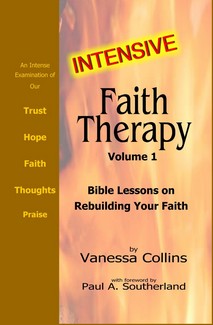
Intensive Faith Therapy
Category:
Spirituality
Publisher: Heart Thoughts Publishing
ISBN-10: 0982332505
Type: Non-Fiction
Pages: 176
Copyright: Jan 8, 2009
ISBN-13: 9780982332504
Intensive Faith Therapy - Volume 1 is a series of Bible studies written by Vanessa Collins designed to strengthen and build your faith, especially during times of trials, tribulations and afflictions.
Why Intensive Faith Therapy?
Many times we now find ourselves feeling that God has not delivered on His promises. We have believed God to the best of our abilities, yet we have not received what we have expected. As a result, our faith has been hurt and injured.
Intensive Faith Therapy - Volume 1 is a series of Bible studies designed to strengthen and build your faith, especially during times of trials, tribulations and afflictions. In this study, we will do an intense examination of our trust, hope, faith, praise and thoughts toward God. This will help our faith to grow and for us to finally see the manifestation of God in our lives like never before.
Excerpt
Chapter 10
Faith in God
Evidence of Your Faith
Now faith is the substance of things hoped for, the evidence of things not seen.
Hebrews 11:1
We will focus on the second part of our scripture today. According to the author of Hebrews, faith is the “evidence of things not seen”. It is by our faith that we stand on the promises of God, even when we do not see the actual manifestation.
In our judicial system, evidence is very important in legal matters, especially criminal and civil cases. If the system is running correctly (which, unfortunately, does not happen all the time), the party that can prove his/her case by the preponderance of evidence wins the case. The stronger your evidence, the more likely you will have a ruling in your favor.
The best evidence you can have in a courtroom is factual, tangible evidence. If you can, so to speak, produce the “smoking gun with fingerprints”, you have something that, in most cases, the judge will allow you to admit as evidence. It will be admissible in court. Admissible evidence leads directly to something else. You can trace it to a logical conclusion. You do not have to infer or guess where or to whom it points. It is direct.
Sometimes, factual evidence is not available. In this case, the lawyer may have to refer to circumstantial evidence or even hearsay. In most cases (again, where the system is running properly) one rarely
gets a major conviction based solely on circumstantial evidence. The bigger the issue, the more evidence is needed in order to get a ruling in your favor.
How does this relate to our study? Faith is the evidence of what we do not yet see. How strong is the evidence that you will receive the promises of God that you are seeking? Are you standing on strong, factual evidence or is your case weak, based on hearsay of what you think God might do?
What factual evidence do we have concerning the things of God? Our biggest “smoking gun” if you will, is the Word of God. As Christians, we believe that the Word of God is true. We also have a true and righteous judge. Psalm 96:12-13 tells us that the Lord shall judge the world with righteousness, and the people with His truth. Therefore, we can stand on the Word of God as evidence to that which we seek. God even instructs us to put Him in remembrance of His Word (Isaiah 43:26). If God says in His Word that He will do something, you can depend on that Word. In Isaiah 46:11, The Lord tells Isaiah;
…I have spoken it, I will also bring it to pass; I have purposed it, I will also do it.
The Word of God is our strongest evidence that God will do what He has promised. When this evidence is presented, a favorable ruling can be counted on.
What other evidence can we use? Lawyers often rely on the testimony of witnesses to convince the jury and judge to rule in their favor. The best witnesses are those that are credible and are basing their testimony on actual facts that they have experienced. If they can say, “I know this happened because I saw it”, your witnesses will have a great impact on the case. However, if they say that we were told that something happened but they did not actually witness it, it may be ruled as hearsay and not viewed as strongly as other testimony.
What testimony are you using to build your case and build your faith? Proverbs 14:5 tells us that a “faithful witness will not lie”. Are you listening to the witness of the “faithful” in God? You need to surround yourself by those that will give you ammunition for your case. Leave the doubters alone! You need people in your life that know that God will make a way. You will then have a faith that is strong and able to withstand the scrutiny of the courtroom of life.
|