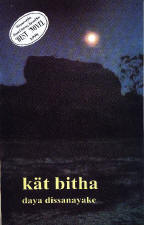
story about 5th cent. rock citadel Sigiriya, Sri Lanka
Sigiriya, Sri Lanka, proposed as eigth wonder of the world
story about the king who built it and those who visited it 5 centuries later.
Professional Reviews
Mirror on the Wall
The Mirror on the Wall
Kat bitha (The Mirror Wall) by Daya Dissanayake.
("You can criticize it as much as you like". He said as he handed the book to me. Having read it first in manuscript, and now in its printed form, I am ready for my "criticism". )
When I close my eyes and let my thoughts dwell on the novel, what first come to mind are the translations of the Sigiri graffiti. Professor Paranavithana, Professor Ashley Halpe and many others have done it before. What is new in these lines is that they are far simpler than the rest. "Plucking a flower from my mate's belt I place it before the golden hued beauty", so goes one poem. Beautiful because it is simple.
The two plots that run parallel to each other are intriguing. The first which depicts the journey of two priests from Kataragama to Anuradhapura in the 10th Century Sri Lanka, brings to mind the trip made by the Lama and Kim along the trunk road in Kipling's Kim. But what the Buddhist priest and his disciple encounter on their sojourns, is far more interesting than the words of philosophy that pore from the Lama's mouth. Interesting because they reveal a past which has hitherto been hidden by the mists of time.' So, this is how ordinary people like us would have lived many moons ago' you muse as you turn the pages, and is pleasantly shocked to realize that things had not been all that different from what they are today. There had been guides at Sigiriya to hang around the visitors! There had been stalls selling souvenirs!
If the descriptions of the lives of the guide and the monks are calm and peaceful, the story depicted on the mirror wall is its opposite. Here is James Michener and Sidney Sheldon blended in one. Here is a plot, blood curdling enough to let you keep on reading long past the normal hours of bedtime. "Blood-curdling" because of the entirely new picture presented of the past, a past which is a far cry from the usual list of events told and retold a hundred thousand times in school text books, in conventional books on history and in the run-of-the-mill historical novels. What would be far more radical than the revelation that a cross was once erected on top of Sigiriya. A cross, in a country at a time, when Buddhism was said to have ruled supreme! The aura of mystery that surrounds Kashyapa, the lack of evidence to support the facts, only leads one to think that this might indeed have happened.
But not everything is so perfect. Like e.e.cummings, daya dissanayake too seems to have an aversion to the capital letters in the English language. Coming across the simple letter "i” which he uses in place of the capital I to denote the first person, one's immediate reaction is to blame the printer. And not even after going through the entire two hundred pages does one get used to this phenomenon. The lack of capitals and the lack of the inverted comma in the conversation of some parts of the novel (he uses the hyphen instead) seem to jar the flow of the story, for the reader's attention tends to be drawn to these radical devices than to what is revealed by the words. Until he gets used to the style, which would probably come with a second reading, much of the content of the words would be missed. And this is a pity, for there is an amazing amount of historical details and philosophical musings in the novel, that deserve attention.
The simplicity of the style leads to monotony at times. Though the structure is simple, the sentences tend to get too long, and the lengthy extracts from the Culavansa which spring up unexplained in several parts of the story, might have been omitted.
"It is not a true story" writes the author at the end of the book. Yet having got close to Tiya - the young protagonist, one finishes reading the book wishing it to be true, wishing that Tiya with his family and friends had lived their humble, simple lives in exactly the way described, and wishing that Kashyapa was indeed the man that the mirror wall reveals him to have been.
(Thus ends my criticism. Yes, my father wrote the book! And I'm proud to be his first "critic".)
Aditha Dissanayake
9/27, Nuge Road
Peliyagoda
Sri Lanka
Tel – 94-1-912900
e-mail – aditha(at)eureka.lk
Tralee, Ireland. September 1948.
An arrogant, and highly agitated, priest arrives home after 40 years.
Days later he's dead. Suicide? Or did his past catch up with him?
Fifth Book of the Southern Swallow Series. Nan Ya and his crew take a final adventure into a mythical Chinese universe and become entangled in court intrigue.