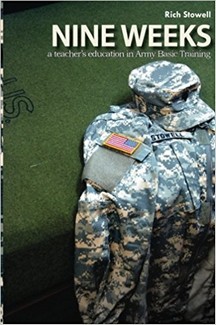
Week by week, this book describes the profundity, the solemnity, and the hilarity that is Army Basic Training.
Nine Weeks tells the honest story of Army Basic Training. Rich Stowell left his career as a high school teacher and college education professor as an enlistee in the United States Army. At the barracks of F Battery, 1/40 Field Artillery at Fort Sill Oklahoma, he trained for just over two months as a Soldier in the most powerful Army in the world.
His story is exceptional. As the oldest man in his training battery (of over 200 soldiers) and the most educated, Stowell had a unique vantage point from which to see and ponder the training regimen. He describes what it was like to live with privates who could have been his students just weeks before, and how young men are taught to fight in the most demanding atmosphere that America has ever produced Soldiers. Drawing on his experience as a professional teacher, he offers a candid assessment about the effectiveness of many components of the Basic Training Program.
Informed people ought to know how the American Soldier is made. In nine weeks-the standard timeline for an Army Basic trainee- he illustrates the process with a sophisticated insight and humor that is a novelty in military books. Funny, yet reverent; critical and honest, Stowell brings refreshing wit and wisdom to the story of how young men are gathered from around the country and molded into modern battlefield warriors. It is a trip back in time for Soldiers who have run the gauntlet of Army Basic Training. Civilians will appreciate learning Army basics-their rationale and history-from Army rank to modern battlefield tactics.
Americans of all ages and political persuasions, whether or not they have friends or family in the military, will enjoy learning about how United States Soldiers are trained.
Excerpt
While many in Wolfpack felt justified in blaming all of our misfortunes on the drill sergeants, we could have easily pinned them on a few select soldiers. One of the biggest thorns in our platoon’s proverbial side was Hamblin, the most offending narcoleptic in our CLS classes. Aside from a tragically low level of common sense and ability, he fell asleep during nearly every class, meeting, or formation. Hamblin was able to sleep while standing at attention. Perhaps because he was always unconscious when we were given critical information and instructions, he always seemed to be a step behind. A step behind at Basic Training will get you run over or thrown from the path.
Professional Reviews
ChronWatch
Rich Stowell, one of ChronWatch's longtime writers, has performed a real service to many people by writing his new book, "Nine Weeks: A Teacher's Education in Army Basic Training." The book is a godsend to young people who are considering a hitch or a full career in the armed forces. The book will show them exactly what it's like to be involved in Basic Training for the U.S. Army.
The book will also he an aid to members of the family or friends of servicemen and women, in showing them what their loved one or friend is undergoing. And it will be an interesting dose of nostalgia for service persons who have previously experienced Basic Training.
And finally, it will be of special note to teachers, for Rich Stowell is a teacher himself, who experienced Basic Training after becoming a teacher. Since Basic Training is itself an educational project in training young men and women to be soldiers, it provided Stowell with many comparisons to education, which he shares with the reader.
Rich grew up in Salt Lake City, Utah, but became a ChronWatch writer when he was a student leader at California State University East Bay (previously Hayward), where he edited a conservative college publication. After earning his teaching credential and master's degree, he taught in high school and for the University of San Francisco. However, he wanted to also serve his country, so joined the Army National Guard in 2007.
From the start, Rich kept an extensive journal of the day-to-day activities that he and his unit experienced in the nine weeks of his Basic Training. Since he is an especially good writer, his coverage of life in the barracks and in the field at Fort Sill in Oklahoma is detailed and absorbing. By this time he was 31, so the oldest (and best educated) of the men with whom he trained. The other privates with whom he trained were young enough to have been his high school students weeks before. He noted that the unit's experiences were funny, exhausting, maddening, rousing, frustrating, and above all, rewarding.
Following his basic training, Rich was deployed with the 40th Infantry Division in Kosovo, where he served as a broadcast journalist. He has now returned to the classroom, and he and his wife, Esther, have a young son, Joseph Aniefiok. They make their home in Oakland.
I found the book a fascinating and absorbing read, and I enjoyed the week-by-week details of his nine weeks of training. I recommend the book for all readers, and it also makes a good gift item for a veteran or for a young person contemplating entry into military service. The book is available on Amazon.com for $17.55.
Ekot Literary Service
Most Americans take for granted that our soldiers are well-trained. Rich Stowell’s book, Nine Weeks: A Teacher’s Education in Army Basic Training describes just what goes into that sacramental rite of soldierhood: Army Boot Camp.
The author was in a good position to analyze and explain, too. He had left his teaching assignment to join the Army, and immediately saw similarities and differences between the drill sergeants’ ways and his own.
Nine Weeks is, above all, informative. How the Army trains so many kids and so quickly is an amazing thing to contemplate. That these young soldiers learn hand to hand combat, medic skills, marksmanship, and all manner of advanced weaponry is remarkable.
Yet it seems frustrating, too. Stowell candidly broaches a broad swath of emotions that most soldiers must feel. They weren’t allowed to talk to family members but once every two weeks or so. They couldn’t question or complain openly, and they were routinely punished as a group for the sins of a few.
“Abuse took two forms,” Stowell writes in Week 4, “physical and mental. Physically, the PT sessions were very trying for me. I was 11 years older than the average private in our battery, and recovery time seemed to correspond with age. I was a full-time athlete in high school, and a recreational athlete since, and I always considered myself able to handle any reasonable amount of physical activity. Drill sergeants were eager to prove otherwise, and they relished the opportunity to break us. Creative and punishing workouts were devised and both Jackson and Robertson vied for the reputation of giving the toughest, engaging in a showmanship that broke the mind, spirit and body. What they failed to achieve in intensity they made up for in duration.”
The book was also funny, the humor coming from the reality and authenticity of the “characters” in his platoon. From the drill sergeants: mean and tough; to some of the younger privates, who were innocent and good hearted; the people in his basic training added to the fun. Stowell recounts the story of Vadney, who fell asleep while standing during a formal inspection. Despite having landed in a bunk, injuring his eye, he was ridiculed on the spot. The platoon didn’t pass the inspection.
The author and protagonist is a deeply sympathetic character. He is well educated and has an interesting perspective, but he is also extremely self-critical, pointing out how the grueling basic training regimen exposed some of his own flaws and weaknesses.
Now at a reduced price, and available in Kindle for under $10, Nine Weeks: A Teacher’s Education in Army Basic Training is well worth the money.
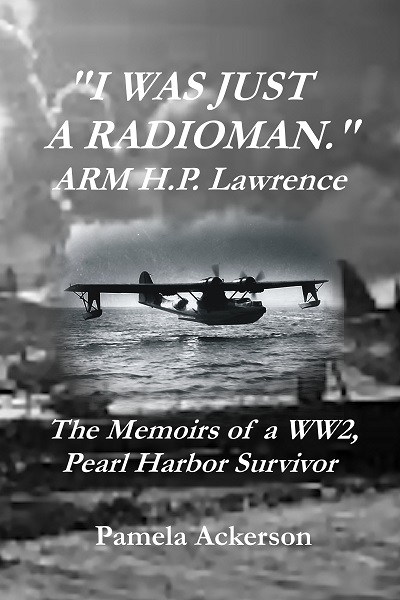
This is not a drill. The attack on Pearl. They were the ghost planes of the night, deadly, illusive, sharp-clawed Black Cats. The Memoirs of ARM H.P. Lawrence, a Pearl Harbor survivor, Black Cat, and decorated war veteran.