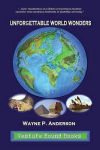
Vivid recollections of a lifetime of traveling to fourteen countries' most wondrous landmarks of yesterday and today.
Where Have You Been? People Still Keep Asking Me.
I have some difficulty believing the series of events that led to the writing of this book, Experiencing World Wonders, which covers forty-five world wonders in fourteen major countries.
When I was a kid in Jamestown, North Dakota, my family lived on the side of town with outdoor toilets, a pump for water and a kerosene lamp for light.I dreamed that someday I might eventually be lucky enough to take a trip to Fargo.To my surprise I have been able to travel to fifty-seven countries.
At ten, I dreamed that I might be lucky enough to grow up to be a crane operator for the railroad, like my older brother.To my surprise I became a psychology professor for thirty-two years at the University of Missouri-Columbia.
With my wife Carla and our four children along, on sabbaticals I taught for the air force one year in Germany, one year in England, six months in the Netherlands, and three months each in Italy and Spain. On long weekends and two weeks between assignments that each lasted three months, we really explored each countries' attractions. I also lived for three months in Mexico.
One day we did hear our third-grader complain, "You are ruining my life by taking me away from all my friends back home," but most of the time they were happy and valued what they had learned, especially as they got older.
Carla, an English teacher and then a psychologist in private practice for twenty-four years, was able to join me on professional tours for psychologists that explored Russia, Japan, Thailand and Hong Kong.We have also been able to take many Road Scholar programs and vacation trips.
After I retired in 1995, I was a volunteer for fifteen years with the International Center for Psychosocial Trauma, training teachers, physicians and mental health workers in or near trauma zones: Egypt, Bosnia, Pakistan, Kosovo and Shi Lanka. I wrote articles for the Columbia Tribune about the struggles facing the people--some really difficult spots at times, but some time was available to explore the wonders of Egypt.
When I wrote a family letter in 1998 about a safari trip to Kenya and Tanzania, a colleague commented that I should take it to the Tribune.When I did, the travel editor exclaimed, "Where have you been?Will you write a regular travel column for us?"So I've done that every week since then, and relatives, friends and strangers have regularly asked, "Where have you been lately?"I continue to be a curious kid who takes advantage of opportunities that sound interesting--and so often end with surprises.
Most of the stories in this book on world wonders were written for the Tribune.This book is part of a series called Venture Bound Books, which you can find listed on the back cover.
Excerpt
TRAVELERS PECKING ORDER
Seasoned travelers are interested in collecting sights and unusual experiences. When they get together, they often play a game of one-upmanship, but the rules vary. In some groups the person who has traveled to the most unusual place or had the rarest experience wins.
In one group of Brits I traveled with, the winner was the man who had gone to Timbuktu, mainly because at the time you had to ride a camel over the desert to get there. Rarity counts for points--if you have been to Antarctica or Tigers Nest Monastery, in Bhutan you get additional respect as a traveler. Having seen the Eiffel Tower or the Grand Canyon doesn't do as much for your status as a world traveler.
The honor also can go to the person who has been in the most dangerous place or been to the most places. One of my readers called to comment on a story and mentioned that she had been to 148 countries. That wins the most-traveled award in any group I’ve been around.
Many travelers would disagree with some of the above lists' rankings because of individual tastes and interests. Some of the most astonishing sights I have seen are not on the top one hundred lists. For example, the catacombs of Palermo, Sicily, are spooky underground passages with eight thousand mummified dead, dressed in their best, awaiting the second coming of Christ. It’s certainly a more memorable and thrilling experience than many of the items I have seen on lists.
Some sights I would have placed higher on the most lists I have seen. The Ajanta and Ellora caves in India that were carved into a hillside of solid stone by Buddhist monks two thousand years ago, don't even make the top one hundred on most lists.
Some travel experiences are so personal and unexpected that although they would never make a public list of the most important, they still replace many of the highly placed items in the mind of the person who experienced them. The Good Friday experience I had in a small village in Spain, where I watched a re-enactment of the Stations of the Cross, was more powerful and memorable to me than when I saw the pyramids.
Some of the highest-ranked destinations such as the pyramids might not be as impressive in person because they can’t live up to their tremendous publicity. The smaller, more personal experiences are novel, and you bring no expectations.
In any case, any one of the above lists of the wonders of the world is a good starting point for finding the most interesting and significant destinations.
As I mentioned above I have seen sixty of the top one hundred of some lists and many on lists of one thousand places to see. Some of these sites I have discussed in other books, and in this book I say nothing about those I visited in India and only a few of those I have seen when I lived in Europe.
Professional Reviews
Anderson's latest is a travel wonder
Review: Anderson's latest is a travel wonder
By DON CULLIMORE
Review: Anderson's latest is a travel wonder DON CULLIMORE
Sunday, June 5, 2016 Columbia Daily Tribune
Reading Wayne Anderson’s latest book, “Unforgettable World Wonders,” is to undertake a marvelous armchair adventure perhaps akin to Phileas Fogg’s literary journey “Around the World in 80 Days” in Jules Verne’s epic 1873 novel.
Anderson’s latest omnibus of his world travels over the past 20 years is filled with tales of unique historic sites, of natural and manmade wonders, of bizarre behavior — both human and animal — and much more.
The book covers 45 world wonders in 14 countries. It is a travelogue that gives readers the bonus of reportage and essay through the eyes of a professional trained in observation of the social order and possessed of the insights of a traveler who has been to 64 countries and six continents.
Anderson’s long academic career as a psychologist gives him a unique perspective from which to view the world, its many and exceptional places and myriad peoples and to write about them in an entertaining and educational way. And the storied stoic nature of his Scandinavian heritage might account for the delightful, wry sense of humor with which he salts his many stories.
This latest of a growing number of fine travel books from Anderson (some co-authored with his wife, Carla, also a psychologist), takes readers along on an African safari in Kenya and Tanzania and contact with the Maasi culture; into the vast outback of Australia with its strange animals and the Great Barrier Reef; to Egypt and its celebrated pyramids and temples along the Nile; China and its Great Wall, the Forbidden City and Tiananmen Square; Israel and Jerusalem’s holy sites; the Bosporus Strait to visit Istanbul, Turkey; to the beautiful city of Kyoto, which served as the Imperial capital of Japan for more than 1,000 years; and exotic Thailand in Southeast Asia.
Anderson describes a fascinating experience during the African safari, when he and his wife witnessed a cheetah making a kill: “Her eyes were focused on a young Thomson’s gazelle. Still over a hundred yards from her prey she made her move. When she propelled herself forward, we were told she was doing sixty miles per hour within three seconds ... The baby ‘tommie’ tried avoidance moves but had her rear feet knocked out from under her and jaws clamped around her windpipe.”
He notes another unusual experience in Sydney, Australia: “We also saw the spectacularly weird platypus. It has the beak and webbed feet of a duck with a beaver-like body and lays eggs like a reptile, but it provides milk for its offspring by oozing it from pores ... We came away from Australia with a strong awareness of how environment shapes animal characteristics and the steps nature takes to ensure survival.”
And on a visit to the Galapagos Islands, 620 miles off the coast of Ecuador: “We saw flamingos, waved albatross and penguins different from those that exist anywhere else in the world. There were three distinct kinds of boobies,” or seabirds, “and thousands of the masked boobies were nesting on the rough lava surface.”
Anderson also takes his readers west to Europe, with visits to Norway, from where his ancestors came to the United States in the 19th century; to the magnificent Niagra Falls; Niagara-on-the-Lake in Ontario and its long popular theatrical festival celebrating the writings of noted Irish playwright George Bernard Shaw; to the colorfully dressed native peoples of Peru, the High Andes and the ancient Inca Ruins of Mache Picchu, a World Heritage Site.
These marvelous adventures are a collection of Anderson’s columns written for the Tribune over a two-decade period. It is a rich compilation of well-written and informative travel literature.
For those of us who enjoy the world of vicarious adventure to be found in good books, Wayne Anderson’s latest offering provides an excellent antidote to the days when we cannot be “on the road.”
Don Cullimore is a Fayette-based writer and editor of Boone’s Lick Heritage Quarterly.
Perfect for fans of Bill Bryson, Elizabeth Gilbert, and Cheryl Strayed, this is more than a travelogue—it's a hilarious and heartfelt journey for anyone who has ever wondered: "Is this it?"