Category: Family Publisher: AKA-Publishing
ISBN-10: 9781936688
Type: Non-Fiction
Pages: 210
Copyright: January 2014
ISBN-13: 9781936688807
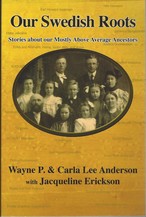
Millions of us are descendents of the great influx of northern Europeans between 1860 and 1920, and know little about why they cam and what conditions were like here. This book will serve as a substitute history for many people because the conditions that caused them to come and the conditons they faced here were very similar.
INTRODUCTION
"Gee, I wish I'd asked Grandma more about our family's history when she was alive." How often people lament about how little they know about their family's history.
All three of us wondered what life was like in Sweden in the 1890s.How did our ancestral family get here?How did they adjust to the conditions in the Midwest back then?What could we learn from exploring our heritage that might be helpful, not only to us and our living relatives, but also to others who are interested in exploring their heritage?
We were full of questions. What kind of abilities and talents were in our ancestors' genes that they have passed on to their descendents?How were they influenced by their culture and what values did they pass down?What kinds of risks did they take to improve their lives? What can descendents learn from the stories that have been passed down?
In Part One we follow Johannes and Erika as they move from Sweden to Callender, Iowa, a small town twenty miles from Fort Dodge.Other family members who had arrived earlier were living about seven miles away in Gowrie and helped them with the transition. After Johannes and Erika moved to Minnesota, we have many detailed descriptions of what life was like from their daughter Lily Fager and their grandson Lloyd Isaacson.
In Part Two we follow each of Johannes' and Erika's children as they raised their families in different parts of the country.We became aware of certain characteristics that seem to have been passed on in unusually high numbers, for example, artistic talent, athletic ability with especially good reflexes, storytelling talent and longevity.
In Part Three we have incorporated material from Birgitta Nilsson, a cousin in Sweden, whose great grandfather was Erika's brother.Birgitta came to a family reunion in North Dakota and invited us to a family reunion in Sweden, which 25 of us managed to attend.We met our cousins who had remained in the area and were able to visit some of the houses, schools, and churches connected with our ancestors.
Part Three also includes Wayne's travel articles based on our drive around Sweden that werepublished in the Columbia Daily Tribune, where he has written a weekly column since his retirement in 1995.The intent of Part Three is to describe the Swedish culture and the influence the Swedes have had in the world.
Professional Reviews
Our Swedish Roots
(This is the English translation of the review of "Our Swedish Roots" that appeared in the Swedish magazine "Kuallsslunden" which Lars Sonnergren sent us. He apologized that he was not a formal translator, but he wanted us to understand what he had published in Swedish. )
Americans searching Swedish roots
by Lars Sonnergren
What made our families leave Sweden in the 19th century? What became of them in the new country? The destiny of a Swedish-American family has now become an interesting book.
It is Wayne P. Anderson, his wife Carla Lee Anderson and the wife's sister Jacqueline Erickson, who together have written "Our Swedish Roots." They started with the couple Johannes and Erika Nilsdotter Anderson, who more than one hundred years ago left a Swedish farm in Jaringsholm in Skanes Fagerhult for a better life in their Swedish words, "I norra Amerika."
It was easy for the authors to choose whom to start with because the emigrant couple was Wayne's grandparents and Wayne's father was a younger brother to the grandmother of Carla and Jacqueline. By destiny Wayne and Carla Lee later met in college where they fell in love and married December 22th 1952. They now have four daughters and six grandchildren.
There are many threads and destinies to keep in mind, but this book is easy to read because the authors mostly write about people's stories, not only how the individuals are related. Jacqueline did the research about the family tree, which will make the book useful for generations to come. She found old letters and photos. Wayne and Carla share their and other's family members memories. A story of her life written by the youngest daughter of the emigrants, Lilly, is also in the book. Johannes was born 1849 and his wife to be Erika was born in 1856.
A future in America
The couple married 1879. After having five children they realized it was not possible to support a family in the Skane countryside. According to Wayne P Anderson two main reasons caused people to leave Sweden during the second half of the 19th century: it was hard to support a family and the Swedish church had very firm attitudes that limited the freedom of people to think for themselves. It didn't help that Swedish society was not equal.
When Johannes got a letter from relatives, who had already emigrated, saying they were ready to pay his trip over the Atlantic, he took the chance. On a farm near the village of Callender in Webster County in Iowa he could work to pay the cost for the ticket. After one and a half year Johannes had earned enough he could ask his wife Erika and the five children to come.
Erika had not seen her husband for 18 months, so she wanted to look pretty when she was going to meet him at the railway station in the small village. Erika, 35 years old with five children all moving around her on a fast running train the year of 1891, tried to do as much as she could. She dressed herself in her nicest scarf with a red rose and tied a beautiful ribbon around her hair. However, at the railway station wasn't her beloved Johannes waiting, but his employer--and that man, out of religious grounds, did not think women should dress up. He made her to take away the beautiful extra dressing. She arrived at the farm from faraway Sweden, with a house waiting for her in Iowa only a dirt floor. But it was true love. Some years later five more children had been born.
Bought a farm
By 1904 the family had earned so much money they could buy a farm near Stanchfield, Isanti County, Minnesota. If you are looking for photos on Internet of Stanchfield, you will find many nice houses and a Sweden-like country side. It was when this writer looked for ancestors on Internet I made contact with Wayne P. Anderson--but we are not related.
Johannes was hardworking many until a day in 1919 when he fell off a hay wagon. In our days he would have been brought to hospital, but they took him inside the house to his bed. He stayed there and become an invalid. He did not leave his bed before his death ten years later. But family celebrated Christmas and Thanksgiving in his room so he could feel he was part of the family. And outside home his grandchildren were his eyes and ears. His wife Erika died three years later after his death in an age of 77 years.
This book has many personal stories but when reading you don't feel them as private stories. Maybe because Wayne and Carla are both educated in psychology and know how to meaningfully relate a person's life. Wayne found work as a professor at the University of Missouri in Columbia, Missouri. Now as emeritus he writes for the Columbia daily Tribune about places one should visit in the US. Carla for many years had a private clinic.
Wayne is born 1929. His father lost his farm during depression. When Wayne started working as a psychologist he often had headache after meeting and treating boys with bad behavior. Wayne later found out it had to do with himself because a youngster he often lost temper when dealing with his father, who had had a stroke. Wayne had to support mother and a younger brother at 17.
The book is not only idyllic, it is also a tale about the hard manual farming work for surviving before the wave of modern farming machines come. A Swede at certain age can find himself at home in many stories from the "Swedish" state in the Middle West. Many memories come to one's mind.
That has also been the case in America when the authors have opened their treasury of family memories. Reading some of the stories has made tears to fall. Up until now they have given their book to round about 300 relatives. In total they believe Johannes and Erika now have more than 600 descendents in the US.
Meeting in Sweden
At a family gathering in North Dakota some years ago they met Birgitta Nilsson from Sweden, whose ancestor was the brother of Erika. And eight years ago 25 Americans took the trip home to the old country. They met some 40 Swedes they were related to in and around the part of Skane where Johannes and Erika once lived.
Wayne of course wrote about this visit to the families home country for the Columbia Daily Tribune told readers how life in the old country, modern Sweden, in nowadays. And finally, all what the authors had found out about their relatives became a book, which name you already know.
It's almost Christmas. Lynn Basil is writing her last book about a secret entrance into the magical doll land of Sha Bebe that she loves so much. Bagannos have taken over the world! Lynn finally meets her dolls in real life. Can she write in a Secret
A wicked Cajun Fairy named Robes Pierre entered the impenetrable Magical doll land of Sha Bebe. Queen Faustina, the ruler of the doll land, thought she had destroyed him, but he's back! Will the doll land survive his evil ways?