
Kindle Edition
Download to your Nook (eBook)
Amazon
Barnes & Noble.com
The Art of Adventure
Amazon
Barnes & Noble
Category:
Action/Thriller
Publisher: Turning Heads
Type: Fiction
Pages: 294
Copyright: 2007
ISBN-13: 9780615623887
Price: $3.99 (eBook)
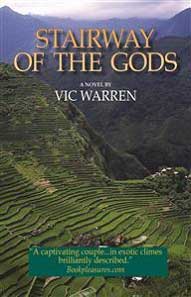
Stairway of the Gods takes readers on a magical journey to the Philippines and the heartland of
its people in the Cordillera Mountains. Warren’s tale of skullduggery unfolds on the slopes of the
Banaue rice terraces when Paul and Joan Webster are trapped in the village after an earthquake. Paul is hospitalized and Joan is left alone to protect one of the most important discoveries of the Twentieth Century—a treasure of gold and precious artifacts hidden in a cave during World War II—that some would kill for.
Buried treasure, high adventure and romance. These are the key ingredients that make Vic Warren’s novel, Stairway of the Gods, a page turner.
Explorers and treasure hunters have speculated on whether the story of World War II Japanese officer, General Tomoyuki Yamashita’s buried treasure in the Philippines, is myth or truth. Warren takes this premise and turns it into riveting fiction. His main characters are peppered with Bogie and Bacall-ish style, while his other characters are a reflection of the local culture.
“Many of the characters in the book are like the Filipino people I have been close to all my life—warm and hospitable—with a deep sense of camaraderie for their neighbors,” said Warren. “I have many friends in the Filipino community who I have seen help their neighbors when they are in need.”
Excerpt
5. BANAUE
The big car rolled to a stop, its tires crackling in the gravel. Rudy turned off the key and set the parking brake. “Mum, sir, it’s Banaue. We’re here.”
Paul looked out the window. It was still raining, pounding hard on the sidewalk next to the car. There was a polite knock at the car door, and then the door was opened. Two tiny young women welcomed them out of the car and under the giant umbrellas they were carrying. They wore modern versions of the tapis, the long Ifugao women’s skirt, in narrow stripes of red, yellow, green and black. “Welcome, ma’am. Welcome, sir. We’re so glad you had no trouble with the road and the rain. We were starting to worry when it grew dark.”
The rain thundered on the umbrellas and poured off their edges like spillways of a fountain as they were led up the thick plank steps and under the broad eaves of the Banaue Terrace Hotel. It was a long, low, modern structure built at one end of town on the edge of the plateau. It was simply but strikingly built of wood and stone. The broad, open-beamed lobby was dominated by a large stone fireplace crackling with pine logs. The polished wood floor gleamed in the flickering light of the fire.
Their hostesses asked them to be seated in wide, comfortable chairs near the fire. A tray with cold bottles of San Miguel Beer and baskets of pork rinds and peanut crackers arrived. The concierge brought them check-in forms to fill out, but please, no hurry. After they had rested a while would be fine. It was only a formality. He strutted off, his elbows flapping like a banty rooster’s wings.
They finished their beers and filled out the forms. As they rose to take them to the reservations counter, the concierge came bustling back to them. Thanking them for troubling themselves with the forms, he assured them that their room was ready, and their luggage was already in the room. Rudy was in his room having his dinner. The dining room was available for their dinner, or it would be happily served in their room, whichever they chose. They were to think of the hotel as their home while they were here in Banaue. After all, they were almost the only guests right now. No one comes to Banaue during the rainy season. It is the worst time. But, please, no offense was intended. They were here at last, and they were welcome to stay as long as they wished.
Should they need anything at all, they need only to ask. If they needed more towels, the answer would be Yes. A magazine or a book, Yes. If a massage was desired, Yes again. Whatever they were to ask him, his answer would be Yes.
As they walked down the hall to their room, Paul laughed, “What a character for my notebook! The concierge of concierges. The ultimate yes-man.” Joan giggled and put her hand over his mouth. They had a light supper in their room, climbed between the goose down comforters on their king-sized bed, and read themselves to sleep.
* * *
“Joan, wake up! Look where we are!” Paul pulled the drapes back from the wide, floor-to-ceiling window in their room. The morning sun streamed in. He opened the sliding glass door and stepped out onto their narrow balcony. Joan slipped on her robe and followed him.
Stretching out below them the steep ravines and flanks of a dozen mountains were covered with huge steps--”the stairways of the gods,” as the Ifugao called them—the Banaue rice terraces. The sun, rising beyond the mountains, reflected in the water-filled terraces, turning them brilliant gold.
Paul had read the story of the rice terraces, begun by Ifugao ancestors more than 2,000 years ago and now reaching thousands of feet up many of the mountains throughout the Cordillera. Of them all, those at Banaue were said to be the most spectacular. He had seen photos of this eighth wonder of the world, layer after layer of stone and clay dikes, each thirty to a hundred feet tall, sculpted around the mountainside and meticulously planned with brooks and canals running from top to bottom, irrigating all the paddies. Flat stones protruding from the walls provided steps for climbing up and down the dikes. There were other renowned structures, like the Great Wall of China and the pyramids of Egypt and Mexico, but they had been built with forced labor and much grief and death. The rice terraces were a living, growing collaboration developed by a community over thousands of years, structures built with simple hand tools and a rare vision for the common good.
Nothing he had read or seen had prepared him for this sight. A thousand feet below, he could make out the tiny specks of people working in their fields. He put his arm around Joan. “In all of those dictionaries, there’s not one word to describe this.” She smiled and hugged him back.
They took breakfast on the hotel’s covered terrace, offering them another spectacular view of the mountains and their amazing constructions. The sun was higher now, and the terraces glowed with the unimaginably bright green of young rice shoots, especially vivid against the dark rock of the terrace walls and the mountain faces themselves.
Their waiter returned to pour more coffee and handed Joan a small piece of paper. “Excuse me, but there is someone of importance in our lobby. He would like to pay his respects.”
Joan looked at the paper. Neatly printed on it was: Teopisto Gumangan, Mayor, Banaue, Ifugao, Republic of the Philippines. “Please,” she said to waiter. “Show him to our table. We’d be honored.” As the waiter left, she whispered to Paul, “It’s obvious that the senator’s been at work for us. It’s the Mayor of Banaue.”
Across the room a group of half a dozen Ifugao men approached them. They wore Western style slacks and sport shirts open at the collar, the tails hanging outside the pants. They were all small, brown men with lined, open faces. As Paul started to get up from his chair, the leader extended his hand and said, “Please, do not disturb yourself. I am Teopisto Gumangan, mayor of Banaue. We are honored by your visit.” He shook hands with Joan, then Paul. “Please call me Teo. And allow me to introduce my deputies of health, finance, education, administration and security.”
He pronounced the word, “finance,” as if it started with a “p.” There is no “f” sound in the Ifugao language, Paul remembered. They pronounce the name for themselves as “Ipugao.”
Grinning with enthusiasm, the five men each shook hands with Joan and Paul, then pulled up nearby chairs, forming something of a circle around them. Coffee was served, and each man added sugar, normally two or three spoons. Paul watched as the deputy of security added six, then stirred the coffee carefully. His name was Valerio Pawid, and he seemed to be the oldest of the six. Paul had noticed that the others treated him with some deference, calling him Lakay Pawid, a term reserved for elders. He was the first of the deputies to shake hands and the first to sit. His face and hands were no more brown than the others, but the creases were deeper, the texture of the skin rougher, the stoop of his back slightly more noticeable.
The mayor was quizzing Joan on their itinerary, “And I am sure you would like to visit some of the nearby villages? If the weather allows, you must go to Batad. I have an aunt there, and there are several families with items handed down for many generations. They will be happy to loan them for your exhibition, I am sure. The mountains may be dangerous to some, but with our help, we intend to keep you safe. And if you visit Batad, you must see Cambulo and Patpat. Luis, here, has a cousin in Patpat....”
So Joan had hit the jackpot. Her plans had intrigued Boy and Vicky. Boy had made a few phone calls, to all the right people in Baguio and Banaue. Every one of these men had relatives throughout Ifugao. And each was anxious for his family to arrange for the loan of finer items than the next.
“The rain, it usually comes in the afternoon and evening,” Teo continued. “Today, we will introduce you to the people here in Banaue--our friends and families. Tomorrow morning, if you’d like, you’ll be taken on a tour of the rice terraces. Then, the next day, you’ll visit Batad.” He pushed his chair back and stood up. “Now, we must go and make the arrangements. Someone will call for you after lunch. Wear simple clothing.” Joan and Paul shook hands again with the six of them, and, with many smiles and bows, they left.
Paul looked at Joan and smiled, “I’m exhausted. And we haven’t even met their wives yet.”
* * *
That afternoon about two, the deputy mayors of health and finance called for them. When they reached the front door of the hotel, the girls who had welcomed them the night before presented them with a pair of heavy-duty umbrellas. They began skirting the mud puddles on the road through Banaue, and Mariano (Sonny) Lumauig and Eduardo (Duarding) Meimban pointed out highlights of the little town. They passed the post office and the municipal hall, a square, two-story clapboard building. Above the second-floor windows and centered on the building’s facade three-foot-high letters announced, “BANAUE MUNICIPAL HALL.” A short way farther north was the Good Shepherd Clinic, a Protestant mission establishment and the only source of health care for miles. Beyond that, the Tourist Information Center, closed now during the rainy season. Just ahead was the town’s market.
“We will meet the mayor at his family’s home,” said Duarding, and they turned off the road and started down a much traveled footpath. A hundred yards down the path they came to a traditional Ifugao house. It was raised four feet off the ground by four corner timbers with barrier blocks, designed to keep rats from climbing faurther. The four-sided, thatched roof looked like a large pyramid extending beyond the windowless wooden walls nearly to the level of the floor. Woven openwork baskets that looked something like tea cozies or large bells hung from the floor of the house; each one was a safe haven for a family chicken during the night. As they ducked under the eave, Paul saw that a wooden ladder reached from the dark doorway down to the ground. At Sonny’s smiling invitation, Joan climbed the ladder, and Paul followed. Next to the door, prominently displayed, was the skull of a pig, sacrificed for the health and safety of those living in the house.
As Paul entered the house, the mayor appeared, smiling and shaking his hand, “Welcome to our home. Please, sit.” He motioned to a space to Joan and Paul’s left. Paul sat down cross-legged on woven mats and glanced at Joan. She was enthralled by everything around her, and hardly noticed him. Paul rubbed his eyes, burning slightly from the smoke in the air, and counted thirteen, no, fourteen other people in the large, central room. Some of them also sat cross-legged, but many of them bent, their legs and feet jackknifed into a low, squatting position. Sonny and Duarding had followed them in and were seated on either side of Joan and Paul.
“Welcome, all,” began the mayor. “We are privileged to have so many people whom we respect in our home. And we are pleased to take this opportunity to welcome Paul and Joan Webster to our community. We are honored by this visit, and we wish to celebrate it with our oldest tapuy.”
The elderly woman next to Teo handed him a large, Chinese porcelain jar, beautifully painted with chrysanthemums and dragons. It had a lid and handles woven of split rattan peel. Duarding leaned close to Paul and whispered, “That’s Teo’s mother with the tapuy. Tapuy is rice wine. This tapuy is the finest, made from rice harvested at the full moon, boiled, then stored with a little sugar in an earthenware pot. Teo’s family has used that jar for hundreds of years.”
As Teo and his mother proceeded with the ritual of opening the tapuy, blessing the carved wooden dipper and preparing the cups for their guests, Paul examined the house, now that his eyes had adjusted to the dim light and the smoke.
The high, slanted ceiling formed a peak at the center of the roof. A framework of four tie beams and a central cross-beam supported two queenposts that rose to either side of the smokehole at the peak. It was designed to suck out the smoke from the smudgy fire that burned slowly, banked back in the fireplace below, but the air in the house was thick with smoke. On each wall, two or three rows of heavy shelves ran the length of the room. Across the room from him, one of the shelves was supported by two tall wooden figures, simply but elegantly carved with lances and shields. Another shelf was held by the skull and horns of a carabao, and two shelves had rows of animals--dogs, pigs, carabaos--carved on the undersides of the shelves, their snouts, horns and tails serving as hangers for clothing and baskets. On the shelves were wooden storage boxes and baskets holding the family’s household items. Paul knew that this traditional home was full of the kinds of things that Joan had come to collect. Teo tasted the wine, swirled it around in his mouth like a wine steward at a three-star restaurant, swallowed, and grinned with delight at all. “It is a fine wine, and I am proud to pour it for our guests.”
Duarding leaned over and said, “The wine ages at least six months. But until it is tasted, there is no way of knowing if it is sweet and good, or sour and undrinkable.”
Cups were filled, passed around, and lifted. Teo raised his highest of all and said, “Let us all drink to the good fortune of our visitors.”
The wine was smooth and sweeter than sake. Everyone drank, and the house was filled with conversation and laughter. Teo was a good host; he made sure that everyone’s cup stayed full. He took Joan over to meet his mother and seated her in his spot so they could talk. Sonny laughed and elbowed Paul. “Your wife sits in the mayor’s place. That is an honor reserved for special people only. I think you are married to an important one, eh?”
“It’s as he says,” said the deputy mayor of security, squatting down on his haunches in front of them.
“Lakay Pawid,” said Sonny, raising his cup, “to your health, and your family’s also.” The three men sipped their wine.
“Mr. Webster...”
“Paul.”
“Paul, tomorrow morning, if you will be ready early, I would find pleasure in taking you and your wife to the rice terraces.”
“That would be great, Lakay Pawid...”
“Please, call me Val.”
“Somehow Val doesn’t seem respectful of your status.”
“My status with my own people is as old as the terraces. With you and Joan, well, all new things from the outside world are not necessarily bad.” He stood up. “Oh, and tomorrow morning, wear clothes suitable for climbing.” He joined the mayor for a minute, then left the house.
* * *
The next morning was brilliantly clear. Paul scooped a spoonful of soft white flesh from the strange grayish fruit in his dish. It was called atis, or custard apple, and it looked something like a hand grenade. “Honey, taste this,” he said, offering Joan a spoonful.
She smacked her lips. “Oh, that’s good! But you know me. I can’t pass up a really good papaya. And this one is perfect!” she said, squeezing more lime onto it.
The sun had risen far enough to reach the terraces at the bottom of the valley. With the heat of the sun, mist began to rise from them. The air seemed filled with magic. They ate their breakfast, then, just as they finished their second cup of coffee, Val arrived. He wore a short-sleeved white shirt as he had the day before, but this morning, instead of slacks, he wore a traditional Ifugao man’s G-string. The long strip of woven cotton was held in place by a narrow sash. Its wide stripes of red and black were accented with yellow and white. The long fringe in front and back hung nearly to his knees. His legs and feet were bare.
“Good morning,” he said. “I trust you slept well? You must excuse my appearance today, but I have climbed the terraces for so many years that I cannot get used to your Western pants and shoes when I am out there.”
“You certainly don’t need to apologize,” said Joan, getting up from her chair. “We feel fortunate that someone with your knowledge is willing to entertain a couple of tourists.”
Paul excused himself and returned to their room to get his daypack and camera. When he rejoined them in the lobby, Val stopped at the front door and picked up a large, woven bamboo backpack. He slipped it onto his back. “I have packed a few things, in case we are hungry later.”
They walked north on the road for a short distance, then Val turned onto a path leading east, toward the terraces. “Before we reach the terraces, I will show you the source of our name,” he said, stopping in front of a small version of an Ifugao house. He opened the door and led them inside. “This is an Ifugao granary,” he said. In the dim light, Paul could see that the building was filled with all manner of baskets, piled high in neat rows.
Val removed the lid from one of the baskets and reached in. He held out his hand to Paul and Joan and dropped a few large grains of white rice into their hands. “This is ipugo,” he said. “It means, ‘from the hills,’ and it is the rice we prefer above all others. It has nourished us for centuries, and it is the word we call ourselves.”
Several small carved figures stood here and there in the granary. They were human figures, either standing or sitting with their knees up and their arms crossed on their knees. “And these?” Joan asked.
“Those are bulul. They protect our rice, and help ensure that the next harvest will be successful. Certain bulul have special powers which can even miraculously multiply the rice after it is stored in the granary.” Val stepped to the side wall and gently stroked the arm of one of the figures. “This one has been in my family’s granary since my grandfather was young.”
He led them outside and secured the door. “Bulul are carved only from narra wood. They are always carved in pairs, a male and a female. And the rituals that accompany their carving are elaborate and expensive. Not every Ifugao family can afford to honor them and receive their protection.”
“Will there be any way to borrow some of the bulul for our exhibit?” asked Joan.
“I’m sure there will be those who will be happy to share them.”
They continued down the trail to the edge of the uppermost terrace on this slope, turned south and skirted it to its farthest edge. The wall of the terrace jutted out about 20 feet, then curved north to parallel the mountain slope. Val led them out the narrow path worn into the top of the wall. On the left, the glassy surface of the rice paddy was a foot lower than the path. To their right was a nearly sheer drop of seventy or eighty feet to the next terrace below.
Val stopped and pointed down the mountain. Joan joined him, shielding her eyes from the morning sun, as Paul snapped their photo. “This is payon di a-ammod, the fields of our ancestors. Down there you see people working,” he pointed several terraces below them. “We will climb down, and you will see what they are doing.” He started along the path, then paused and turned to Joan, “This is something you wish to do? I understand that these heights can be frightening.”
Joan looked back at Paul, and he nodded. “No, Val. It’s all right. I know I’m nervous, but it’s fascinating. We’ll be careful.”
They started down the steps built into the terrace wall. Paul marveled at the way the wall was built. The large stones were placed so perfectly that the wall was nearly smooth except for the flat rocks protruding as steps. A mortar of clay held the entire construction together. They reached the base of the wall, followed the path around the next terrace level and started down again. He looked ahead, past Joan, at their guide. Val’s bare feet were so accustomed to climbing these rocky walls they had become nearly prehensile. They curved and grasped, adjusting to the terrain met with each step. His legs were slightly bowed and, even at his age, looked strong and powerful.
At the fifth level, they stopped for a rest. The sun was warm on their faces and the still water in the paddy calmed him. A small carp swam by, its back disturbing the glassy surface.
“What is that shrub growing on some of the walls?” asked Joan.
“It is called dongla,” answered Val. He squatted down, opened a small woven pouch on his sash and pulled out a short pipe and tobacco. “In Manila, they call it tea plant. It is sacred to the Ifugao. Its roots strengthen the terrace walls, and its red leaves are used in the headdresses of our warriors during the Himong, the war dance ceremony.”
“Speaking of war dances,” asked Paul, “how long ago did the Ifugao stop hunting heads?”
“They still do,” answered Val, tamping the tobacco into the pipe’s bowl. “It’s true that once head hunting was a common occurrence and an everyday part of our men’s lives. Today, we have learned to live in peace with the other highland tribes, but there are still occasions when outrage demands retribution.”
“What kind of occasion could that be?” exclaimed Joan.
Val lit his pipe and puffed on it silently for a moment. “In 1977, an Ifugao youth was hit and killed by a bus. The village council decided that the bus driver or a member of his family must die, and soon after that a member of the village took the driver’s head. Only two or three years ago, several Ifugao passengers died in another bus accident. The relatives of the dead sharpened their head axes when the bus company failed to admit any fault. As a result, no bus driver would enter Ifugao territory, and local jeepneys were the only transportation available until the bus company finally made reparation for the deaths.”
It was a simple, terrible system. An eye for an eye, a death for a death. But somehow, sitting here on this silent mountainside, Paul could understand the reasoning behind this kind of law that Val was talking about. It was far removed from the courts and attorneys and penal codes of the States, but even here they had plea bargaining. Taking a head in revenge was all wrapped up in loss of face, not just loss of life. The bus company admitted responsibility for the accident rather than lose a driver. Paul had read that in recent years, differences like this were often settled with the payment of carabao or pigs.
Far down the mountain, he could see three carabao being driven across a paddy, their hooves turning and plowing the rice stalks into the muddy soil. The beasts were broad and dark, their massive horns silhouetted against the shiny water of the terrace. “Val, those carabao down there. How do they get them up to these terraces?”
“They don’t. Carabao can only be used on the lower, flatter terraces. All these terraces up here we work completely by hand, with hoes and our feet.” He snuffed out his pipe with the calloused tip of a finger and slipped it into its pouch. “We’d best be going,” he said, shouldering his pack.
The mountain slope was more gradual here, and these terrace walls were only thirty or forty feet high. Paul watched Joan step carefully but surely from ledge to ledge. She was at ease here, he thought. She was as comfortable here as she was hosting a corporate fund-raiser in San Francisco. He had heard stories from Emory Barclay’s travels, and he could see the same intensity in Joan. The thrill of discovery would continue to drive her, as it had Emory.
As they climbed down the terrace wall above the work party, Paul could see that it was an entire family, from older children to grandparents. They were spread in a line across the paddy up to their knees in water. Each carried a handful of young rice plants. Bent at the waist, they moved slowly down the paddy, reaching under the water and plunging each plant by hand into the mud.
Val waved, and the oldest man, grayer and more weathered than Val, straightened up and waved back. He wore nothing but a G-string, and his body was dark and wiry. He called to the youngsters minding the store of young plants stacked at the edge of the terrace. One of them waded out to take his place, and he crossed over to Val and stepped out of the water, shaking his hand warmly. Val spoke briefly in Ifugao, and the patriarch grinned, his toothless mouth open and his eyes slits in the deeply creased face.
“Joan and Paul,” said Val, “I’d like you to meet Charles Tumapang. Lakay Tumapang, this is Joan Webster, and this is Paul Webster.” The old man pumped their hands energetically, smiling and bowing. “Lakay Tumapang’s English is not too good,” said Val, “but he is happy you are here to watch his family.” Val pulled out his tobacco, and the other man warmly accepted the symbol of respect, squatting down to fill his pipe.
Val pointed out to the Tumapang family in the rice paddy. “Today they are transplanting the small rice shoots,” he said. “About two months ago, they chose the best seed rice from their granary, and when the weather and the gods said the time was right, Lakay Tumapang’s wife planted the seed rice in one of their paddies.”
At the sound of his name, the weathered little man nodded to Val, who smiled and nodded back.
“While the ipugo, the rice, grew, they prepared the soil in their other terraces, turning it with hoes and leveling it by stamping it with their feet. Now that the rains have come, it is time to transplant the small shoots.”
“Then they’ll harvest it next year?” asked Joan. Paul was hunkered down low to the ground, taking a low angle shot of the row of planters.
“No,” answered Val. “Now that we have chemical fertilizers, we get two crops a year at this altitude. This crop is a small one. The main crop is planted in three months’ time. Terraces above 4,000 feet only get one crop, because of the cooler weather.”
“You mentioned the weather and the gods. There’s a god for growing rice?”
“Rice is so important to the Ifugao, we actually have many gods who are important to our crops,” said Val. “Wigan is one of the major gods of Daya, the Upstream Region. He watches over the terraces, and many call him the god of good harvest. Yesterday, Lakay Tumapang and his family sacrificed a pig to Ampual, the chief god of the fourth Skyworld. He has power to make the rice transplanting successful.”
The old man looked up at Val and grinned, “Ampual, yes, and Jesus also.”
Val smiled. “You see, we take no chances when it concerns our ipugo.”
The sun was high in the sky by now, and a thin cloud cover was starting to build. Val opened his pack and produced a thermos of strong, dark tea and a package of sweet rice cakes. Their host accepted a cup of tea, but declined the rice. Paul was really starting to develop a taste for rice, in all its many forms, and Val encouraged him to take more cakes, which he did, until they were gone.
“We should head back,” announced Val. “The rain will come soon, and we have a good climb ahead of us.”
They shook hands with the old man and waved to his family, who waved back without interrupting their planting. As they walked along the terrace wall one level up, Paul looked back down at the Tumapang family. Their patriarch was back in the water, planting with the rest of them. Families around the world who toil together like this, thought Paul, share a bond that the rest of us will never know.
* * *
Back at the hotel, as Paul and Joan were finishing their lunch, the concierge bustled up to their table. “I hope everything is satisfactory. Have you any complaints at all?”
“We couldn’t be happier,” answered Joan.
“Well, just let me know if you need anything at all. And, there is someone here with a message for you.” He glanced up for them and indicated a young man standing at the doorway. “He is from the mayor’s office, and he says that the mayor regrets to inform you that he will not be able to meet with you until later today. He hopes that will not be an inconvenience.”
“Later today will be fine,” said Joan.
The concierge nodded to the messenger, who left with his answer. “Please let me know if you need anything,” said the concierge. His elbows flapped slightly. “Anything at all,” he said, looking back over his shoulder as he returned to his perch in the lobby.
“Free time,” said Joan. “I guess I’ll work on my notes now, while the hike down the terraces is fresh in my mind.”
Paul finished his beer. “I’m so stuffed from having lunch after eating all those rice cakes, I feel like taking a nap.”
“Well, why don’t you?” said Joan. “I’ll wake you when I get back from the mayor’s office.”
“But first I’ve got to get a shot of that great sky. Look at the way the sun is shining down through those clouds onto the terraces,” he said. “It doesn’t look real. It looks like a painting.”
He unzipped his day pack and rummaged through its contents. “Where on...? Damn! My camera! I must have left it.... Shit! It’s sitting on a rock where we took that break on the way back up! I’d better go get it before the rain starts.”
“That wasn’t too far,” said Joan. “I’ll hike down with you.”
Joan stopped at the hotel desk, and the concierge beamed with hospitality. “Please tell our driver that Mr. Webster and I have to go retrieve his camera down the mountain.”
“But madam, we can send a boy to get it for you. It will be raining soon.”
“Thank you, but Mr. Webster wants to take some pictures,” she said, and they left the hotel.
The precipitous steps on the terraces were feeling more familiar, and they climbed quickly down. Sure enough, the camera was exactly where Paul thought he had left it, four terraces down the mountainside. But by the time they got there, the light had changed, and the photogenic sky had disappeared. They started back up along with the first few spatters of rain.
As Paul followed Joan up the rocky steps, he admired the way her khaki shorts fit her. “Hey, beautiful,” he called. “I’d follow you up any mountain.”
She turned and laughed as she reached the next terrace. “Let me follow you for a while. I want the good view for a change.”
As they reached the next to last terrace, the rain began to come down hard. They hurried around the rim of the paddy, and stopped at the base of the last terrace. They were both soaked to the skin. Joan’s hair hung clinging to her wet shirt. Paul put his arms around her, “Just like in the movies. The couple gets caught in the rain, and throws caution to the wind.”
He pulled her to him and kissed her. Joan twined her fingers in his wet hair, as he held her tight. He could feel her warmth through their cold, wet shirts.
“Oh, baby, I want you,” she whispered.
He put his hand on her breast; he could feel her heart beating.
“Not here in the mud, silly,” she said. “I meant in our hotel room.”
He let her go reluctantly. “Follow me,” he said, and he started back up the mountain.
“Be careful,” she called. “It’s slippery.”
He hurried ahead, feeling at one with everything around him: this country, the mountain, the rain, the woman he loved. He was sure-footed as a goat. The rain worried Joan, and she climbed more cautiously. He looked back down the rock wall and called, “C’mon, wonderful.”
He reached the top of the terrace, climbed onto the edge of the paddy and hiked around to its end. When he stopped to wait for Joan, the thunder started. He hadn’t seen any lightning, he thought. Then he realized, the thunder was coming from all around him, from the ground. He started to run back for Joan, but the top of the terrace began to shake, and he slipped and fell to his knees. The rocks under him came to life, moving terribly. He turned back and scrambled toward solid ground just in time to see the end of the terrace separate itself from the mountainside. The path under him broke away, and the placid rice paddy became a torrent. The water hit him and swept him off the mountain.
|