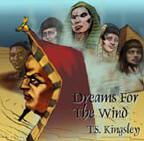
The life of the Pharaoh Akhenaten who preached moral rectitude and fathered his heir by his mother.
Condemned at birth, because of an ominous prophecy that
he would kill his father and breed heirs with his mother, he
was spirited away and reared in a distant land. Returning as
a young man to claim his Kingship, some say by murdering
his father, he had children by his mother, as prophesied. It
was believed it was his incest that brought a plague upon his
capital city, for which his subjects banished him, blind, into
the desert.
Not the legend of Oedipus Rex but the history of the Egyptian
Pharoah Akhenaten, in the opinion of Immanuel Velikovsky,
the historical precedent to the Greek legend. This is the story
of the last twenty-four years of this extraordinary man's life.
Excerpt
Unfinished.
No matter how reality confines me
Truth shall always set me free.
My deeds shall not be for the sand to cover
Nor
My dreams for the wind to blow away...
(Poem attributed to Akhenaten early after his return to Thebes
PROLOGOS
Akhut-Aten is mine today, truly all mine, in a way I never dreamed and certainly never would have wished. The city I built as the capital of the New Kingdom of Aten in Egypt is empty this morning, save for me...and the wind.
I was awakened today by a nightmare that was all the more horrible because it was the echo of a recent memory and not a shadow of a prophecy.
The crowd of rough men and women surrounding the naked Fahtira, demanding, "Where is the Beast of Akhut-Aten?" and, when she gasped that I was dead, the upraised arm with the stone, the thud of rocks on flesh, more terrible because of her silence...
And then the crowd dispersing, leaving behind a bloodied lump of naked flesh that, only just now, had been a lovely woman. And I held her in my arms until she died.
As a blood-red sun-disk rose in the East, I ventured forth from the tiny room Fahtira and I had occupied in secret for seven years and dared to walk the streets in daylight for only the second time in all that long period.
We had heard and seen them departing for days, of course, the people I once called my subjects. We had peeked out of the tiny slit in the North wall that serves for a window, and had seen them, on camels, in chariots, even on foot, streaming along the road by the river, going North at first, crossing the Nile at the shallows and then heading South - back to Thebes, where who knows what fate awaited them. By yesterday evening, the flood of humanity had slowed to a trickle and it was apparent that the last of them would be gone before darkness fell.
So, this morning, as I walked in the stale-fresh air under the sun, I felt more cribbed and confined than I ever had in my little room.
Part of it was that Fahtira was dead, for she had been my almost constant companion for the past seven years. But even when she was out foraging for our meal, I had always had the company of the faint sounds of a living city, drifting in to me through the window-slit, or up the hidden stairs. And when we made our nightly brief sorties to scavenge food to live another day, there were the smells of life - the smouldering cooking fires, the damp wash on the lines, even the faint body odours of human occupation. Even when we saw no one, they hovered about us in spirit as we skulked through the streets. And there was always the fear of discovery to hone our own senses and keep them alive. The air was always charged with the presence of Life itself, tingling as it does just before the lightning strikes.
Then, abruptly, three days ago, there was no more Fahtira. And now the rest had gone.
This morning, as I emerged into the sun, I turned first to the crude burial mound I had built for her against the North Wall. Some of the stones were still stained with her blood and I forced myself not to relive the horrible scene of her death consciously. Instead, I plucked a bit of wild clover by the side of the King's Way, placed it on the apex of the mound and turned away.
As I walked the deserted streets, the city was a corpse, the dry wind hanging with the scent of death. I proceeded south from my cell along the King's Way, toward the Great Temple of the Sun-Disk on the right and Hat-Aton, the small temple that was to be the centre of the New Religion, on the left. And, just as I passed between them, a great cloud obscured the sun and the wind rose and scattered some fragments of papyrus ahead of my feet. And the only smell that reached my nostrils was the stench of the edible offerings to the God, already beginning to decay in the rising morning heat.
My feet now took me past the massive State Palace to the left of the King's Way, its windows staring like black and sightless eyes at my poor, shrivelled body, and then my steps led me to the right and into the building that had been home to me and my family, the stately Royal House on the banks of the Nile.
The house was no longer mine. Its draperies and furnishings had been carted away, probably by Ay - the High Priest and, later, Vizier to my son - who had been the last one to live there. And the wall paintings - of Nefertiti, of the children, of my mother, Tiy - were pitilessly damaged, nowhere more so than where my face had appeared. In fact, on the great mural behind the altar to Aten, where I had been pictured as Great in the Life of Aten, with my consorts Nefertiti and Tiy flanking me, Nefertiti's beautiful face had also been chiselled out of the limestone and mine was covered with demotic glyphs in black ink that read "The Beast of Akhut-Aten." Only the portrait of Tiy remained unmarked.
I turned and left the Royal House the moment I saw that, wishing I hadn't cast my glance upon it.
Further south, at Maru-Aten, the Pleasure Palace, where Fahtira had first saved my life, the ornamental lake had begun to dry up and the water gave off a brackish odour that clung to the nostrils for blocks afterwards. Even the multiple greens of the papyrus plants and other foliage around the lake seemed muted this morning and no waterfowl swam on its surface, no fish stirred its waters.
The Pleasure Palace itself, with its ornately carved stone facing beginning to chip and fall away, had its gilded doors thrown open as always, but now the black aperture with the bridge and causeway issuing from it, looked like a wide mouth, gaping, its tongue lolling in astonishment, and no sounds of laughter or music emanated from it...only a profound sighing as the omnipresent wind rushed through its inner halls on a fruitless search for life.
Inside, I could see in the gloom that the water cascade that had turned so murderous had finally ceased to fall.
Anguished by the emptiness, I turned my feet up a side street towards an area of the city with which I had become quite familiar in recent years, but had visited only twice during my reign - and then I was disguised as someone else. My feet led me past the Priests' Way to The East Way, also called The Greek Way, since this was where the shops had been and their proprietors were mainly Greeks from Mycenae. Great bargainers and story-tellers, they were. But the shops were silent for the Greeks too had followed their customers.
Here, however, I was able to load my sack with assorted produce which had been deemed over-ripe and left behind. The air was redolent with garbage now that there was no one to dispose of it. A ladies' kerchief fluttered in the breeze outside a shop, its hushed flapping the only sound, save that of my footfalls in the gravel.
Chilled in spite of the sun's heat, I turned North again and hastened back to my hole in the wall. The whole city was mine, but I could not bring myself to occupy any part of it, except the tiny space that had been mine and Fahtira's since Ay and Sakkara had us exiled from life. As I approached it, I saw that the gates to the city had been left ajar and the wind was already beginning to drift the sand over the pavement of the King's Way.
With great effort, I managed to close the gates, knowing I was only temporarily postponing the inevitable, and then, as I turned back inside, I saw that the wind had blown away the sprig of clover that I had placed on Fahtira's grave.
Disconsolate, I returned to my cramped cell.
And was alone with my thoughts.
Having seen my city beginning to be buried by the invincible wind and sand, by nightfall I determined that I must record what I can still remember of my life and then place that slim scroll in the highest tower of Akhut-Aten, where the sands will reach it last, so that, should anyone ever find it, the world will know that once there was a man, a King, who tried to live in Truth and died in a web of lies.
I had often toyed with the idea of committing my thoughts and memories to print, each time deciding it was a project for another day. But today it was impressed upon me in a new way that there is some urgency to begin if the work is to be completed.
For my second sortie into the daylight in seven years had revealed that, not only is there the problem of my memory, but my eyesight has deteriorated alarmingly. Living as I have been in the gloom of my small chamber, venturing outside only after dark, I had thought my eyes were adequate. But today, in the bright sunlight, I realized that my left one is nearly blind - it can distinguish only light and shadow - and my right eye's vision is also beginning to dim. It is necessary, therefore, to embark on this record of my existence while I can still see to make the hieratic glyphs.
Many are the ironies in such a narrative, I realize.
Once I had been dubbed, for reasons I hope to make clear, "He Who Has Survived to Live Long." I see now it should have been amended to "Survived to Live Too Long." And, of course, there is the irony that I should be trying to defend my other motto, "He Who Lived in Truth" at a time when I am becoming progressively more unsure of what the truth is...or was.
But perhaps there will come a further irony that may make my narrative, ultimately, worthwhile. The blind seer, Hapu Amen-hotepshut, serves as an example that, as physical eyesight fails, the mind may come to see eternal truths that visions of the temporal have formerly obscured. May that be the case with me.
At any rate, it is better that I should try to record the truths as I now know them than to wait until I know nothing, for no other man will ever do it for me or, for that matter, even admit to remembering The Beast of Akhut-Aten.
Surely, my city has not been deserted by its god. Surely, I have not devoted my life to the worship of Aten as the one true god, only to have him abandon me at the end. Surely he would want his Truth to survive.
Surely...there is no certainty.
So I must at least try to leave some record of my being, for I cannot content myself with suffering the fate of the single raindrop in the desert, whose falling only gives warning that it will be, but makes no sound that it is and leaves no mark that it ever was
Professional Reviews
A Sweeping Story!
Set in ancient Egypt, this is the fictionalized autobiography of a
pharoah who tried to do the right thing and ended up doing just about
everything wrong. Akhenaten has a mind of his own and uses it, but
doesn't always think through the consequences. His adopted sister,
his mother, his wife and later his concubine all play major roles in his
life - forcing it along lines predetermined by a seer's vision at his birth,
and following closely along a 'newly' heard Greek story, Oedipus.
DREAMS FOR THE WIND is a thought-provoking and outright
sensuous saga of one man's lifetime and the people in it. This book
does contain graphic sex, which is actually an integral part of the plot.
While some passages are rather redundant near the beginning and
slow the pacing, T.S. Kingsley has crafted a sweeping story of the
intrigues, incest and incredible dramas of ancient Egypt.
Karen Larsen for Scribes World ****
First Place Winner in historical fiction in the Purple Dragonfly Awards for excellence in children's literature, and named a U.P. Notable Classic.
Feel like you are in the moment nearly 100 years ago with a young girl, daughter of Finnish immigr
Marooned is the 1860's saga of Justin Radcliff, a young American, who is beaten and thrown overboard by his evil twin brother, Edward.
Kolya, a handsome Black man and new leader of the transplanted Zulu tribe there, finds Justin caught in hi
Book I of Southern Swallow Series – 12th Century scholar Li K'ai-men takes command of his first official assignments during a time of political unrest and barbarian invasions.