In January of 1987, Rebecca Cann, a research scientist from the University of Berkeley,
published an astounding discovery. Using mitochondrial DNA as her blueprint, Dr.
Cann was able to trace the fi rst human to a solitary female born in Africa about 200,000 years
ago. These facts suggest that this large step in evolution occurred within the span of a single
lifetime. The study clearly departs from Darwin’s concept of evolution. Furthermore, there is a
fundamental truth hidden in Cann’s research: if a Genesis event happened once, it is inevitable
that it will happen again.
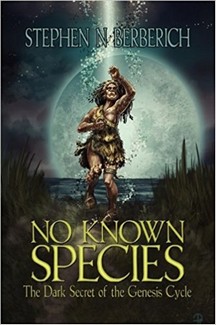
No Known Species—The Dark Secret of the Genesis Cycle is a novel that blends Darwin’s
theories and a mysterious force that seems to control the destiny of the human race. The book
begins with the recreation of the biblical tale of Genesis; only this time it is not the story of our
ancestors’ birth, but the birth of a vastly superior race and it takes place, not in the Garden of
Eden, but in the belly of contemporary society.
In 1984, two extraordinary babies are born on identical birth dates, 3000 miles apart, and
under mysterious circumstances. Imagine for one moment that you are Peter Gault and Kate
Donavon, lone mutants with advanced physical and mental gifts. How would you adjust to a
primitive world that was governed by humans? Moreover, would humanity ever learn to accept
a race of beings that had such vast superiority? One central question builds in the minds of Kate
and Peter: If it were discovered that their birth meant the end of the human race as they knew
it, would these special beings be permitted to survive?
As the story unfolds, the interwoven lives of Kate and Peter serve to unravel the mystery of the
Genesis cycle, and possibly wreak havoc on the natural order of man.
In January of 1987, Rebecca Cann, a research scientist from The University of California, Berkeley, published an article in the journal Nature, suggesting that the origins of the human race can be traced back 200,000 years to a single female born near coastal sub-Saharan Africa. The existence of Eve, as she was known to others, was a stunning discovery because it implied that this unique woman was indirectly responsible for the sum and substance of all human history. Clearly, the story of Eve was not evolution as described by Darwin. Rather, it was a large-scale change, occurring at a single moment in time that radically altered the nature of man. And if it happened once, it will certainly happen again.
No Known Species—The Dark Secret of the Genesis Cycle is a 300 page, 78,000 word techno-thriller that is based on Dr. Cann’s landmark study. It explores the possibility that giant leaps in human development can occur within the span of a single generation. The novel is a blending of Darwin’s theories and a mysterious force that seems to control the destiny of the human race. This manuscript begins by reconstructing the biblical tale of Genesis; only this time it is not the story of our ancestors’ birth, but the birth of a vastly superior race, and it takes place, not in the Garden of Eden, but in the belly of contemporary society.
In 1984, two extraordinary babies are born on identical birth dates, 3000 miles apart, and under mysterious circumstances. Imagine for one moment that you are Peter Gault and Kate Donavon, lone mutants with advanced physical and mental gifts. How would you adjust to a primitive world that was governed by humans? Moreover, would humanity ever accept a race of beings that had such vast superiority? One central question builds in the minds of Kate and Peter: If it were discovered that their birth meant the end of the human race as they knew it, would these special beings be permitted to survive?
For as long as Peter could remember, all he really wanted was to be left alone. At some level he knew that he was different, just how different would eventually shock him to his core. Peter’s parents were aware of this as well. Based on a strangely abnormal maternal amniocentesis, Elizabeth and Joe were told that their son had a previously unknown genetic defect, and she was advised to terminate the pregnancy. Then a strange thing happened. That night Elizabeth had a dream. It was a peculiar dream of which she had very little memory. The following day, though, Elizabeth knew that she was destined to have her baby.
Born with a full head of platinum blond hair, a porcelain complexion and translucent blue eyes, Peter is viewed by his extended family as an unusual child. Introverted and reclusive, he began reading the works of Newton, Einstein, and Maxwell at the tender age of three. But Peter’s reticent behavior would begin to change the moment he meets Kevin on the first day of kindergarten.
Kevin Murphy is a freckle-faced, high-energy child born of privilege. In spite of these obvious advantages, he appears to be just an ordinary kid with an irrepressible personality. Kevin becomes Peter’s best friend and serves to draw him into his world of action. For the first time Peter feels accepted by his peers. There is only one problem: Kevin has an addictive personality. Because of this disability, he will come to hate Peter for Peter’s apparent perfection. But he loves him as well. Unfortunately, many years later, Kevin will give Peter up to save his own skin. And he will pay dearly for his decision. The outcome of their long-term relationship will prove once and for all that fate is a hunter.
While enjoying incredible scholastic and athletic achievements in high school, Peter temporarily separates from Kevin to continue his pursuit of knowledge. The door to trouble opens for peter when he stumbles upon an article in Nature Magazine written by Rebecca Cann. To Peter’s mind, the story of “Eve” is not evolution as described by Darwin. Furthermore, there is a fundamental truth hidden in Cann’s research: if an Eve event happened once, it will certainly happen again. After reflecting on the article and considering his own unearthly gifts, Peter suspects that he might be the next step in the evolution of man, just as Cann’s “Eve” was the first human on earth. In the process of self-discovery, Peter begins to fear that his secrets could place his at risk and he decides to stay under the public radar, which means quitting tennis and scaling back his academic performance. Peter thinks that adopting these measures will allow him to control his own destiny. But his plan would face an immediate obstacle.
After losing both his parents in a tragic accident, Peter is left to fend for himself; but not for long. He is taken in by Kevin’s family and treated like a son and the brother that Kevin never had. Peter enters college and continues to moderate his behavior until it’s time to choose a profession. He decides to serve his fellow-man and become a physician and then scrambles for grades good enough to permit his acceptance to medical school, where he meets a beautiful woman named Kate.
Caitlyn (Kate) Donavon has an eerily similar appearance to Peter; in fact, she was even born on the very same day. Kate is a quiet infant, not deemed particularly unusual by her parents. And as she matured, neither Kate nor anyone in her family questioned the source of her many extraordinary talents. In a sense, Kate is blissfully ignorant of her unique persona. So Kate sails through this chapter of her life without the burden of Peter’s self imposed constraints. She is free to reach to the heights of her potential. Kate’s early life fully reflects her numerous genetic gifts. She graduates from college after a stunning athletic and academic career and enters medical school.
Only one cloud hangs over Kate’s otherwise idyllic life. Three days before her eighth birthday, while making rounds in the hospital with her father, Kate inadvertently pierces her finger with a used hypodermic needle that is contaminated with a virulent strain of meningitis bacteria. Kate develops a full-blown case of the infection and nearly dies. Her miraculous recovery is linked to a strange abnormality seen in her blood smear. All of her white blood cells have not one but two nuclei. When exposed to the offending bacteria, the WBC’s demonstrate a remarkable 100% kill ratio of the bacteria. Kate’s pediatrician is puzzled by the results and sends a sample of her blood to Stanford for analysis.
The specimen ultimately finds its way to the desk of Gene Slater, a renowned expert in DNA analysis. Exhaustive routine testing of the cellular elements of Kate’s blood provided nothing definitive, so Slater decides to run a complete DNA analysis of the nuclear material in the white blood cells. When he received the results—NO KNOWN SPECIES—Slater is stunned. Is it possible that Kate Donavon could be some sort of alien being? No, thought Slater, her DNA was more than 97% human. One interesting difference, though, was the addition of two base pairs in Kate’s genetic blueprint. This change clearly separates this young woman from the rest of humanity in a very substantial way.
The most plausible explanation seems to be that Kate is some sort of genetic mutation and may represent a large-scale step in human evolution. Slater is intrigued by the implications of Kate’s existence and decides to write a paper about his findings. Ultimately though, he places the contents of the dossier into the paper shredder. Gene Slater decides that he would not be the one responsible for derailing this evolutionary juggernaut.
Kate and Peter meet in anatomy lab and are drawn to each other immediately. After some initial problems with communication and a six-month hiatus, they have lunch and, over time, become inseparable lovers. They eventually come to realize that they have more in common than they originally thought, and Peter deduces that Kate is a mutant like him. At first Kate refuses to believe that she is different, but after Peter’s convincing arguments, she finally accepts his premise. This realization leads Peter to believe that there must be more people like them in the world, so he designs an intricate test for individuals who claim to share their traits. Out of all the responses, 50 people are vetted. Along with their newfound peers, Kate and Peter swear to keep their secret under lock and key to protect their lives.
Both Peter and Kate possess many special gifts that adapt well to the medical profession, not the least of which is an ultrasonic ability to “see” inside the human body. The gift is similar to the sonic vision that bats use in caves no light. This ability makes Peter an excellent diagnostician, but using this gift could expose his deepest secrets.
But things begin to fall apart when Peter is faced with the reality of an acute care hospital. On the first day of his rotation in the ER, Peter is forced to make a decision: save the life of a hemorrhaging patient by using his ultrasonic ability or let the patient die to protect his own life. Something inside him compels Peter to choose the former and, following a series of these heroic acts, Peter ultimately comes to the unwanted attention of Dr. John Paul Scott, Chief of Cardiac Surgery.
John Scott is a typical surgical prima donna. He is six feet, two inches tall with a full head of silver-gray hair and the presence of a Roman senator. He is also a gigantic pain in the ass and hates competition for the spotlight, especially from an upstart medical student. Scott suspects Peter’s differences are much more than meets the eye, and slyly obtains a sample of Peter’s blood for DNA testing. When “NO KNOWN SPECIES” appears on the results, Scott, understanding the implications of the test, immediately contacts Phil Mackey, his college friend who works for the FBI. The Gault issue is promptly carried to the highest levels of government. When it becomes obvious that beings like Kate and Peter would mean an end to the human race, President Flynn finally issues an executive order: terminate. It is a difficult decision for Flynn, since it was Peter who saved his life while Flynn was running for president seven years before.
This begins an intense and suspenseful cat-and-mouse chase across two continents with the CIA’s top assassin and resident sociopath, Tony Pizzaro, in hot pursuit. Kate and Peter outsmart and ultimately kill Pizzaro, but the couple is finally captured when Kevin Murphy betrays Peter by revealing their location.
Kate and Peter are sent to a maximum security prison on an island near the coast of Maryland, where they are extensively tested then given a choice: have Kate’s nascent pregnancy terminated, be sterilized, and remain on the island as prisoners for life, or be executed by lethal injection. It is their darkest hour. Kate and Peter choose the latter and undergo the execution ritual, but are ultimately saved by surviving members of their clan. They were able alter the appearance of one of the clan members and then she forcibly replaced the nurse who was to deliver the lethal injection. The female member of the group is able to substitute medications that will only mimic death. The plan works perfectly and the clan flees the island.
With the entire force of government on their trail, the group is able to escape a second time using a teleportation device invented by Peter some years back? The conclusion of the book will challenge the very foundations of your belief system
Excerpt
The birth of the human race had long been etched into the fabric
of time. And that time had come . . .
The Dawn of Man
Coastal Sub-Saharan Africa—200,000 BP (before present)
Despite a diffi cult day in the hunting fi elds, the males of the
clan seemed unusually restive. One of the females had ovulated that
afternoon, and the scent of her pheromones permeated the musty
air of the cave dwelling. The clan’s alpha male fi nally moved to the
female. Without ceremony or pretense, he satisfi ed himself and then
returned to his place in the cave. During the act of intercourse, the
female remained completely passive, tacitly accepting the physical
10 Stephen N Berberich
union with complete indifference. The ritual was simply a fact of life
to be endured by the female members of the clan.
Hours passed, yet the woman was unable to sleep. Instinct compelled
her to move to the mouth of the cave and step outside. The cool breeze
wafting from the tropical forest presented a welcome relief from the
stale air inside the cave dwelling. Her thoughts were uncomplicated
as she stood motionless in the gentle wind. She breathed a sigh of
fulfi llment. She was at peace with her world.
And then, in less than a heartbeat, it happened.
The darkness about her was suddenly shattered by a blinding fl ash
of light. She recoiled as the night sky was fractured from horizon to
horizon by shards of radiance, cascading like billions of fi refl ies falling
to earth.
Several moments later, a residual ghostly aura enveloped the woman
and instantly stirred her primal fears. She turned in haste and retreated
to the safety of the cave. The female had no knowledge of her nascent
pregnancy, nor did she grasp the monumental genetic change that had
just occurred in the secret recesses of her body.
14 years later—Eve
The girl was asleep beside her mother and she was dreaming. It
was a wonderful and recurring fantasy that brought joy to her lonely
existence. In the dream, she imagined herself in the middle of a
sunlit fi eld, reaching out to embrace a fellow traveler. As their hands
touched, she felt the ecstasy of a union with this person, a feeling clearly
unknown to her in the waking world. “I am with you always,” he
would say. Then, as in the past, the vision began to fade and the gentle
No Known Species 11
wisps held in this enchanting place were replaced by the harshness of
her bleak reality.
She sat up and cautiously looked about the cave. It was dark and
dank, she thought, perhaps a refl ection of her present mood. She stood
up and stumbled through the cave entrance to the grassy knoll beyond.
As she attempted to gather her thoughts in this quiet place, the ordeal
of the previous night once again fl ashed before her eyes.
She had lived 13 winters and was now of child-bearing age. This
fact became well known to the clan and last night, for the fi rst time, a
male had demanded certain things of her, and she had relented. Now,
in the harsh morning light, she assessed her injuries. She was sore,
cut and bruised. But most disturbing was the awareness of an intense
feeling of violation embedded deep within her soul.
“How strange it is that I feel this way,” she thought. None of the
other females, not even her own mother, seemed troubled by this
natural act. Was it that they didn’t feel used? Or was it the circumstances
of the coitus that upset her?
The thought served to intensify her feelings of isolation and
alienation from the members of the clan. Why couldn’t she be more
like the others? Why couldn’t she at least look like them?
She began walking to a nearby pond in a vain attempt to wash
away the memory of the previous night. She glanced at her face as it
was mirrored in the still waters. Her cheekbones were too high, and
her forehead too broad. Even the color of her eyes and hair stood in
stark contrast to the others’. “I’m so hideous,” she thought. Yet this
was not the fi rst time that she was aware of the differences. And the
differences were not just physical.
12 Stephen N Berberich
Since early childhood, she was able to grab objects by pressing her
stubby fi fth fi nger against her other four fi ngers. This enabled her to
place objects that she had pictured in her imagination into an ordered
sequence. She learned to secure each item in place by using various
lengths of animal hide. Some of the objects were pleasing to her senses.
Occasionally, the fi nished product proved useful to lighten the load
of her daily chores.
Yet, to her profound disappointment, she noticed that the females
began to look upon her with puzzlement and fear. Gradually that fear
had turned to anger, and their anger had infected the entire clan. She
became a pariah whose only function was as a potential vessel to satisfy
a male’s biologic needs. And last night the inevitable happened.
Following the assault, in the bitter cold of the evening, she made
her fi nal decision. She would leave the clan.
Her thoughts returned to the present as she began to focus on the
tasks that lay ahead. She went to the place of storage and assembled
the necessities. She then bundled herself in warm furs and headed for
the path leading away from the cave. She did not turn to look back.
As she moved on, she had no way of knowing that within her womb
was a child, a fellow traveler, exactly like her. Nor did she know that
her footprints on this path leading from the cave would be the fi rst
steps taken by a human on a journey to a distant future.
Chapter 1
The next cycle of man’s rebirth began long before the modern
era in the far reaches of deep space. Ten thousand light years from
Earth, a white dwarf star achieved critical mass and exploded in a
cataclysmic celestial fi reball. The surrounding space near the white
dwarf became fi lled with trillions upon trillions of neutrinos traveling
at near light speed, some randomly headed for a small planet, orbiting
an unremarkable sun in a remote region of the Milky Way.
Light years passed as the neutrinos continued their fateful journey
across unimaginable distances in space and time. And our Mother
Earth waited in anticipation, as the seasons marched inexorably from
past to present.
14 Stephen N Berberich
Marblehead, Massachusetts—January 4, 1985
January is a particularly dreary month in the northeastern coastal
town of Marblehead. The weather this time of year frequently drives
many of the village residents to the local bar for a stiff drink. The
remaining teetotalers stay at home, anxiously praying for the arrival
of spring.
Like many residents in town, Joseph and Elizabeth Gault spent
much of their time hibernating during these inclement months.
But, unlike some of the other winter homebodies, they appeared to
be quite happy with their confi nement. After all, Elizabeth and Joe
had endured these foul weather conditions since early childhood and
simply accepted them as an inevitable part of their life along the North
Atlantic shoreline.
The Gaults were a quiet couple living an average life in an average
New England community with no pressing needs, save for one. For
years Joe and Elizabeth had wanted a child. But, as fate would decree,
the Gaults remained barren after nearly two decades of a committed
marriage.
Currently the couple was over 40, and had long since abandoned
any hope of having a baby. Despite this, Joe loved his wife dearly, as
Elizabeth loved him. Each Sunday, without fail, they would make
intimate love in the privacy of their upstairs bedroom. Little did they
know, on this fi rst Sunday in early January, a male child would be
conceived in the womb of Elizabeth Gault. They were also unaware
of the far-reaching consequences spawned by a remote supernova
occurring 10,000 light years in the past. The effects of this epic
happening would forever change the nature of their family, and perhaps
the future of the human race.
On that fateful night in early January, as neutrinos from a distant
star showered our earth, the genetic blueprint of the Gaults’ newly
conceived son was undergoing a monumental structural reconfiguration.
Another sea change of evolution had been set into motion.
Professional Reviews
Review-No Known Species-The Dark Secret of the Genesis Cycle
Review
No Known Species: the Dark Secret of the Genesis Cycle. Stephen N Berberich. Xlibriscorporation 2009. 337 pp.
If you want a fun-read of a novel written by a highly-qualified and experienced physician, a cardiologist, who also knows much about the basic and applied sciences that underlie the clinical aspects of medicine, this is your read. If you do not have fun reading this novel, and in the process shed a tear or two, enjoy the romance of young folks, and identify with some real descriptions of some “can you top this” vacation spots, join in with some great beach time, a tennis match or two (one too many?) and high-level skiing, then you are a hard-sell. The theme, if you will, is based on the quite well-documented research findings of one Rebecca Cann, described as a “ research scientist, from the University of Berkeley,” and more on that later. The back cover of the book contains the ouevre of her work, and the theme of the book, that is stated by reason of “using mitochondrial DNA as her blueprint, [she] was able to trace the first human to a single female born in Africa about 200,000 years ago.” Apparently the genetic profile of this signal individual was the outcome of a random event, somewhat at odds to Darwinian evolutionary concepts. But read this book to digest the readily explicable statements of the author, who notes, among other things,that as random events have occurred, we may reasonably anticipate future such random events. You will find out why in the reading, and what all this may mean for our future as a human species. This is not strict sci-fi: this is fictionalization based on scientific findings, at its best.
Cutting back to the chase, you will meet the subjects who carry the noted theme: Peter Gault, and later Kate Donavan, who have some special characteristics,that only you, the reader, will discover. Recollect that apparently each of us is apparently descended from that noted lone African female, and all other species of less than adaptable ‘human types’ failed to make the evolutionary cut. If the African female was the start of us all, could not this event occur again? Peter and Kate know they are “different,” but to discover just how they different, and what fate will hold in store for them, becomes the major construct of the novel. But, read on.
Yes, the author, who in addition to his medical studies, has well-absorbed a broad-base of science in general, and has also studied writing. This latter study is manifested in a sometimes overuse of coincidence, but any author has to move the scene, right? Using another time-honored literary device, he skillfully “hangs the sword on the wall” in the beginning chapters, as Kate, in an early scene, bids her West Coast family farewell, “never to see them again.” All these devices are traditional, well done, and visible. Most of all, please have a fun read, indeed, and watch out for later developments in our DNA and other parts.
One criticism of the volume, or the editorship, is to note that my father’s, my oldest sister’s, and my alma mater is University of California, Berkeley, (not ‘Berkeley
Page 2.
University’ as on the back cover) and Dr. Cann, in real life, is not only a ‘research scientist’ but truly, Professor, Department of Genetics and Molecular Biology at that
slightly misnamed center of learning wherein the density of Noble Laureates is exceptional, and whose unofficial motto is, “We are not interested in developing safe ideas for students, but rather students who are safe for ideas.”
Have a fun read, and do not take all this too seriously. Not just yet? But when?
Robert E. Tumelty, BA, MPH, DrPH, Professor Emeritus and Founding Chairman, Health Care Administration Department, California State University. Long Beach
Michael, just Michael, simply wanted to live life his own way. He had no intention of becoming a revolutionary. Yet destiny calls even the uncertain and the arrogant to duties beyond themselves. Hidden agendas, false friends, and his own confusion le
MONSTROSITY n. 1. That which deviates greatly from the norm in appearance or structure. 2. The quality or character of being abnormal; hideous; frightful; shocking.