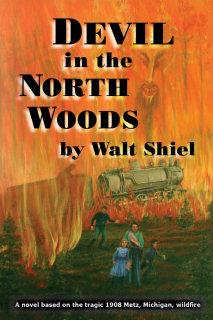
Vivid novelization of the true story of a 10-year-old’s survival during the 1908 Michigan wildfire that left 43 dead, 4600 homeless, and two million acres decimated.
What would you do if a wildfire swept through your area without warning?
In October 1908, a wildfire swept through northeast Michigan and consumed 900 homes and two million acres of farms and forest. Despite the valiant efforts of the farmers, lumbermen, and shopkeepers, only Lake Huron could quench the flames. With no fire watch towers, spotting aircraft, telephones, or organized firefighting and only limited telegraph, warnings were too few and too late.
Devil in the North Woods accurately depicts the fire's genesis, growth, and aftermath. The story's real-life protagonist, 10-year-old Henry Hardies, survived the fire but family did not. Relying on Henry's personal recollections and author Walt Shiel's faithful recreation of time and place, the book vividly brings Henry's ordeal to life.
Devil in the North Woods contrasts the terror of nature's destruction with a chronicle of family, love, sorrow, and recovery. The story leaves the reader buoyed by faith in the resilience of the human spirit and belief in love's ability to germinate amid the ashes of ruin.
Includes a map and six historical photos.
Excerpt
PART ONE
The Devil Awakens
Wherever God erects a house of prayer,
The devil always builds a chapel there;
And 'twill be found, upon examination,
The latter always has the largest congregation.
--Daniel Defoe
Chapter 1
Thursday — September 3, 1908
10:30 AM
Ten-year-old Henry Hardies had no idea how the fire could have raced out of control so fast. He only knew it had, and now they had to fight it.
He dug the shovel into the dry soil, scooped as much as he could lift, and tossed it on the closest flames. The blanket of dirt smothered a square yard of flames. Clouds of dust puffed three feet into the air. To his right, new flames sprouted, seemingly from nowhere. Henry threw another shovel of dirt on it, marveling at how the fire seemed to jump from one patch of dry grass to the next, like an invisible living thing springing from under his loads of dirt.
The main body of the fire burned less than six feet away. The dry wood that fueled it popped. Its flames roared like an enraged beast. When Henry looked up, he imagined wild, red eyes taunting him and flaming arms reaching for him, so he tried to focus on the closer burning grass. But the waves of heat pummeled him and drew his attention back to the bigger fire.
Is it the beast's breath? he wondered.
Like the summer just passed, September was starting out warm and dry, offering no relief to the parched soil, crackling grass, and brittle underbrush. Henry had helped create a pile of brush and branches over the past three days, dragging the scratchy stuff or tossing it from the back of the buckboard. He and his 12-year-old brother Eddie had worked every bit as hard as Papa and their older brother Adolph to clear another acre of dense northern Michigan forest. This morning, Papa had carefully poured a small amount of lamp kerosene on the upwind corner of the pile and put a match to it.
The wind had been light all morning. They piled the brush in a 50-foot clearing a full hundred yards from their main field, farther than that from the house and barn. Everything should have been fine. Just like the half-dozen other piles they'd burned over the summer.
But this fire sprang to life with all the fury of Hell itself. Flames sprinted up the side of the pile, hissing and popping, driven by the breeze that, without warning, became a gale.
The fire sucked the wind. The wind pushed the fire. One fed the other until the flames soared 30 feet and more upward, smudging the clear blue sky with smoky gray clouds. Flames jumped to the lower branches of trees left dry by the summer's drought. Embers fell to the ground and ignited the dry grass in the clearing. The wind pushed the flames eastward, toward the house and barn.
While Eddie and Henry frantically dug up dirt and tossed it on the fire, Papa and Adolph used the two-man crosscut saw to drop the closest trees inward onto the fire, hoping to deny the beast a fuel-rich path to grow.
Despite their best efforts, the fire moved relentlessly east-ward. One stand of trees at a time. Ever closer to the house with each passing moment.
How long ago had it started? Henry wondered, scooping another shovel of dirt onto the flames. An hour? More?
The flames leaped again, gobbled another patch of grass, threatened to dash out and seize him. Grunting from exertion and anger, Henry flung another load of dirt at the attacking fire. Sweat stung his already smoke-irritated eyes.
"Eddie! Henry!" Papa shouted over the fire's roar. "Come here!"
Henry ran to him, dragging his shovel. Eddie got there first.
On his father's signal, Adolph, 16 and taller than his father, paused to catch his breath. The teenager, with his father's dark hair and eyes and angular face, showed signs of maturing into a beefier version of his father. He stretched the kink out of his back, put there by an hour of steady sawing.
Dust and sweat matted the older man's dark hair into a tan-gle as dense as the underbrush they'd been working all summer to clear. Thirty-four years old and the father of eight, Edward Hardies stood only five-foot-seven but had shoulders broadened by a lifetime of farming and lumbering. He mopped his forehead with the sooty sleeve of his green plaid shirt and told his younger sons, "I want you two to take the wagon back to the house. Rake and dig away every bit of vegetation you can between the edge of the woods and the barn. And have Mama and the girls fill every bucket and barrel with water."
Oh God, Henry thought. The whole farm's gonna burn up.
"But, Papa," Eddie protested, glancing back at the inferno behind him.
"Now!" Papa stuck a finger out toward the house. "Go!"
They ran to the wooden buckboard as fast as they could carrying the heavy shovels. Harley, a black gelding draft horse of uncertain ancestry, waited in harness, pawing, snorting, and straining against his harness.
Eddie tossed his shovel in the back and hopped onto the seat. "I'm driving."
For an instant, Henry thought about arguing but decided there were more important things to worry about at the moment. He hoisted himself and his shovel into the back. He mashed his well-worn straw hat tighter on his head until it was snug. He did not want to lose it as it had been a birthday gift a year ago. And, after all, Eddie did not have such a straw hat.
Eddie slapped the reins across Harley's rump and hauled back. The big horse clomped backward a few paces, snorting and flaring his nostrils but pushing as steady and straight as always. Eddie pulled the reins hard to the right, and Harley wheeled the wooden wagon around and set off down the trail. Harley, an implacable horse that had worked on the farm since he and Henry were two, had only two paces — plodding and slow. He eased into a slow walk. Eddie slapped the reins again, trying to urge him ahead faster.
No use in that, Henry thought with a shrug. Harley goes at his own pace, no matter what you do.
Eddie slapped the reins again and shouted, "Go, you durn horse!"
Harley stomped his feet harder but his pace stayed slow and steady. The wagon wheels clattered over the hard, rough ground, and the buckboard rocked side-to-side.
Henry leaned against the back of the wagon seat. Had the fire eased up? The flames seemed less fierce, the wind lighter.
I hope so. Dear God, let the fire-beast die now. We're a good family. If we lost our home, where would we go?
The wagon broke into the southern end of the cleared field that Papa was preparing for winter wheat planting. Eddie pointed the wagon at the big log barn and slapped the reins one more time. He parked the wagon between the barn and the log house. The house was older than Adolph with two additions sticking out like the afterthoughts they were. Mama, holding 11-month-old Minnie balanced on one hip, stood just outside the door watching them with her free hand shielding her eyes from the sun. Nine-year-old Pauline stood beside her, brow furrowed, clutching three-year-old Marie tightly. Theresa, seven, and Louise, six, stopped hoeing weeds in the fenced garden beside the house and turned to see what was happening.
Henry leaped out of the wagon first and raced over to Mama.
Despite mdash; or maybe because of mdash; the never-ending toil of caring for her eight children and their home, Emma Hardies retained a girlish slenderness, although with the weary bearing of a woman who had given birth to 11 children and buried three of them before they had uttered their first cry. Despite all that, her still-smooth rounded face, light brown hair, and lively blue eyes could turn male heads in town. And no one seeing Henry and his mother together could fail to notice the resemblance.
"Mama," Henry said, eyes wide, "the fire's coming this way."
She reached out and brushed his dirty, tangled hair from his equally dirty face and noted a fresh burn on one cheek. "Are you all right, Henry? You look a fright."
Henry pushed her hand away. "Papa says Eddie and I are to clear away the grass and whatnot between the barn and woods. He wants you and the girls to fill up all the barrels and buckets with water."
Pauline inhaled sharply and pulled Marie even closer. "I don't like fire."
Mama considered the smoke drifting above the woods the boys had just left. "It doesn't look so terrible."
"But it's terrible enough," Henry said.
Eddie agreed, "It really is, Mama. It's real bad 50 yards into the trees. Papa's worried they won't be able to stop it."
She sniffed the air and frowned. "I see."
"What is it, Mama?" Theresa called from the garden.
Mama waved for her two gardeners to join them. She turned to Pauline and said, "You fetch the buckets and bring them to me at the pump."
"Yes, Mama," Pauline put Marie down and headed for the barn.
Marie began to whimper. Mama shushed her and patted her head with her free hand.
Theresa and Louise came up, looking worried at all the commotion.
Mama handed Minnie to Theresa. "You two take Minnie and Marie inside and wait. Papa's worried about his fire."
"Fire?" Louise asked.
Mama smiled as she smoothed the girl's hair. "I'm sure it's nothing. Papa just wants to be careful, that's all."
"Come on, Henry. Let's go." Eddie turned to leave.
"I'm coming." Henry followed a few paces back. As he passed Harley, now standing calmly, he ran a hand along Harley's right shoulder. He liked the feel of the horse's summer coat. Even more, he liked to feel Harley's muscles working just beneath the skin when he pulled the plow. In fact, Henry liked all animals, even the skunks and snakes his sisters hated. He grabbed his shovel from the wagon and patted Harley once more for luck.
Like most boys in his situation, Henry would rather have been anything except the youngest son. His five younger sisters didn't count; they were just girls. He yearned for the responsibilities meted out to Eddie and the increasing authority assumed by Adolph.
"Henry, come on!" Eddie shouted.
"Yeah, yeah," Henry grumbled, trotting to catch up with his brother.
The fire burned unabated on a direct path toward their home. Henry could hear the pine needles crackle and the cones explode as the fire swept closer.
Starting out side by side, Henry and Eddie dug into the hard ground and turned the grass and weeds under, leaving only the unburnable dirt exposed. Henry worked down the row to the left, Eddie to the right.
Minutes later, Eddie yelled, "That's far enough. Let's start working back toward the barn."
Henry waved that he understood. He looked into the woods. The flames were getting closer, licking the sky like monstrous, hot tongues. He looked at the ground they'd cleared so far. A band of dirt barely three feet wide stretched across the fire's path.
We'll never clear enough, not just the two of us. The fire'll just leap on past.
He dug into the dirt and worked faster. Digging. Turning. Sweating. Panting.
He met Eddie at the middle again. They stopped and surveyed the results of their efforts. The patch of overturned earth was maybe seven feet wide now, narrower in some places, not quite fully overturned in others.
Eddie looked at Henry and asked, "What do you think?"
Henry shrugged. "It's not enough, but what else can we do?"
Eddie pointed down their fresh row. "I don't know, but this sure ain't much."
"Think we're gonna lose the barn?"
"How do I know?"
"You're always telling me you're so darned smart." He planted the shovel blade in the dirt and leaned against the handle. "I'm waiting for you to prove it. What do we do now, big brother? Stand here and wait for the devil to burn us out?"
"Shut up and dig."
"Great idea." Henry scooped a load of dirt. "Why didn't I think of that?"
They solemnly returned to their task. Dig, scoop, flip. Dig, scoop, flip.
By the time he'd reached the end of the row again, Henry's arms ached. His neck ached. His back hurt. Sweat soaked his shirt and the waistband of his pants. He wanted to stop, but dared not. He couldn't let the devil win and suck the whole farm into Hell.
***
Voices, accompanied by clattering and clanking, drifted up from behind. He turned around. Three wagons pulled up beside the barn, filled with a dozen men and boys and three women. The men and boys jumped down with shovels, hoes, and axes and ran toward Henry and Eddie.
Henry had never been as glad to see anyone as he was at that moment. Now, they might have a chance to force the devil back down inside the gates of Hell where he belonged. He relaxed, for the first since the fire had started, and watched as the three women got down from the wagons carrying more buckets, which they took to Mama at the pump. One of them motioned her away and started pumping. Mama stepped back and wiped her face with the hem of her apron. Another woman waved Pauline aside and pointed for her to go inside.
"Henry? Is that you, boy?" Mr. Spleet asked with a two-bladed ax angled over one shoulder.
"Yes, sir."
"Where the devil's your father, son?"
Henry pointed into the midst of the trees where the flames were brightest and said, "Adolph, too."
Mr. Spleet looked back and hollered, "Davie! Jonathan! Bring your axes and come with me."
The two Spleet boys, 16 and 18, sprinted after their father, already advancing on the fire to aid his neighbor.
Davie, the oldest, paused to pat Henry on the shoulder. "You're doing a great job. Keep it up."
Henry, heart still pounding from his frantic work, stood a little straighter and dug his shovel back into the dirt. The others spread out and began turning the soil all around him. Some-how, the work seemed easier now.
A half-hour later, Davie Spleet reappeared at the edge of the woods. "We need some men with shovels back here!"
Three men broke ranks and ducked into the woods with shovels held horizontally in front of them. Henry thought they looked like soldiers charging into battle.
Gradually, the crackling and popping and roaring from within the woods lessened. Henry looked up and realized he could no longer see the flames, although gray smoke still curled up into the treetops. The word spread quickly, and everyone slowed their working pace, expecting to hear any moment that everything was under control.
Henry dropped to his knees on the ground and let the shovel fall. Tears welled up in his eyes. Annoyed, he swiped at them. He didn't want anyone to see him crying. His breathing and pulse slowed, gradually returning to normal.
Papa and Adolph, closely followed by the other men, came out of the woods, axes over their shoulders and tired smiles on their grimy faces. Everything was all right again.
Clearing fires were a fact of life throughout northern Michigan as families forged farms from forest and lumber companies harvested virgin timber. But Henry had never seen one flare-up and spread like this one, and he hoped he never would again.
Papa told Mr. Spleet, "We need to haul some water in there and make sure the fire's completely drowned."
Mr. Spleet nodded. "I'll see to it. You and Adolph go back to the house, clean up, and get a drink."
Papa shook Spleet's hand. "Joe, you saved our farm."
"We did what any good neighbor would do."
"Well, thank you, anyway."
"If any of us lose control of a fire, all of us have to pitch in." Spleet looked back at the woods. "These woods are certainly beautiful but so dry this year. The smallest fire can too quickly run out of control."
Henry followed Papa to the house, noting that the wind had diminished along with the fire. As they passed the barn, Henry stopped to check on Harley, stroking the gelding's muzzle. He began to unharness the big horse. As hungry, tired, thirsty, and sore as he was, he knew Harley needed to be taken care of first. Without Harley, the field would not be plowed, logs would not be hauled, and supplies would not be brought out from town. At least, not until their old brood mare Fanny, still in her stall in the barn, foaled and the youngster grew up enough to work. The foal was due in six to eight weeks, and Henry looked forward to playing with the newcomer and helping to train it.
Henry stood on his toes to lift the bridle over Harley's ears. The gentle beast lowered his head and gently mouthed Henry's arm. The horse always did whatever they asked of him with no complaints. He deserved to be treated well.
***
That night, Henry and Eddie lay side-by-side in bed, watch-ing what stars they could see through the one small window in the room they shared with Adolph, who had his own bed.
He rolled to face Eddie and whispered, "Did that fire today scare you?"
"I was too busy to be scared."
"Uh-huh. Sure you were."
After a moment's silence, Eddie whispered, "Were you scared?"
"I was sure it was gonna gobble up the barn, the house, and everything else."
"Yeah, it sure took off fast."
Henry sighed. "It was almost like it was alive."
"Yeah, I guess so."
"It was...I don't know...it was like the devil. All red and angry and all."
Eddie chuckled. "The devil?"
"The way it roared and sort of leaped through the air to start more fires. I even thought I could see red eyes and-"
"Red eyes? You've got too much imagination, that's what I think."
Henry elbowed him in the ribs.
"Hey!" Eddie squealed.
Adolph stirred. "Will you two be quiet and go to sleep. I'm tired out."
Henry lowered his voice. "That's right. Red eyes. And red tongues that flicked out like a snake's tongue. All it needed was a couple of horns and a pitchfork."
"Sheesh." Eddie pulled the sheet over his head. "I think Adolph's right. It's time to sleep."
Henry rolled back over and continued staring out the window at the stars. He was tired, more tired than he ever remembered being, but he couldn't sleep.
The image of the devil rearing from the flames haunted him.
Professional Reviews
Northern Express Weekly
The best of the bunch reviewed here is Walt Shiel's hellraising account of a blazing inferno that torched the northern end of our peninsula.
Author Shiel bases his historical novel on the true story of 10-year-old Henry Hardies, whose family faced an all-consuming fire in the farming town of Mertz in 1908.
Hardies was the paternal grandfather of Shiel's wife. He and his family were trapped in the path of the largest wildfire in modern Michigan history — a firestorm that swept across the northeast part of the state, burning Metz to the ground along with 900 homes and two million acres of forest.
Henry survives the fire, but his mother and three young sisters are among the 43 dead. The fire left 4,600 people homeless in October of that year, with winter setting in.
Shiel's metaphor of the fire as a devil is apt: "With no fire watch towers, spotting aircraft, telephones, or organized firefighting organizations and with only limited telegraph servivce, warnings were too few and too late."
Shiel dramatizes one incident of a literal hell-bound train, which strives to save refugees from Metz only to plunge into the flames at a place called Nowicki's Siding, killing 13 in a gondola car. Written with the pace of a thriller, "Devil in the North Woods" is a grim but fascinating read, building a bonfire of the dusty pages of history.
Historical Novel Society
Ten-year-old Henry Hardies is afraid of fire. He knows its deadly power, and sees the devil in its glowing red light. Wildfires are nothing new to Henry's Metz, Michigan community, built up from the wood of the acres of forest that surround them, yet he knows to fear their unpredictability. "Devil in the North Woods" presents the story of the October 1908 wildfire that tore across Northern Michigan, destroying over two million acres of land and ruining hundreds of lives.
Building on contemporary reports and recorded oral histories, Shiel presents us with the seemingly endless day of the wildfire as seen through Henry's eyes. The horror of the wildfire becomes a personal tragedy that the reader, too, experiences. Shiel does not wish to comfort the reader, just as young Henry is not comforted — the oppressive heat, singeing embers, the smell of burning hair, and the heavy smoke-filled air makes one appreciate the ability to come up for air from the oppressive fires of this story. Despite this dreadful scene, Shiel's compassionate writing creates a community of bright, supportive, and determined people, whose characters develop and deepen as the fire grows. Not for the faint of heart (or stomach), this novel never slows down, but leaves the reader with a great respect for the hardy, strong-willed people who fought and survived wildfires all across the States, and built up their lives in the aftermath.
Midwest Book Review
"Devil in the North Woods" is a work of historical fiction, based on modern reports and oral histories of a terrible 1908 wildfire in Michigan. Ten-year-old Henry Hardies survived the fire that claimed his mother and three younger sisters; in real life, Hardess told personal stories that his own children have handed down to this day. "Devil in the North Woods" vividly recreates the terrible blaze from start to finish, the toll it took, and the trials of human beings forced to recover from the devastating losses it inflicted. Though Devil in the North Woods tells the story of man vs. nature, its core is emotional and human-centered.
Tralee, Ireland. September 1948.
An arrogant, and highly agitated, priest arrives home after 40 years.
Days later he's dead. Suicide? Or did his past catch up with him?
Third Book in Five Book Series - Southern Swallow - a tale of 12th Century China. Li K'ai-men becomes entangled in an intrigue that becomes his undoing.