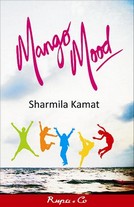
Category: Humor Publisher: Rupa Publications, New Delhi, India
ISBN-10: 9788129117229
Type: Non-Fiction
Pages: 166
Copyright: Nov 1, 2010
ISBN-13: 9788129117229
The story of Goa, India's beach paradise told tongue-in-cheek. Using gentle satire, it covers men, matters and headliners in the part of India that once spoke with a Portuguese accent.
http://www.rupapublications.co.in/client/Book/MANGO-MOOD.aspx
Thisbook chronicles the story of Goa, and India, in its recent past, as retold by a bemused, yet indulgent, Goan. Using mostly gentle, sometimes hard-hitting, insightful, satire, it leads the reader through headline-grabbing incidents in recent times through the medium of 60 short satirical pieces.
While the first section, “A Goan Pot-Pourrie” deals with all things Goan, in the second half, “With a Dash of Garam Masala,” the cast of characters expands to include personalities, and events, across India. The piece-de-resistance of the book is a history of Goa retold, from its birth at the hands of Lord Parashurama, through the Portuguese interlude, to its present-day status as the undisputed party capital of India.
Like the King of Fruits whose soft exterior belies the hard core at the centre, the lighthearted rendition of front-page news in Mango Mood conceals pertinent comments on certain hard realities in our society. Besides, can there be a better symbol for Goa than the luscious, mouth-watering mango?
Excerpt
The coming of the Portuguese, in 1510, gave new direction to Goa’s quest for fame. Like all colonial rulers, the Portuguese came uninvited, and then proceeded to dig themselves into the wood¬work for the next 451 years.
When measured on the geological time scale, 451 years does not amount to much. However, it provided time enough for the Iberian influence to touch all aspects of the Goan culture.
From the pork vindaloo on the dining room table to the cashew apple on the tree and Carnival on the streets, the Lusitanians made sure that they left their mark on everything before the Indian Army gave them the royal order of the boot.
The Portuguese chapter in Goan history is not one that has suffered from want of attention. The Lusitanian link has been discussed at length in research journals and history texts, and more importantly, in travel guides, tourist brochures and count¬less advertisements issued by the Department of Tourism, inviting the world and his wife to 'Come, partake of the pleasures of India’s beach paradise!'
The travel world’s version of the Portuguese rule may not be the most authentic account available, but it is by far the most origi¬nal. Sometimes, startlingly so.
The most im¬portant achievement of the colonial regime was introducing, in the common man’s lexicon, a word that soon came to symbolize Goa - soçegado (relaxed).
Opinions differ as to who made whom soçegado. One school of thought firmly believes that the Lusitanians caused the Goans to adopt a more leisurely life-style. The rival body contests this claim, sub¬scribing instead to the viewpoint that contact with Goa led a once-mighty sea power to retire to the sidelines.
This debate, like all others, is conducted in what is un¬doubtedly Goa’s most popular forum for such discussions - the 'Letters to the Editor' columns of the local newspapers.
The ball is set rolling by Ermelinda da Cunha Rivara from Betalbatim in South Goa. In a missive to the Editor, she asserts that it was the Lusitanian influence which caused an otherwise hardworking Goan people to put up their feet and relax.
Untrue, protests Charmaine de Menezes e Furtado in the next day’s edition. The Goan tendency to take things easy rubbed off on the imperialists. That is the reason why, once settled in Goa, the Portuguese chose to take a backseat and let Britannia rule the waves.
The last observation causes M.L. Mhapsekar, from the village of Salvador-do-Mundo, to step into the fray. His observations elicit contributions from Fr. X. de Souza, N.B. Kalangutkar and a ‘Name withheld on request.’
By now, the decencies of debate have been abandoned in favor of an unrestrained fistfight. Charges and counter-charges are trad¬ed. Words like neo-colonialist, lap dog of the imperialists and quisling feature prominently in the columns.
Professional Reviews
Goans are no longer sossegada
Read the complete review of Mango Mood at Gomantak Times, June 28, 2011
ANd a reading from the book in the company of Oscar winning songwriter Gulzar: http://shortsnipz.blogspot.in/2011/12/video-of-release-by-padma-bhushan-and.html
Also see History of Goa Retold: The Herald Newspaper:
http://candidcomments.livejournal.com/8549.html
Bringing out different shades and colours of life
Read the complete review on Sunday Book Reviews at Fachcha May 22, 2011
http://signaturesnark.blogspot.in/2011/11/on-people-and-peculiarities-snark-and.html
AN inborn flair for light satire
The great French dramatist, Pierre Augustin Caron de Beaumarchais once wrote, I hasten to laugh at everything, for fear of being obliged to weep. On going through the book, Mango Mood, one gets the impression that the author, Sharmila Kamat, too, subscribes to the same philosophy.
Indeed, Sharmila Kamat has an inborn flair for light satire. She has wielded her pen with ease to depict the foibles and weaknesses of human nature without hurting the feelings of the subjects of her pieces. From her writings, one gets the impression that she would like to see a change for the better from those entrusted with the destinies of the common man.
http://mangomood.blogspot.in/2011/11/observant-eye-and-witty-turn-of-phrase.html