Kindle Edition
Audiobook
Download from Smashwords (eBook)
Amazon
The Queer Spirituality of Toby Johnson
Category:
Action/Thriller
Publisher: Peregrine Ventures
ISBN-10: 1727066928
Type: Fiction
Pages: 298
ISBN-13: 9781727066920
Price: $4.99 (eBook)
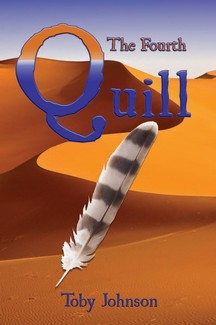
The Fourth Quill recasts the story of AIDS into a parallel universe with a surprising and happy ending, where its main character can wonder if he really has brought about the cure of AIDS. Woven through the hero/adventure plot are two lovely and heartwarming romances, one straight, one gay—both with unexpected twists. A little modern, scientific and sensible and a little mystical, The Fourth Quill exemplifies Toby Johnson's style of dramatizing gay spirit through storytelling and speculative fiction. This is a parallel universe readers will likely remember and come back to.
In the early days of AIDS, a San Francisco Health Department counselor is propelled into a mystery quest after a very ill member of an AIDS support group he runs kills himself in a way that brings media attention and political controversy which gets the counselor, Jonathan Stiers, on national television. Lynn Graves, a young woman from LaCrosse, moves to D.C. and gets a job with a consulting firm with a patriotic-sounding name that audits government research; in the xerox room one day she finds what seems to be a report on research into a totally successful cure for HIV—an issue which has become critical for her personally as she's learned that her boyfriend is positive for the virus. Lynn tells Jon about her discovery when they are coincidentally introduced during a Thanksgiving vacation back to LaCrosse. When Jon goes in search of this successful clue, he seems to uncover a plot to keep the cure secret.
In a medical-thriller plot peppered with clues, coincidences and misperceptions, a strange old house with secret rooms becomes the site for an assassin's attack. The counselor who's been teaching his group Buddhist and New Age healing principles of relaxation and acceptance, becomes suspected himself of murder. In a final confrontation, Jon's spiritual principles are challenged when he's forced to answer the problem of evil in game of wits with the Director of the Liberty Bell Foundation. The hero's example of enlightened attitude, even in the face of personal loss, so affects the Director's righteousness that, it seems, the cure is released.
In the end, the heroes triumph, but it is never clear if the plot they suspected has ever really existed, but the search and the confrontation with suffering and evil have changed them all and taught them the secret of finding miracles.
Interesting as historical documentation of a time when AIDS was fraught with paranoia and miracles were the only hope and still relevant today as a parable about overcoming evil and healing oneself of fear.
Excerpt
Prolog
The Not So Distant Past
“You’ve got to bomb the whole area… it’s the only chance… only chance, I tell you!” The distraught voice boomed out of the speakers, echoing in the Central Communications Control Room.
“Get those two old men out of here,” muttered Major O’Hara, the Communications Chief, to the young man from the public relations office who’d just escorted two visitors into the room. O’Hara reached out and pushed a button on the console and the raving voice went silent.
“Both Mr. Wilson and myself have top security clearance,” Edward Buchanan announced. “You will not ‘get us out of here’ without a good explanation.”
“Mr. Buchanan, sir,” spoke up the P.R. officer, “I’m sure the Major didn’t mean any offense. It’s just… it’s just that this doesn’t have anything to do with your audit of the agency.”
“Let me be the judge of that, let me be the judge,” Buchanan declared.
George Wilson, standing behind Buchanan, felt sorry for the P.R. officer who’d been assigned to guide them through the facility. Now, by sheer coincidence, while the young man was explaining to them the extensive network which coordinated the various projects of Alternative Weapons Research Corporation, they walked right in on that unexpected and disturbing communication. That was a message outsiders weren’t supposed to hear.
But Buchanan and Wilson had heard it.
“We’ve been contracted to oversee this agency. Frankly, Mister, I’m not sure there’s anything around here that isn’t our business,” said Buchanan, a tall heavy-set man with broad shoulders and an impressively oversized head crowned with snow-white hair. In his career as a weapons consultant and agency auditor he’d learned to use his size and his presence to intimidate those around him.
“Edward, perhaps we should allow them to submit a report on this through regular channels.” This suggestion came from Wilson, Buchanan’s sidekick and business associate. Wilson, a small man with thinning brown hair graying at the temples and a small, well-trimmed mustache, looked dwarfed beside Buchanan’s towering bulk. As Buchanan’s partner he’d learned to seem polite and meek to coax cooperation from the programs they were auditing.
“Where is this communication coming from?” Buchanan asked, appearing to ignore Wilson’s comment.
“I guess you’d better tell them,” the P.R. officer spoke up. “He’s right that this is part of his job.”
“A research station near Ilebo,” O’Hara replied. His tone did not sound cooperative.
“Where’s that?” Buchanan asked. And, half to George, he added, “Is that one of the projects we’re supposed to be auditing?”
“A couple of hundred miles east of Kinshasa,” O’Hara answered.
“Zaire.” George announced. “Central Africa.” He was paging through the thick contract document he carried.
“And I don’t know what projects you’re supposed to be auditing,” came back O’Hara’s surly answer.
“Stop fighting us, Mister, and play the damn message,” Buchanan said. “Or else… ” he added with a tone that meant business.
“Here it is on my list,” Wilson said. “Ilebo Station.”
“Okay.” O’Hara sighed and turned to the technician sitting at the console. “Start that tape over from the beginning.”
“(static)… the thing got out of control… ” a strained voice blared into the room a moment later, “… can’t stop it. I’m about done for… only one left here… the animals broke out… Oh God, a whole wall of ’em came at me… (sobs)… attacked us… everybody exposed… went rabid… Oh God, all dead now, all dead… except me… Animals escaped…
“…You’ve got to bomb the whole area… it’s the only chance, only chance, I tell you!” the voice began to scream.
Then suddenly the speaker composed himself, “Believe me, I’ve been thinking about this. This thing could destroy the world. I don’t think there’s any other way. And there isn’t much time. I mean it. It’d be worth it. An atom bomb—like the one we dropped on Hiroshima—that’s about the only thing that can stop this… this… (silence)”
“What is that man talking about?” Buchanan demanded.
“Look, sir,” the communications chief answered, apparently struggling to be polite, “I don’t know what your security clearance actually is. I do know this particular project is about as secret as they come. Maybe you’re supposed to go over there and audit them. I don’t know. You can do that, if you still want to,” he added. “But I’ll be damned if I’ll explain to you what any of this is about.”
“He’s probably correct, Edward,” spoke up Wilson. “It’s not his place to explain.”
Seeming to reverse his position, Buchanan answered, “Yes, well, I suppose so… I suppose so.” He turned to the P.R. officer who’d been acting as guide, “I think it’s time you took us to somebody who can tell us what this is about. I want to know what kind of money this country’s sending over there. And I want to know what’s happened and why that damn fool wants us to drop atomic weapons on Africa. This is the nineteen-seventies, not the forties. The world’s a powder keg. What that guy’s talking about could trigger a nuclear war.”
|