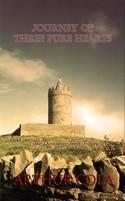
Journey of Three Pure Hearts
Book One: The Doonagore Theft Trilogy
By Arthur Cola
Prologue:
Standing on the coastline of County Clare in western Ireland is a 16th Century Round Tower House with surrounding enclosure walls. It is called Doonagore Castle and lies just above the Village of Doolin. The tower has served as a beacon of sorts for seafarers both legitimate and otherwise for centuries. In fact in 1588 a rather famous event took place called the Spanish Armada. Of course the armada was headed for Britain proper to destroy its Queen, Elizabeth I of England. Philip II of Spain had his sights set on the British Isles but thanks to the forces of Britain, the Queen herself and the ever changing weather conditions along the British coastline the Armada of bulky ships was destroyed by the smaller and easily steered ships of England which found it far easier to navigate the churned up waters of the Irish Sea when storms brewed. It was the aftermath of that encounter in which Doonagore Castle was involved.
170 ragged survivors found themselves on the west coast of Ireland when they spotted the lone tower piercing the sky above Doolin. By the time they had reached landfall however, the Sheriff of Clare, Boetius Clancy, had also heard of their arrival and had them rounded up and imprisoned in the Tower of Doonagore Castle. All were later hanged and buried in a barrow in a mass grave, known as “Cnocan an Crochaire,” as enemies of the Kingdom. Watching the proceedings from the tower was Sir Turlough O’Brien of Ennistsmon, the owner of the Castle and its surrounding lands.
Two and half centuries later Doonagore Castle still dominated the coastline over the Village of Doolin. Only now besides the enclosure walls around the Tower itself a series of short stone walls, often referred to as “famine walls,” also broke up the land area around the castle. The walls were built by tenant farmers referred to as “cottier” who were driven from their small parcel of land, usually less than 3 acres, because they could no longer pay their rent nor support their families due to the “potato blight.” The blight would become known as the Great Famine of Ireland or “an Gorta Mor.” It lasted from 1845-1852 and devastated the staple crop on which these tenant farmers depended to survive. Many of these so called “famine walls” had no purpose other than to give work to the peasants who got a bowl of soup or piece of bread for their work. The people of County Clare were the most severely impacted by the famine with County Mayo coming in a close second in devastation and the resulting starvation and diseases related to malnourishment and exposure to the elements. The latter resulted when they lost their one room stone cottages with thatched roofs upon eviction due to either non-payment of rent to the often absentee landlord or a decision made by the landlord’s “middleman” to use the land for sheep grazing rather than growing a grain crop. The potato crop was mainly used to sustain the tenant farmer’s family and was often their only source of food. The “potato blight” ended that and their capability to pay the rent.
This “middleman system” which had evolved in the managing of the landlord’s property was subject to exploitation of the tenants, who were 80% Catholic. The agent of the landlord was usually Protestant. And even though the Emancipation Act of 1829 was almost twenty years in force, the freedom to worship as one chose, that is openly, was still a relatively new right and not universally enjoyed. In addition to this animosity between the Catholic tenant farmer and the Protestant “agent of the landlord” that agent or middleman subdivided the land which he leased from the landlord into such small parcels so as to exploit as much rent as was possible from the holdings. This however resulted in eviction should a crop fail or the land be turned into grazing fields.
This practice of land use in Ireland was put under scrutiny in 1843 under the chairmanship of the Earl of Devon. In 1845, at the very beginning of the recorded “potato blight’s” full impact, the report on how the laws were enforced with regard to the occupation of the land in Ireland was issued. The Earl reported that “It would be impossible to adequately describe the privations which they (the Irish laborer and his family) habitually and silently endure…in many districts their only food is the potato, their only beverage water…their cabins are seldom a protection against the weather…a bed or a blanket is a rare luxury…and nearly in all, their pig and a manure heap constitute their only property.” Devon and his commission concluded that the Irish patiently endured suffering greater than any other country in Europe.
It is against this backdrop of privation and the “potato blight” that our story begins as three young people face the devastation of their land, their right to worship and their hope to seek a better life in a new land across the sea. This is a fictional account of life and love but one which reflects the 19th Century in Ireland and in the United States.
Chapter One: Victoria Regina
Queen Victoria was enjoying the relative isolation of what she called Osborne House on the Isle of Wight which was still under construction. Her husband, Prince Albert was busily overseeing to each detail as its final façade was being constructed in the style of an Italian Palazzo. That relative informality, so unusual in London at Buckingham Palace or Windsor Castle, was to the Queen most welcomed indeed.
She was seated in the lower garden of the estate next to an oval fountain when the news was brought to her as was custom in a black box. She removed the folder containing the reports she expected but found instead a request from the Corporation of Dublin. It was in fact a deputation of citizens of Dublin which included the Duke of Leinster, the Lord Mayor, Lord Cloncurry and Daniel O’Connell and was sent by the Lord Lieutenant of Ireland to Her Majesty, Victoria Regina, the Queen Empress. The Queen gave little notice to the construction workers milling about her as she opened what was then called a “memorial” or request. In this case it was one to recall Parliament into an early session for the purpose to recommend the requisition of some public money for public works, especially railways in Ireland. The request was dated 1845. Not long before receiving the request to convene Parliament she had discussed with Albert another communiqué in which her Royal Commission chaired by the Earl of Devon stated that the living conditions in Ireland were deplorable and the failure of crops and land use in Ireland needed revision.
Now she was reading that if “Ireland was indeed an integral part of the realm, the common exchequer of both islands should be used, not to give alms, but to provide employment on public works of general utility.”
She folded the paper gently and looked up with an almost serene look and yet with a questioning glance. Prince Albert, upon whom she greatly relied on for advice was summoned as was her Council of Advisors. The question was to address the issue of land use in Ireland and what seemed to be a growing “blight” on its farmers due to a potato crop failure. One thing she had already decided upon before consulting anyone. She wanted a first hand look at Ireland for herself. That would take place but not until 1849 at the height of the “potato blight” caused by a crop disease which effected all of Europe called Phytophethora infestans. But no where was it felt so intensely as in Ireland where because of the land use or misuse as the case may be, tenant farmers had come to depend on their potato crop for the sole support of their families. In the meantime the British Relief Association was formed to address the effects of the growing issue of famine in Ireland.
Across the Irish Sea and on the west coast of Ireland some two years later a slender youth clutched onto the rocky cliff overlooking a shallow harbor on Inishbofin, an island off the western coast of Ireland. As yet the relief efforts were in infantile formation and the blight itself was now a fact of life. Still the youth persevered despite his long thick black hair gathering in clumps and matting in his face causing his difficult climb to be even more perilous. The result of his hair and for that matter the rest of him being sopping wet was that a mist like spray was being forced upwards onto the Cliffside as the waves of the incoming tide were now nipping at his feet. Those almost bare feet were covered with a cloth like sandal for leather shoes were something only people of means could afford for children. Most of the time children actually ran about bare foot. This foot issue made his precarious climb and route all the more dangerous as well as uncomfortable and unsteady. And yet the lad continued his climb up to a ledge which would serve as a pathway to his destination.
The wind continued to whip up the normally calm waters of the small harbor around which this finger of rocky cliff seemed to embrace. The lad knew that once the high tide came in that the tip of the finger of rock would be cut off from the rest of the Inishbofin harbor area. Thus he plodded on grabbing onto the Cliffside until he finally made it to that path like ledge. Leaning against the jagged wall to catch his breath, his already ragged shirt caught hold of a sharp edge of one of the rocks protruding along the pathway. Another tear resulted, another pathway for the chilly air to cause a shiver down his spine. He shook off the effects of the newly formed shredded gateway to his pale bare skin. The lad carefully lifted the faded material from the pointy rock and looked to his left.
There at the tip of the finger protecting the harbor entrance were the ruins of a 12th Century fortress and Church. Its limestone walls with carved out windows were all that remained. Rising out of the Church like structure, given its peaked front and back walls and arched window areas in the Gothic style, a narrow ribbon of smoke made a steady upward movement into the clearing sky. The lad seeing the rising smoke began to chide himself for not having left for the ruins earlier, but that would have been most difficult as he had chores to perform and care to give his ailing mother while his father tried desperately to save a couple of the potato plants so that they might mature. Little did anyone realize that this blight which was now in its third season would go on for another three years.
So it was to backbreaking work that the lad’s father went to try and save the garden set aside to support the family on the leased acre of land on which his father was a tenant farmer. That lease was created by the middleman or overseer of the property owned by what locals called the absentee landlord. In point of fact the lad had never seen the actual landlord in his twelve years of life. The leasing of the plot of land was an agreement between the farmers and the landlord but overseen by the landlord’s representative. In that lease the farmer would raise a grain crop or sheep for export and the garden area was where they could grow potatoes which in Ireland had become the sole food supplement for the family of the tenant farmer. The lad had indeed seen the overseer many times when he came to collect the crop or announce that the grain crop would cease to be planted and the land would now be used to graze sheep. That latter alternative was the case in Inishbofin. With its rocky soil and rugged terrain it became financially more profitable for the overseer to use the land for sheep but that meant less money for the farmer as he usually had just a few sheep to raise and shared a common pasture which in itself was quite barren. And yet until the blight the family had managed to survive though in a most primitive state. Now going into a third year of crop failure the situation for the tenant farmers was becoming desperate indeed. Even the luxury of burning a candle was soon to be a fond memory. There was no money to buy new candles or supplies to make them. The exporting of the sheep for food or wool was profitable for the overseer and the landlord. What the famer received for his toil was the use of the land and a plot to grow what he could to sustain his family. There was the cottage as well. The thatched roof edifice hardly kept out the elements and that is why the lad was running late for his rendezvous. His mother had taken ill.
The lad’s stomach began to grumble as the digestive juices attempted to reduce the couple of slices of potato for absorption into the boy’s scrawny body. That soup which was nothing more then hot water with a potato in it would serve as the family’s only meal of the day. She cooked it over the hearth which was now their only source of heat and light. As for oil lamps, those would be found only in the homes of the land owners or the overseers.
The wind shifted causing that stream of smoke emitting from the ruin to waft toward the ledge on which the lad now stood under a small gush of water flowing down the rocky slope. The lad thought it provided an opportunity to wash off the mud splattered, hardened and crusted over his clothes and body after several days of chores in the field. He wanted to look his best for the arranged meeting in the ruin; so he scrubbed his tattered pants and shirt on a smooth rock and then rubbed his skin violently to remove the dirt which had become muddy. His rib cage clearly showed the ravages of lack of nourishment. The relief funding had yet to arrive on Inishbofin. Scrawny though he was he was better off than many of the children on the island. So many of his friends had taken ill or died that a special children’s cemetery had been created. Would he soon join them? That was a question he didn’t want to answer and that’s why he made his way toward the ruin on the finger tip of the harbor.
As he ran his fingers threw his long black hair so as to remove any clumps of mud which remained the smoke floated toward the ledge on which he stood. His nostrils picked up the sweet smell of peat which was quite familiar to him and brought him thoughts of family gathered around the hearth in happier days sharing stories of the Island and folklore tales of how Inishbofin got its name of “White Cow.” His grandfather would sit with the lad on his knee and tell the tale of how two fishermen were lost at sea and landed on the shore of the island. As they searched for signs of life they came upon an old woman carrying a stick and guiding a white cow along a path toward a lake. That lake was named Loch Bo Finne and from it the woman and the cow would come forth to warn of impending danger. The tale was told in the ancient language of course, one which the outsiders could not understand readily. The lad having stepped under the cascading stream, letting the cold water splash over him now wrung out his clothes as best as he could and slipped his pants over his boney legs and up to his waist. He tied the rope securely so that they would stay in place as there was little to hold them up otherwise. All the while he wondered why the old woman had not come to warn the people of Inishbofin of the landlord’s overseers whose policies made it so difficult to support a family.
“And what about the crop failures?” he thought.
Certainly the impending disaster of the blight was worthy of a warning of some kind. He slipped his shirt over his narrow shoulders and rib cage. It hung like a wet rag on a clothes line but at least it was clean. More of the sweet smell reached him. It was from a peat fire for sure. He was acutely aware of that as peat was the source of heat and light in the family’s stone cottage. He would help his father cut peat from the village bog and haul it home. He and his father as well as the other farmers were allowed to harvest peat as part of the lease agreement. And so it became a monthly chore which at least brought him into contact with other boys around his own age for there was, as yet, no formal school house on the island. The fragrance filled his nostrils again and he again felt that sense of family being about him. It was because of that love of family that he was about to do once again what was done before in the ruins on the fingertip of Inishbofin Harbor. What he was about to do was the last hope for he and his family.
The ledge on which the lad traveled was getting narrow as it approached a crevice which split the slope. On the other side the rocky surface was flatter. Soon that crevice and low lying area would be covered with the waters of the incoming tide. This would isolate the ruins from the rest of the island until morning when low tide set in and the waters would recess from the low lying surface leading to the ruins. He leapt across the crevice without much difficulty having followed this route in keeping this appointment on a regular basis since he was ten years old. He landed on the uneven surface of rock, slipped and found himself in a puddle of sea water. A curse from his young lips ensued, not a terribly horrific one. It was more of a “Saints preserve us” type of exclamation which was followed by a quick glance toward the source of the peat smoke rising in the center of the former chapel building. Picking himself up and checking for muddy residue which he had so laboriously sought to eliminate in the hasty cold shower under the water fall stream, he shook his head and began the final leg of the journey. As he began he surveyed the entire landscape of the harbor from his vantage point.
Directly in his vision was a centuries old mast of a sunken ship which had sunk in the harbor when it entered at low tide and struck a huge boulder. It was, according to his grandfather who had passed onto glory just over a year ago, a pirate ship.
“To be sure,” granddad would say. “It belonged to the O’Malley clan which sailed along the western coast of Ireland searching for vessels to intercept and to loot seaside towns. Their claim to fame was none other than the pirate queen herself, Gracie O’Malley.”
The lad smiled as he gazed upon the decaying mast worn by tides coming in and out for some two hundred years. “Aye, but that was a great tale,” the lad thought as he created the vision of the captured Pirate Queen being brought before Queen Elizabeth I of England. “I wish I could have been there when the Queen and Gracie met face to face.” 'Twas at that meeting that one of his father’s favorite terms was created when he was told the same tale. That happened when Her Majesty questioned Grace about her pirating ways and the conditions of western Ireland. She ended with the command that the Queen of Pirates should not feed the Queen of England any Blarney; that is exaggerated tales.
The lad laughed quietly and almost gave a skip as he turned to quickly reach his goal. How many times had his father given a similar directive when he returned home at a late hour after his scheduled rendezvous the purpose of which his parents knew nothing at all. Then he became somber as he realized that after this day’s meeting it may be too late for him to return home until morning.
“Oh, mi Ma will be upset and praying on the beads that I might not be dead,” he spoke aloud but softly.
The lad began to fancy himself as a pirate of sorts as he approached the site for his clandestine meeting with someone who just a couple of decades ago, was in prison. He too would seek his fortune, save his family and buy that plot of land as poor as it was for them. And if that meant prison then he was willing to accept the consequences for his act of meeting with an ex-convict, who until the Act of Emancipation of 1829 sat in a prison cell waiting to be deported to Australia or Bermuda.
With the passage of that act by Parliament the convict was freed of the sentence of exile. After centuries of being forbidden to own land or even live within 5 kilometers of a town, he being a Catholic could once again sit in the British Parliament and practice the faith openly. However, Emancipation or not, most of the 80% of the Catholic population lived in abject poverty. And that state worsened with the onset of the blight as it took hold on the potato crop two decades later.
On the tiny island called Inishbofin that Act of Emancipation had hardly been understood let alone experienced. Within the 7th century ruins of a Church founded by St. Colman the Catholic population would gather in secret to worship. Rarely could a priest be concealed and sneaked onto the island. Even so on occasion through the efforts of the Pope and through Spain’s help one was smuggled in now and then. The priest would arrive aboard a pirate ship which even in the 19th century still threatened those on the seas off western Ireland, celebrate the Mass and hastily be brought to other villages along the coastline.
It was with that sense of history and swashbuckling folklore that the lad came to an abrupt stop in the stone archway which served as the threshold of the Church ruin. At the opposite end of the ruin sat a man warming his hands over the peat fire which was the source of that smoky yet sweet fragrance which had brought on those family history lessons. The shadow of the back wall cast a pall over the black clad man. His flame red hair served to offer the only sense of vibrant color to the rather bleak scene of shadow and glowing embers. Next to the man, resting on a flat stone was a black leather sack. The man, having revived his hands over the glowing peat, turned slightly and opened the sack. He withdrew a black leather bound book. Its only ornamentation consisted of gold letters which read “Holy Bible” and an emblazoned gilded Cross below the words.
His now more nimble fingers began to page through the book of Scriptures until he came across the passage for which he was searching. Having found the verse he obviously sought he pulled a thin red ribbon attached to the binding and placed it across the page. Closing the Bible, he then looked up. The glow of the peat fire illuminated his stubbly facial hair which matched the flame red of his thick head of hair. The stubble somewhat concealed a scar across his right cheek. That he had received when arrested some twenty years ago when he was but a young man of twenty-two. It seems when arrested those who did so mocked his faith and struck him to test his knowledge of Scripture as to a disciple being required to turn the other cheek. The ring on the hand of his captor cut into his fair skin resulting in a garish bloody cut. His green eyes darted about the ruin until he noticed the slender figure pausing under the threshold. The lad smiled having recognized this face which was highlighted by the fading light of daylight as well as that of the small fire contained in a ring of stones. It was indeed the man with whom the lad had been sneaking away to meet for three years. This was his teacher, friend and priest come to meet with him once again.
“Hi Father Thomas,” the lad called out.
The priest smiled gently and waved to the lad to come to him. He pulled out a pocket watch and glanced at the time, knowing that it was well past the usual time for their meeting. He motioned to the lad for quiet as the term “Father” was still rather shocking to him after having been called so many things other than such a familiar term. Even after almost two decades of Emancipation for Catholics he was still nervous about being publicly recognized. His memory of being released from Lynch’s Castle prison in Galway where he had been taken upon his capture on a small boat headed for the Aran Islands was still quite vivid. Back then he was a young man and newly ordained returning from Rome in 1828 as an Augustinian Priest in that year before Emancipation. The Prior had sent Father O’Malley back to his homeland to minister secretly. It wasn’t long before he was hunted down for preaching and celebrating the Sacraments in another harbor village by the name of Doolin in County Clare. Authorities were dragging their feet regarding the release of priests who were considered to be undermining the authorities. The few remaining priests included he, Thomas O’Malley, of the very clan which had achieved fame for pirating and that was reason enough to continue to hold him.
It was decided to transfer those that remained to the Aran Islands just outside Galway Bay and so isolated so as to be able to keep a close watch on their activities. Upon arrival on Inishmor Thomas O’Malley built a small Church across from the ruins of the Seven Churches, so named as to recall the monastic community which for centuries had run not only a Holy place for worship but also a school which attracted young people from across Europe until Oliver Cromwell finally destroyed it during the English Civil War two hundred years earlier. Thomas O’Malley felt a connection to the ancient site founded by scholars sent from Rome as he had been. For almost twenty years he ministered to the struggling people of Inishmor, Inishmaan, and Inisheer who made their living by fishing in the coastal waters off Galway and the Atlantic Ocean itself. Some were also farmers trying to raise sheep and grow what crops they could on the soil originally created by bringing sand and sea plants out of the sea to be placed over the limestone surface covering the island. As it became more accepted to practice the faith O’Malley began to be an accepted figure on the three islands comprising the Aran Islands. He would travel from island to island each week-end to celebrate Mass for the farmers and fishermen, the latter being the main source of income and food for the residents of the islands. On one of those journeys, he hitched a ride on a fishing vessel and was caught in a storm. These quickly brew off the Atlantic Ocean. The fishing boat was blown off course up the coast of western Ireland. As the tiny fishing vessel was tossed on the open sea Father Thomas O’Malley prayed the Holy Rosary for the crew as they desperately brought in sail, so the wind would not rip them completely apart and thus prevent their use when the winds finally subsided. The Captain of the boat, one called Eoin O’Flaherty, shouted out orders as the waves came crashing over the side of the vessel threatening to capsize it. His crew was comprised of his two sons and a son-in-law. Each of them drenched to the skin despite their somewhat water resistant woolen sweaters woven with a family pattern so as to identify them should they be drowned. At one time it was the O’Flaherty family who along with the O’Brien clan had held reign over the islands until the time of Queen Elizabeth I. During the English Civil War all their power was taken when Oliver Cromwell subdued the island. From then until the 1950’s the islands would evolve very little from what could be seen on that tiny fishing vessel.
The O’Flaherty boys and the O’Brien lad were having a dickens of a time trying to bring in the sail. The boom shifted and knocked Adam O’Brien onto the praying priest huddled along the storage hold for the caught fish.
Apologizing fervently the lad added, “’Tis a wild storm it is Father, lost mi footing a bit. But she won’t be getting the best of me.” Then with a reddened face he turned into the wind and shouted, “Pog mo thon, ye beast.”
The fact that the lad had just addressed the storm as a person so as to say that it should kiss his ass did not make the priest flinch in the least. In fact he slapped young Adam’s back and helped the young man to his feet as he made it known that he did not build his Church nor endure prison to be drowned in the wilds of the ocean. And with that he pocketed the beads and went to help lash the sail into place. Once accomplished, the vessel, though still being tossed about, was no longer “leaning to” so far as to capsize.
The Captain held tightly to the tiller along with the eldest of his three sons, Aedan, a sturdy lad with arms which might well tow the boat onto a shore without help or so he would want you to think. They did however lend necessary steadiness to keep the tiller firm. After nearly the greater part of the day being spent righting the boat and fearing that their end was near the winds subsided as quickly as they appeared and the black clouds parted letting through rays of sunshine. The waves of the sea became such as to rock the vessel as one would a child in a cradle.
All save the Captain collapsed on the deck to breathe a sigh of relief and give thanks to God for their safety. ‘Twas while the crew and priest lay on the deck that Captain O’Flaherty began to shout, “land ho.” Scrambling to their feet the youngest of them, one called Aengus O’Flaherty parted his reddish brown hair which lay matted across his face.
He was named after a prehistoric chieftain who had built a fortress on the Western Cliffside of Inishmor not far from the village of Kilmurvy. He thought himself to be a warrior more than a fisherman. But like any of those souls on the rocky islands there was little hope to ever leave what was home to them. This was especially true now that the blight had virtually devastated most of western Ireland. They at least could fish and sheep had been brought to the island to supplement the meager crops.
Aengus began to shout, “Dadai, I can see some kind of fort, a ruin of one. There’s someone on the wall waving at us.”
The youngest son was quite correct in his observation. There was indeed someone straddling the fortress’s ruin of a wall facing the sea. It was a boy of around ten years in age, the very lad who would befriend the priest and be educated by him. He was doing more then offering a greeting, however. He was frantically motioning them to follow the watery passage away from the ruin so as to avoid partially and totally submerged rocks. The lad, who had rarely seen such a vessel even though it was quite modest in size to be sure, instinctively knew that it was too large to sail over the rocks surrounding the fingertip of the harbor of Inishbofin. And so he was directing them to steer to the left of the Cromwellian Promitory Fortress ruin, which had been built over the ruins of an even older church.
Thus Aengus found himself being the navigator and taking signals from a boy atop a rock pile which once was a fortress wall.
As the boat sailed closer the lad jumped up and followed along the wall all the while motioning and shouting to them as to where the safest entrance would be to the harbor. With hands on his hips the raggedly dressed lad with wind swept coal like hair then took both hands from his waist and gestured to an area just to the left of the sunken pirate ship the mast of which was quite evident to the fishermen as well as the Priest. Captain O’Flaherty ordered that the anchor be dropped and signaled to the lad that all was well.
“’Tis grand,” the lad shouted. “Welcome to Inishbofin.”
The almost adult style of the language impressed O’Malley and the crew. They shouted back and began to untie the dingy, which was rather beaten up from the storm. This they used to row to the lad, who was now on the rocky ledge on which the fortress ruin stood. The boy in him was jumping up and down with excitement as the five men tied the dingy to a rock and began to climb up toward the lad. The storm had moved off to the east its line of dark clouds could still be seen in the distance. But over the harbor area there was bright sunshine and welcomed it was by the sopping wet men of the little fishing vessel named “Eoghanacht” after the village where the Ruin of the Na Seacht dTeampaill (Seven Churches) is located as well as Father O’Malley’s new church.
It was, however, the man in him (despite the rags covering those parts of his frail frame which needed to be clothed stating otherwise) that received the five burly men onto the ruin of what he identified to be his castle.
“Indeed mi lord, we are honored to be welcomed by such nobility,” began Captain O’Flaherty.
“Aye, to be sure,” chimed in the sons as they offered a slight bow.
“But most of all we owe ye a debt of gratitude,” Father O’Malley started to say when he noticed an inquisitive look on the boy’s face. He thought upon his words and corrected them. “That is, we give ye thanks for your help in getting our boat into the harbor safely.”
The lad beamed his pleasure and understanding. Those words of debt and gratitude had been a bit over his head so to speak.
“If you would be so kind as to follow me, I have a fire ready,” the lad said as the men looked at each other with surprise and followed obediently into the very church ruin where the lad would meet with Father O’Malley over the next two years.
As they huddled around the fire the lad made note of how wet they were and that a good fire was what they needed to warm themselves up after what appeared to be such a dangerous journey in a storm. It was then that the Captain had to admit that they were not on a journey but rather just blown off course from the Aran Islands fishing waters. The news that they were not on an adventure did not disappoint the boy. He inquired as to who they were and who their people were. The O’Flaherty and O’Brien names brought a smile to the lad’s face for even on Inishbofin they had heard of the noble families from the old days. But when Thomas O’Malley introduced himself the boy could not be subdued within that fragile body any longer. He began to shout and jumped up to point back into the harbor and spew out the tale of the Pirate Queen Grace O’Malley and how her people sailed the waters to bring vengeance on the ships which took away the goods grown and created in Ireland.
“And that is a mast of an O’Malley pirate ship, sir,” the boy concluded. “Lost at sea they were just like you. Alas they had no one to tell them where the rocks are.”
The lad was so excited now that he hadn’t noticed the other men motioning to him, well more like pointing to Thomas O’Malley, who was blushing at the story being excitedly told. Captain O’Flaherty coughed loudly to gain the boy’s attention.
“Mi lord, may I introduce you to Father Thomas O’Malley who is not a pirate but sent from the Holy Father in Rome to preach the Good News.”
The lad made a sign of the Cross quickly from head to heart to each shoulder. “Father O’Malley, I had no idea that you were a priest. I mean you look like one of them.” He pointed to the fishermen. “I just thought….”
Father O’Malley placed his hand on the boy’s shoulder and smiled, while explaining that he was indeed a “fisher of men.” He added how honored he was to be placed in such esteem as that of the Pirate Queen herself. Then he finally got to ask a question.
“And now young sir, would you honor all of us by telling us the name of the gentleman who knows of such tales and rescues seamen from the storm?”
“Aye, if you insist. It’s just a common name on Inishbofin. Mi name is James Richard Shields.”