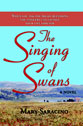
The Singing of Swans takes readers on a multi-century, magical journey to uncover secret rituals, ancient spiritual beliefs and long-silenced traditions.
The Singing of Swanstells the story of Madalene Ross, a thirty-year-old American who lives "in her head" cut off from her body, her heart, and her sense of purpose in the world. En route to and from her job as a computer programmer for a financial services corporation, Madalene is hounded on the downtown streets by a homeless woman who asks, "Got a match?" Each night, Madalene is also haunted by inexplicable dreams, filled with mysterious events in the lives of three women: Rosalina, a priestess of Persephone in 70 B.C.E. Sicily; Ziza, a strega (Italian witch) in 16th Century northeastern Italy; and Ibla, an herbalist and painter in 18th Century southern Italy. The novel unfolds, interweaving Madalene's, Rosalina's, Ziza's, and Ibla's stories. Midway through the manuscript, circumstances transpire compelling Madalene to travel to Sicily where she meets Julia and Iside, two eco-activists intent on restoring a dying lake near Enna, in the center of the island. In Sicily, Madalene confronts all that's she has repressed over the last 20 years and experiences a transformation. By the novel's end she learns the identities of the three women in her dreams and of the homeless woman who had been badgering her. She returns to America, intent on reclaiming her life.
Elements of magical realism dovetail with historical lore as this compelling tale of redemption unfolds.
Excerpt
Chapter 1
Night Rider
The night sky held no moon as Ziza pushed through the roof of her house and soared into the stark blackness. A gust of wind became her wings, pushing her up and up above the slumbering sounds of her small village, Caneva, in Friuli — a province tucked away in the northeastern corner of a country that what would someday be known as Italy. Far below, beneath an inky darkness, only the occasional stray cat peered up from the cobblestones, twitching its tail in anticipation of a passing mouse. Ziza’s neighbors snored in their beds. Her husband, Aldo DeSante, tossed and turned, unaware that while his wife’s body lay beside him, her spirit traveled elsewhere. She promised to return before the stroke of five to ensure that death would not claim her mortal limbs. Her children were lost in complicated dreams and her mother, Carmela, nursing a bout of insomnia, sat before the family’s ancestral Lare altar, next to the cold hearth in the corner of their small home. She alone knew that Ziza had been called away on official business.
It was cold that Thursday night in the midst of the Ember days of fasting. A sharp wind howled fiercely down the alleyways that third week of September in the year 1575, foreshadowing a long, frigid winter, but Ziza felt nothing of the chill for her body was as vaporous as air. Light and porous she flew past the church steeple, the shops that lined the piazza, and over the well in the center of her village. Dense clouds hovered over the land; no stars shone to guide her, but still Ziza kept on. She levitated above the tiled rooftops, pausing a moment to determine if the others were ready, as well. From the darkened bell tower, an owl hooted, signaling for her to proceed.
Professional Reviews
MatriFocus Review: The Singing of Swans
by Dahti Blanchard The Singing of Swans
Mary Saracino, Pearlsong Press (October 2006)
There is a lake, of waters clear and deep
Not far from the walls of Enna, called Pergus.
Even Cayster never heard Such singing of swans, so many have nested here;
With dark branches, a wood gives shade,
Encircling the lake as though to defend it;
Here flowers always bloom, winter never falls,
Here eternal spring smiles.
These words from Ovid's "Metamorphoses" grace the second page of The Singing of Swans, Mary Saracino's lovely novel of a thoroughly modern woman, Madalene Ross, who has no time for either thoughts of eternal smiles or a singing of swans. The first page holds a dedication to "…the Dark Mother, humankind's first deity, our most ancient memory." It is Madalene's reluctant encounter with the Dark Mother and how She leads to that special place where one can hear the singing of swans that form the crux of this story.
Saracino deftly takes the reader between times and weaves the stories of several women tied together in a line that calls to Madalene, though she fights the call, certain that she must, quite simply, be going bonkers.
Madalene, also known as Maddie, is frightened by and tries to avoid a mysterious bag lady who keeps stopping her on the street and asking her if she has a match. Maddie is also having strange dreams she doesn't understand or want. Dreams "…full of women who said and did strange, unpredictable things: women of magic who flew through the air, walked through walls, and defied the laws of nature in countless ways. Women who concocted liniments and teas from strange and unusual plants. Women who chanted weird songs and cradled terra cotta statues in their hands; women who screamed in stonewalled courtyards in a countryside of rolling hills and fields filled with wild, red poppies — a landscape Madalene did not recognize."
As a "sensible" workaholic with no social life, she dismisses the dreams as "something she ate" until the bag lady accosts her one too many times and says, "My daughter, do not be concerned with all that you are seeing with your dream eyes. They are coming for you. Your sisters are returning. Your Mother wants to talk to you. Listen and you will know what to do." Maddie has no intention of listening — to the crazy old woman or her dreams. But fate steps in and Maddie embarks on an unexpected journey to Sicily, carrying with her a small statue of a dark Madonna that was hidden away in her family's mementos. While there, Madalene discovers many things about the place, the people and herself.
This is not just the story of Madalene Ross, however. The author does a wonderful job of painting a complete picture of the women who are Madalene's "sisters." We come to learn of each of the characters: their lives, thoughts, joys, fears and pain as if we're right there with them, though they and Maddie are separated by time.
Saracino also manages to convey a message that resonates for us in the real present without the unwelcome preachiness that a less talented author might fall into. This is one of those rare, lovely works of fiction that touches on past injustices, ecology, healing and women's spirituality, while managing to keep the reader engaged and entertained throughout.
www.matrifocus.com/SAM06/review-fiction.htm
The Femiinist Review: The Singing of Swans
Individualism. Capitalism. Survival. Of the fittest. These are values in our society that have evolved from the ideals taught in our mythologies. Historically, these mythologies have been male dominated and, in many cases, have been interpreted in ways designed to oppress certain groups - among them, women. Mary Saracino’s novel The Singing of Swans is a female-centered mythology focusing on the feminine divine, the Divine Mother.
The story revolves around Madalene Ross, a woman in contemporary society whose connections to those around her are tenuous at best. She lost her mother when she was a child, she has a poor relationship with her father and most of her friendships are work related. She discovers her spiritual connection to the past through dreams and an encounter with a homeless woman. Madalene is one in an ancient line of women: the Streghe, women with deep spiritual connections to the Divine Mother, who have been silenced by male dominated social structures, particularly the Catholic Church.
Saracino’s mythology gives a voice to women while also providing social commentary about oppressive forces throughout history. Woven through Madalene’s story are the stories of other Streghe: Ziza, Rosalina, Josephina, Ibla, and Magda, and their struggles to maintain their voice and their connections to the Divine Mother. Using the physical connection of blood ties – to our ancestors and Mother Earth – as well as spiritual ties, Saracino illustrates our sacred connection to the divine in nature and each other, woven as thread through a tapestry, to the past and the future.
While I occasionally enjoy a fun story in a nice, neat package, I truly appreciate those stories that leave me asking questions and searching within myself. How am I connected to all that has happened in the past and all that will happen in the future? We are not islands unto ourselves and Saracino shows our connections – how our pasts have shaped our world today and how we shape the future.
Review by Jeanne Winslow, The Feminist Review, March 21, 2007
Story Circle Reviews: The Singing of Swans
Mary Saracino's novel, The Singing of Swans, is so chock full of goddess lore I am tempted to keep it for a reference book. The author has crammed her story with well-researched information about the Dark Mother, Cybele, or Demeter, who she calls "humankind's first deity, and our most ancient memory."
The story begins with Ziza, a woman who flies through the roof of her house on a night in September, 1575 and meets with other "keepers of the blood ways," shamans, healers, herbalists and astral travelers. They are the Benandanti, and four times a year they leave their bodies to battle the Malandanti, their arch enemies, thus ensuring a bountiful harvest.
In the second chapter, we meet Madalene Ross, a workaholic software specialist in Minneapolis who smokes, drinks and is troubled by strange dreams of old women chanting and holding handfuls of herbs.
Soon she is stalked by a homeless woman who appears out of nowhere and tells Maddie "Your Mother wants to talk to you." And then Madalene finds a note that says "Go to the Lake" written in her own handwriting.
In her closet, in a box her deceased mother saved for her, Maddie finds a notebook labeled "Rossolino Family Tree" and a small figure of the Virgin Mother with dark skin. Still troubled by disturbing dreams of women healers, Madalene suddenly loses her job in a corporate downsizing. She gives in to an overwhelming desire to travel to Pergusa, Italy, in search of her family's roots.
Meanwhile, the author takes us back to the women of the Benandanti as they struggle through the years. The leaders of the Catholic Church try to demolish their traditions and force them to conform to church teachings. Some of their tactics are violent, but the women persevere. In secret, they keep their worship of the Dark Mother alive. She is called the Black Madonna by all who join them, accepting her as the virgin mother of Jesus, which the church allows. But in secret, they worship her as the Divine She, a deity in her own right.
I first learned about the Black Madonna as a child, when I saw a painting of her in my Polish Catholic church. I was told that in the original painting in Czestochowa, Poland, her skin was blackened in a fire. Imagine my surprise and joy to discover, as an adult woman, that her image is older than the Church and can be found throughout the world. Most recently, I visited another Black Madonna in a four-hundred-year old church in Puerto Rico, and was told her skin was darkened by the sun.
Back in the present time, Madalene arrives in Pergusa and finds the lake is dying from pollution. She meets an eco-feminist working to save the lake.
In a dream, she meets Ziza and the other ancient women, learns about the long tradition of the Dark Mother and talks with her own mother, who urges her to use her intuition, which she has always ignored, as well as her brain.
Madalene realizes what she needs is to reclaim her self, in all its complexity, just as others are reclaiming Lake Pergusa. For me, she is a stand-in for women as a whole, throughout history, especially in times of patriarchy. Saracino is realistic in her portrayal of the violence of women's struggle for personal power and self-determination in ancient times. We would do well to remember this and realize that even today, voiceless women suffer at the hands of male-dominated societies around the world, a story we don't often see on the evening news.
Without being heavy-handed or taking political sides, Saracino educates the reader about women's spirituality, herbalism and Italian culture and traditions, while keeping us turning the pages, rooting for Madalene and following her adventures to the conclusion.
Mary Saracino is the author of the novels No Matter What and Finding Grace and the memoir Voices of the Soft-bellied Warrior.
Reviewed by Linda Wisniewski, Doylestown PA ; April 10, 2007
Major League ballplayer Justin Moore is kidnapped from his own ballpark and transported to a foreign land. It might take high-level international negotiations to free him. Or maybe he will take matters into his own hands.