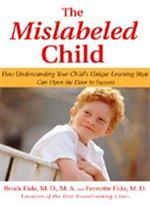
The Mislabeled Child is a revolutionary book that looks beneath the labels children receive, and addresses the real underlying issues. Essential reading for parents, teachers, and health care professionals alike, this highly readable text provides specific, practical approaches to recognizing and capitalizing on children's strengths in order to help them flourish. From sensory processing difficulties to dyslexia, from language problems to poor handwriting skills, the Eides provide useful insights and marvelous advice.
Professional Reviews
Publishers Weekly
This husband-and-wife team (both doctors run the Eide Neurolearning Clinic in Edmonds, Wash.) offer this informative but clinical aid to labeling and dealing with various "brain-based learning challenges." Each of the 11 chapters focuses on "a single type of learning system and the challenges that affect it"—"Overlooking the Obvious: Visual Problems in Children"; "Getting It All Together: Attention Problems in Children"; "Making the Right Connections: Autism and Autism-like Disorders." After discussing the brain processes that underlie each learning system, the Eides offer steps that can be taken to help children whose processes fall into each category. In-depth case histories might have put a human face on a book that is supposed to be aimed at parents and teachers as well as educated child-care professionals, but as it stands, the college –textbook–like tone renders it most suitable as a solid reference tool. (Aug.)
Booklist
Because of the propensity of schools and society to label children, the Eides, physicians who specialize in treating children with learning challenges, want to ensure the accuracy of those labels. In their practice, they have seen children with misdiagnosed, undiagnosed, and untreated disabilities who are called lazy or underachievers. But the Eides emphasize that even the correct label does not define a child. The Eides show readers how to determine children's learning strengths and weaknesses and how to make the most of their potential. They focus on assessing children's learning systems, using that information to complete a learning profile, and using the profile to design a program of education, therapy, and play. The Eides offer physiological research on brain development, and how learning disabilities tie into behavior difficulties. The Eides get a bit academic at points, but they intersperse case studies that keep the material accessible as they examine a range of learning disabilities from ADHD to dyslexia and dysgraphia. A valuable resource for parents and educators. Vanessa Bush
This valuable educational tool for students and teachers not only entertains with engaging stories on the lives and events which comprised the Harlem Renaissance of the 1920s. It also provides important case studies of diversity, multiculturalism, an
At last, a version of Simple Steps to Sentence Sense for younger students and those whose native language is not English. Students can learn to analyze sentences in 5 easy steps.
Do you teach more than one grade level?
If so, you may be ready for some NEW Reproducible Exercises, Tests, and Writing Connection Pages to use with Simple Steps to Sentence Sense for High School by Charlene Tess