Kindle Edition
Download to your Nook (eBook)
Amazon
Laury A. Egan
Humanist Press
Category:
Young Adult/Teen
Publisher: Humanist Press
Type: Fiction
Pages: 214
Copyright: September 30, 2013
ISBN-13: 9780931779374
Price: $7.99 (eBook)
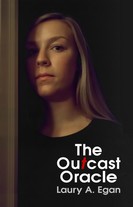
Set in 1959 on the shores of New York’s Lake Ontario, fourteen-year-old Charlene Beth Whitestone has been deserted by her parents, leaving her in the custody of her grandfather, C.B. Although he loves Charlie, he is a charming con artist, moonshiner, and religious fraud who inducts her into his various enterprises yet also encourages her dreams of becoming a writer. When C.B. suddenly dies, Charlie is left alone and must use her wits and resourcefulness to take charge of her life, all the while wrestling with the morality of continuing her grandfather’s schemes. When a handsome cowboy-stranger, Blake, arrives, he insinuates himself into C.B.’s religion business and into Charlie’s heart. Despite her resistance, Blake mounts a lucrative PR campaign, touting Charlie as an “oracle” and arranging for her to perform miracles.
“The Outcast Oracle is a page-turning tour de force, full of humor, irony, winks at societal conventions, and serious revelations about the ruses and abuses of organized religion. This lively tale stars Charlene “Charlie” Beth Whitestone, an all-American teenage girl grappling with the pain of growing up, feeling alone, and finding her path through a thicket of family disasters. Hers will be one of the most enduring voices of contemporary fiction: humanist, feminist, or otherwise. She’ll make you think; she’ll make you laugh out loud.”
—Karla Linn Merrifield, author of Lithic Scatter and Other Poems
Excerpt
“Charlene Beth Whitestone, you are a darned fool!”
I’m standing in a little clearing surrounded by laurel bushes, shouting at myself and kicking rocks. This is what I do after a bad day at school, and today was nearly a disaster.
Normally, I keep my diary in the secret compartment of my bedroom closet, but I brought it to the school library to transfer short story notes from the diary to my composition book. I was trying to do this without anyone noticing, but one of the girls, Peggy, grabbed the diary, ran over to a crowd of my classmates, and started reading aloud. I jumped to my feet and chased her around the table, finally ripping the book out of her hands. All the kids were heehawing like a bunch of donkeys. My face got hot and I wanted to whack Peggy or else disappear, neither of which I could do because the librarian came when she heard the ruckus. I sat down, feeling miserable and yet incredibly lucky. Lucky because the first entry didn’t contain any of our family’s secrets.
A little breeze stirs the laurel leaves and brings me back to the sad task at hand. I finger the embossed gold “1958” on the cover and sigh. I don’t want to part with my diary because it’s the last present my mother gave me, but I must. Gently, I lay the book on the ground and surround it with stones from the creek bed, recalling that I started writing entries in October, two days before my fourteenth birthday. That afternoon I came home from school and my parents had gone. Vanished without a goodbye. Grandpa promised they’d return in the spring like robins, but the robins are bobbing around the green grass and no red Chevy truck is in sight.
It’s a toss up if I miss Daddy. He was quick with the belt and heavy on the liquor. Sometimes he could be nice—playing catch or taking me fishing—but he was more likely to get mad if I threw the ball over his head or got my hook snagged. Then big trouble would start. Unless Grandpa or Mama were around to help, he’d hit me until I could escape or his anger got stuck on someone else. I don’t know why Mama fell for him—maybe because she likes her liquor, too. Whatever reason, she never married him, though Daddy pretends she did and throws a fit whenever he sees “Whitestone” on my school papers instead of his last name, Cullem.
Mama comes from good stock, educated folk like Grandpa C.B.—that’s short for Charles Barrett Whitestone, whom I’m named after. Grandpa has some unusual ways, but he thinks Daddy is a real scoundrel and doesn’t understand why Mama left with him last October, especially because she loves me, or so Grandpa says every night before bed. I think she does care, but the love is mixed up with the bad stuff inside her and the need to wander.
Ever since I was little, there would be times when she’d work herself into a lather, talking fast and staying up all night. When these excitements took hold, Mama would disappear for a week or so, spinning all her energy out into the world until she’d find her way home, dead-tired. If one of her spells met up with one of Daddy’s drinking bouts, they’d carry on like two wildfires until Mama’s heat became too much and she’d get in the truck and fly away. When this happened, Grandpa and I would climb in his car and go to Rochester or Niagara Falls until Daddy sobered up. All in all, I’m not eager to have Daddy return. Mama is a different story.
The diary holds many memories, probably best erased. From now on, I will only write about things I imagine and places that are different from my home of Butztown, New York, which is near Lake Ontario. There’s not much to Butztown. A general store, filling station, bank, bar, school, and post office. Most of the people are farmers who grow corn, soybeans, apples, grapes, and raise livestock. Neighbors don’t tend to congregate except for school activities and church on Sunday, which is when Grandpa takes center stage.
On the face of things, my grandfather appears to be a man of God—the Right Reverend Whitestone. I don’t know why he glued on “Right” in front of “Reverend,” but since he says he’s always correct about everything, I suppose it’s accurate. He has a diploma in a black frame to prove he’s a minister or, rather, a fake diploma created in our basement. Because there isn’t much competition in the religious market around here—just a small Methodist church serviced by a circuit preacher and a Catholic church in Brockport—Grandpa has lots of customers. He also gets to be tax-free, though Grandpa isn’t one to pay taxes in the first place.
Anyhow, on Sundays or when someone dies or a kid needs dunking in holy water—supplied by me from the kitchen sink—Grandpa holds forth in the “chapel,” a large downstairs parlor we expanded on the right side of the house. Eight rows of folding chairs are arranged facing the front of the room, and a couple of Virgin Mary and Jesus paintings are hung around, which Grandpa bought cheap at a Chinese auction. He made the altar cross himself, painted it with gold, saying it was rustic but heartfelt, and winked right after he said this so I knew he was joking. At a busy service, sometimes he has a full house of forty, and sometimes—during hunting season or when the fish are running—the service is mostly attended by women and children. He doesn’t care who comes so long as they contribute.
Because I’ve recorded details of C.B.’s religion business and other shady deals, this is the main reason why I must destroy the diary. I sigh again and spread open the book. After striking a match, I light the gilt-edged pages, puffing on the tiny flame until the fire is licking orange around the white leather and turning the brass lock to a greenish black. The lined pages lift and curl, burning up five months of painful words and heartache. As the smoke swirls through the tree branches, I sit back, relieved that I’ve done the right thing by Grandpa.
I toss some twigs on the fire, listen to them snap, smell the sweet smoke, and think about my short story. Though I probably won’t risk it, I’d love to make one of my characters into a moonshiner because a writer should write about what he or she knows best, and I am fairly knowledgeable about making corn whiskey because it’s one of Grandpa’s other profitable enterprises. From a little building tucked in a grove of willow trees just off the driveway, we sell the hooch—or rather we’re supposed to say my Daddy does in order to protect Grandpa’s good name and moral authority.
Last fall, my cousins built the place. It’s as big as two times me in one direction and two and a half times me in the other. I actually had to lie down on the grass for the measurements. My cousins Buck and Corey thought this was funny until they realized they also had to dig below ground—my height plus some maneuvering room. Grandpa insisted this had to be done in order to create a hidey-hole for our one-quart Mason jars. After the boys built shelves all around inside the “basement” and placed a ladder so I could get down to the wares, they covered it with boards except for a hatch hidden under a red oriental carpet, upon which we keep a stack of Bibles that Grandpa sells when someone is in need of enlightening. One of my jobs—and I have many—is to get the corn liquor for customers since Daddy’s gone and Grandpa isn’t so quick on the ladder these days. He’s 76 years old and suffering bad from rheumatism. I also have to pay the bills and keep the books, adding up columns of numbers so he knows who owes money. Some of his customers run short of cash when they forget to earn a living because they enjoy the moonshine too much. After a month of credit, if a fellow hasn’t paid up, Buck and Corey pay the man a visit.
Grandpa has some legal businesses, too. The corn syrup for the hooch is supplied by Mr. Carter, who leases Grandpa’s fields and gives us corn, beans, tomatoes, squash, and a pumpkin or two round Halloween. And Mr. Cossantino rents land on the ridge above the lake for a vineyard. In the autumn, he lets me stomp grapes, which turns my toes purple. Grandpa prefers I stay off our moonshine and keep to Mr. Cossantino’s wine or Chivas Regal—Grandpa’s drink of choice every night and sometimes before the sermon on Sunday. He says it helps him see God, though I’ve never seen a trace of God when I take a nip. Once, Grandpa caught me taking a swig before school and told me that was no way to start the day. I did it because I’m often bored, and the liquor slows my brain down. I’m no genius or anything, but the guidance counselor told Grandpa and Mama that I’m very smart. I scored 144 on the IQ test, higher than everyone else by a good measure. Of course, I don’t put much stock in those things. I probably do well because I read all the time and because I have to learn five new words every day and use them in one sentence. It’s a ton of work, but if I want to be a writer, I need a good vocabulary. Grandpa also doesn’t tolerate laziness of any kind, though I notice he lays about most of the day, smoking cigars and scheming, which is what he does best according to him.
Thinking about Grandpa, I realize I’m late to mind the Hooch Shop. I kick the ashes apart and dump some dirt on top, then knock the stones into the stream.
__
“Charlie!”
Through the shed’s single window, I see Grandpa ambling down the dirt road toward me, his black cane steadying his side-to-side gait. He’s wearing his brown, broad-brimmed fedora, khaki pants, a blue sports jacket, and a white shirt under a blue wool sweater that’s fraying at the V-neck where he rests his left hand when he thinks. For Butztown, he’s considered well-dressed. Most folks wear jeans or Carhartt pants, sweatshirts over flannel shirts, and yellow leather boots except to church or school.
“What, Grandpa?” I step outside the Hooch Shop.
“Ah, there you are.” He sighs and sits in the green metal chair whose orange rust has eaten most of the paint away. The chair doesn’t care much for his weight, but it holds him. Grandpa isn’t that tall, but he has a big belly that sticks out in front like a shelf. “How’s business this fine Friday afternoon, Charlie?”
“Good. Guess the warm weather brings out our customers. Sold four quarts.”
“Sixteen dollars.”
“No, sir. Fourteen. Dusty Tiebock was short.” I feel around in my pocket. “And forty-nine cents. I wrote everything down in the book.”
Grandpa C.B. shakes his head and looks at me with sharp eyes through his round spectacles. “Dusty owes us, right?”
“Yes, sir, he does. I told him.”
“Best we can do until next week.”
I know what this means, and Dusty does, too, because I explained what would happen if he didn’t pay up. “Do you want the money?”
“Yes. It isn’t prudent to leave it lying about.”
I place the cash in his hand, which is all crisscrossed with worry lines—that’s what Grandpa calls them. His knobby fingers close around the money.
“Oh,” he says, “that reminds me. We’re on ‘P’ today, aren’t we?”
“Yes, sir, we are. Prudent, preamble, pontificate, prostitute, and polecat. Those are my words. So let’s see. I will begin with a preamble about a prostitute who smelled like a polecat and wasn’t prudent about her affections with a minister who liked to pontificate on the purity of love—I threw in another “P” word as an extra.”
“Ha! You’re a clever girl!”
I give him a big grin. “I thought you’d like the part about the minister pontificating.”
“Indeed,” replies Grandpa. “A very useful word around here. If you don’t watch out, you may turn into a pontificator yourself.”
“I don’t think I’m cut out for that.”
Grandpa pokes my arm, rises out of the chair, steadies his weight with a wide stance, and pockets the bills and coins. “You never know what you’ll be good at until you try. That’s sagacious advice, my dear. Who knows, one day you might become an oracle of wisdom.” He smiles at this thought and pats me on the shoulder. “Now best keep an eye out.”
“I will.” I know what I’m keeping an eye out for.
Grandpa shuffles off, singing a hymn or rather several hymns running together. It doesn’t matter much because all hymns sound the same. A lot of Lords and Gods and Jesus Christs and Hallelujah this and Alleluia that. A bunch of Amens for punctuation.
After a quick peek down the road in both directions, I go back into the shop and sit at my wooden desk. It came from an old schoolhouse and smells of pencils and dusty books. Initials are carved and inked on its top by pupils who wanted to leave their mark on something. Considering Butztown, this may be the only place their names will ever appear except on their tombstones. The desk has a slot for my pen and pencil, a round hole for an inkwell, and an opening in front where I store the accounts ledger and my composition notebook. To my left, near the window, is a row of books and my well-used Merriam-Webster’s. From this shelf, I pull out an ancient copy of Oliver Twist that Grandpa said I should read for my edification. I’ve found this to be true, though looking up all the words I don’t know in the dictionary is a lot of work. The book is amazing, however, especially the characters. Sometimes I pretend I’m the Artful Dodger and C.B. is Fagin, though it’s a stretch imagining the cornfields of Butztown as foggy London.
I’m reading for a bit, in deep with my new English friends, and don’t hear the car coming down the dirt road until a door shuts. I jump and quickly check the window. There stands Billy Shackrack in his blue uniform, staring at me from under the brim of his hat, hands on his hips above his holster and the black belt full of police gizmos.
I raise my hand in a little wave and call out through the open window, “Afternoon, Sheriff.”
“Afternoon, Charlie.”
He takes this as an invitation to walk around the building. I only have seconds to kick the rug over the hatch and move my chair on top before his big body fills up the narrow door.
“C.B. around?”
“No, sir. Well, I mean, he was awhile ago.”
“Writing his Sunday sermon?”
The way he says this doesn’t require an answer so I shrug.
Sheriff Shackrack’s eyes get all slitty. I can’t read what he’s thinking, but it crosses my mind that he’s looking at me as a woman, although no one has looked at me that way before.
He touches the tip of his black boot to two Bibles on the floor. “Still selling the Good Book?”
“Yes, sir. We sold several today and a pamphlet written by Soren K. Swenson. He’s a professor of theology at Southern Minnesota Seminary.” I pat a pile of pamphlets written and printed by Grandpa.
Shackrack nods at my ledger so I open it and point to the newest entries. Every purchase of a Mason jar is marked as a sale of a religious pamphlet; two jars equal a Bible; a gallon is a deluxe Bible. When we actually sell a Bible, we list it as the real thing. It’s a convoluted system, one I don’t explain to the sheriff.
He glances at the book, then laughs, not at me or my neat numbers, but at something else. I don’t like the sound of it. He turns and takes a few steps around the tiny space, picking up a jar of raspberry preserves—another one of our lucrative endeavors along with strawberry jam and pickled onions, all canned by yours truly—and then sets it on the shelf. “Well, all right, I guess.” He acts like he’s going to leave but doesn’t. “Your parents ever come back from tending that sick relative?”
I shake my head.
“No loss about your daddy,” he says, tossing me a mean wink. Then he takes another slow gander around the room before he heads for the door.
I don’t like this comment, although I feel the same way about my father. I let it pass, however, because the less time I’m around the sheriff, the better.
After Shackrack drives off—not to the house to look for Grandpa but through the grove of willow trees toward the road—Harley Garfoyle rushes out of the bushes. He’s in a sweat, worried the police car will return.
“Gimme two quarts, will you?” He stands outside the open window and plunks a five and three ones on the windowsill.
“Having a party?”
He removes his red bandana and swipes at the grime and perspiration on his face and neck. “No. Just stocking up.”
Harley is one of our best clients, though he’s looking more and more like an alkie every day: red nose and splotchy cheeks and a way of holding his eyes in one place too long, as if it hurts to move them around.
I stick the money in my pocket, shove aside the box of Bibles, the chair and rug, and lift up the hatch. As I descend the ladder, I smell the damp earth. It’s like being in a coffin underground, a creepy feeling I get upon entering this space I call Worm Heaven.
When I surface with the Mason jars, Harley grins like I’m handing him gold bricks. Some men are like that when they love the liquor too much.
“Thanks, Charlie.” He hides the bottles in a paper bag and takes off through the fields.
I sit down by the window, watching in case the sheriff decides to pay another visit.
__
|