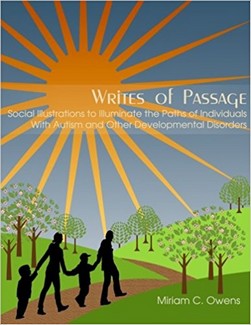
Writes of Passage is a collection of faith-based, workbook-style social stories for children and adults.
Writes of Passage: Social Illustrations to Illuminate the Paths of Individuals With Autism and Other Developmental Disorders was primarily written for children and adults on the autism spectrum who are looking for ways to improve their social skills. The workbook-style layout offers readers interesting and thought-provoking activities at the end of each fill-in-the-blank style story. These fun activities serve to deepen the readers understanding of each theme or social skill presented. Each activity gives readers the unique opportunity to review and apply key elements of the corresponding story in ways that are both reinforcing and fun!
The social stories within Writes of Passage are unique. Many of them give readers the opportunity to personalize them by filling in blanks within the actual text of the story. This feature helps to make each story uniquely familiar to the reader, and very personal. The author believes that the more personal each story is to the reader, the more memorable it will also be. As an added benefit, the stories can be used time and time again, each time with new details if necessary, to meet the reader's current needs.
Each story is intentionally written in the first person to make it easier for readers to internailze the information being presented. Readers will be further inspired by the author's incorporation of relevant scripture verses from the Bible.
Excerpt
Dear Friend,
“Writes of Passage” is a collection of social illustrations. I began to write them when it became apparent that my youngest child needed help navigating the increasing number of social settings that she was being placed in. My daughter, at one time, had been diagnosed with PDD-NOS (Pervasive Developmental Disorder- Not Otherwise Specified). She was beginning to experience increased levels of fear and anxiety while in school, daycare, church, etc. Sharing social illustrations with her became one of the most effective interventions that we’ve ever used!
Some of you will recognize PDD-NOS as a form of autism, and indeed, it is. “Writes of Passage” was written to assist individuals like my daughter who themselves, have been diagnosed with autism or a different developmental disorder. In fact, this book may be helpful to individuals with ADHD, Non-verbal learning disorder, intellectual disabilities, Down syndrome, or any other person who needs help trying to figure out the often complex social exchanges that most people master with relative ease.
The acquisition and mastery of social skills and etiquette is an attainable goal for many individuals with developmental disorders.
They are, however, skills that must sometimes be modeled, taught, and practiced before they begin to feel comfortable applying them in “real-life” scenarios. School personnel are sometimes ill-equipped to teach these vital lessons to children. Parents themselves are hard-pressed to find the extra time that is needed to teach these lessons at home. Amidst the chaos of working their jobs, making and keeping doctor’s appointments for their child, attending therapy sessions with their child, attending IEP (Individualized Educational Plan) meetings with school personnel, and tending to the physical and emotional needs of other family members, it’s no wonder that we, as parents of children with developmental disabilities, often feel overwhelmed!
With so much going on in your everyday lives, how will your children and loved ones with developmental challenges acquire the social skills necessary to meet the social challenges that they are sure to encounter? It is my hope that you will find the answer to that question in this book. As you read “Writes of Passage”, you may discover that the social illustrations offered here are wonderful compliments to a program that you have already implemented with your child or loved one. “Writes of Passage” includes illustrations that are appropriate for young children, adolescents, and even adults! If you have a very young child who isn’t reading yet, read the children’s illustrations aloud to her. She will love having this “snuggle time” with you. Also, because the main idea of each illustration is repeated throughout, it is likely that she will remember most of the content.
If you have an older child who can read independently, give him a story to read (aloud or to himself) that he may be interested in. When he’s finished reading, discuss the social illustration and possible outcomes together. You can even add a few role-playing exercises as a way to apply the suggestions and techniques that he’s read to help build his confidence! Finally, if you yourself are an adolescent or an adult, use this book as a tool. Reading and applying the illustrations and suggestions found here may be a tremendous help to you as you meet new social challenges and experience new things.
I am thankful to God for giving me this opportunity to positively impact the lives of so many. I pray that this book will bring smiles to the faces, joy to the spirits, and hope to the hearts of all who read it.
Professional Reviews
Writes of Passage: Social Illustrations to Illuminate the Paths of Individuals with Autism and Other Developmental Disorders
The social illustrations in Writes of Passage offered many wonderful suggestions and explanations which have helped my children to exercise better social judgment in school, at home, and, in our community. – Parent of children with ADHD and Asperger's Syndrome
Helps, Hints and Hope for the Homework-Weary Among Us
THIS IS AN ABSOLUTELY AWESOME READ! I'm going to get a copy for myself! Miriam is a wonderful writer and God has used her experience to display her gift of connecting to others through penning easy to understand, comprehensive guides. – Tamara, Mom to Donovan and Saleena, ages 3 and 4 regarding the new book, Helps, Hints and Hope for the Homework-Weary Among Us.
Crisis Management for First Responders is for first responders to be able to help victims of critical incidents as well as their own personnel who are affected by the trauma they witness or experience themselves.
This book is for first responders who want to improve their communication at work, at home, and in public.
Note: The contents of this book are mostly included in the book for supervisors, Leadership Training for First Responders. Therefore,