Kindle Edition
Amazon
Jo Barney Writes
Jo Barney Writes
Category:
Women
Publisher: Penner
ISBN-10: 1940811368
Pages: 289
Copyright: 2015
ISBN-13: 9781940811369
Price: $3.03 (eBook)
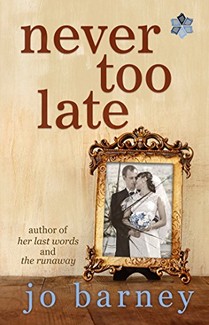
Edith awakes to find her husband of many years lying dead beside her. It is Christmas morning. She wonders if she should go ahead with the grandchildren's celebration and the strata she's cooked for brunch, or deal with the body in her bed.
Decades ago, a shot-gun wedding locked Edith into a life with a husband sh'e not sure she ever loved. At sixty-five, she feels like a ghost in her own life, wondering how it all came about: a scoornful husband, the mercenary brood of grandchildren, her well-meaning but controlling daughter-in-law.
Her husband dies on Christmas morning. Edith wonders if she should go ahead with the brunch she's planned with her son's family. She doesn't and begin the job of sorting out Art's things after the funeral. Questions arise about the scraps of paper she finds in his pocket. Edith is determined to find out what they mean--and they lead to secrets he kept from her, and also to secrets her son, her perfect son, kept from her and his wife.
In the search for the truth, Edit finds herself.
Excerpt
CHAPTER ONE
Christmas Morning, 1993
I wake up with a pop, the kind of jolt that informs me that I’m through sleeping, even if I close my eyes and try to bring back the warm arms that had wrapped around me, the music swirling behind my eyes. What I usually hear when I wake from this sort of dream is a raspy wind rushing through Art’s narrow nostrils, the angry snort that accompanies it, rattling the innerspring mattress that holds us afloat. This morning Art lies on his side, the snores silent.
Lately, whenever I wake up too early and try to sink back into a little more sleep, memories pick at me. Right now it is the memory of lying on a different mattress, one crunching with straw. I have not thought of that old mattress in years. What other almost-forgotten scene will emerge, depress me, if I don’t stretch my legs? I have to move and trust that the usual cramp will relent, that I’ll be able to roll out from under the quilt and step into my slippers without going down on one knotted knee.
My feet brush the lump of soap that is under the bottom sheet. My thighs pull my knees up to my stomach, but I’m not quite ready to straighten my legs, get out of bed.
The night Art found the bar of Ivory soap in our bed, he sneered at me, more of a twitch of his thin upper lip, as if he could barely hold back a ha. For leg cramps, I tried to explain. It was in the Oregonian. As usual, that scornful ha. Like the time he smelled the alcohol on my breath from the nine gin-soaked golden raisins that I had pulled out of the jar with a toothpick. For arthritis, the article said. Ha, Art said. And like last week when I suggested having the young new neighbors over for Christmas punch, and he blew out a loud puff of air before I could finish my sentence.
I close my eyes, remembering about the worst ha of all, that one last Fall. I’d read an article about people going back to college, not college really but the free classes offered for anyone over sixty-five at the university downtown. Maybe anthropology? I thought out loud. His lip curled. “Don’t be so stupid.”
I pull the comforter over my shoulder and try to stop this digging into the past, a habit I can overcome by forcing myself to get up. But I need a little more sleep before I face this day. Christmas morning. And my daughter-in-law, Kathleen. As usual, her fingers will wrench the potato peeler from mine, will take the old knife out of my hands as I slice the onions, will grab the garlic in the garlic thing and squeeze just once more. She’ll remind me, ever so gently, that the strata smells a little burnt. Kathleen believes she is being helpful. My son Brian, oblivious, now twisting in some sort of midlife whirl of his own, will pass his lips over my cheek as he opens my front door, will not hear me say as we touch, “I love you,” his eyes focused on the destructive small brood he has produced as it races to the packages under the tree.
Relief overwhelmed me a year ago on Christmas Day as I called out a final goodbye to my son’s family, their shopping bags full of shirts and electronic games, three hours after the morning had erupted. I leaned back against the closed door, breathed, and saw Art slumped in his lounger asleep, avoiding the chaos, as usual.
I poke a foot out from under a tangled sheet. Find some joy! yesterday’s horoscope had advised me. Right now, I’ll settle for coffee. The air is morning-warm, the furnace groaning somewhere under me. I push the covers to one side, turn toward Art’s flannelled back, the wall he builds between us when he comes to our bed.
I know I’m being mean-spirited, a disposition Christmas always delivers like a seasonal virus. Joy, I tell myself again and touch Art’s hump of a shoulder, give it a poke. If I have to get up, layer the cheese strata, set the table, pick up yesterday’s newspapers, he at least can help by turning on the tree lights and starting the fire in the fireplace. Shit! I’ve forgotten the stockings. They, and the stuff I’ve collected to fill them over the past six months, are piled in a box in the closet. I shake him a little harder. “Get up!”
Art rolls over on his back. His blue eyes stare up at the ceiling fixture hanging above his head. His mouth is open, as if he’s about to snore, but he isn’t rasping, gurgling, even blinking.
I raise myself up on an elbow. I pat his arm, bring my hand up to touch his cheek. His skin feels like that of an unripe peach, hard under whiskery fuzz. Cold.
“Art?”
My ear grazes his mouth as I listen for a breath. Silence. I press my hand against his chest, feel his pajama buttons with shaking fingers.
“Art?”
Art is dead.
It isn’t as if I never imagined him dying, leaving me to finish my life alone. At those times, the idea hadn’t been frightening, maybe even the opposite. A new life for me once he was gone, I envisioned, a better life, maybe. But this actual moment is not part of that scene. I drop my head back to my pillow and try to figure out what to do.
My breath isn’t taking hold. I seem to be leaking at the seams, lungs empty, about to be as dead as Art. I force my mouth to open, suck in air, push it out in a whoosh. The morning scrambles into focus: the unfilled socks, the strata, the fire, the tree lights. The dead man lying beside me. Three miles away, the grandchildren have gotten up, already wild with anticipation, are racing around, knocking each other about, not hearing their mother’s threats from the bathroom, not noticing their father’s clenched jaw, determined to get through the morning.
Like me, my son does not like Christmas. Genetic, we almost-joked last year, over a too-sweet eggnog as we watched Meg and Winston squabble about a useless toy, pieces of it already lost in the piles of colored tissue. Standing over us, Kathleen, her lips gripped in her steady, motherly smile, sent an unmistakable time-to-go look to her husband and gathered up the strewn toys.
I close my eyes. Christmas is difficult, but Christmas with a dead person as its centerpiece will be unbearable. Brian, a kind, open man, a good son, too sensitive, really, will have to deal with the unopened gifts piled in front of a cold fireplace, his disappointed children’s howls, his stalwartly competent wife patting his arm as he tries to find a way to say goodbye to a father who has remained a stranger to the end.
I know I can get through what’s next––I’m not crying, maybe won’t ever––but I’m sure Brian hasn’t rehearsed this death as I have. I feel a flush of a plan, and I sit up, search for my glasses. Yes. I will put Art aside for a day. I will tuck the comforter up around his chin, explain that he’s sick, shut the bedroom door, and go ahead with the morning’s ordeal. “Don’t wake Grandpa,” I’ll warn the children. I’ll let the wife meddle in the brunch, try not to care when the boy and girl tear open their gifts like little savages, hide their uneaten casserole under their napkins, whine as they edge toward the door, bounty in hand. I’ll wave at them as they climb into their car, leaving red-and-green garbage for me to clean up. I will whisper, as always, “I love you,” to my son as he raises a goodbye hand from the open car window. Then, after they disappear, I will call someone to take care of Art.
Yes, it can go that way.
I glance at my husband. He is still staring. I should close his eyes. With my thumb, I push down the lids, am relieved that they stay down. I get out of bed, find my glasses on the floor, turn back to the man I’ve left behind—no, who’s left me behind—and arrange the comforter over him.
On my way to the bathroom, I kick against his abandoned shoes, and I bend to pick up them up, along with his dirty socks, and at that moment I understand that the plan won’t work. Nothing has changed. Art, and all of his carelessness, is still here. His ghost will wander the house, lips twitching. He will continue to make his ha sound at me. Later, after the strata, I will say goodbye at the door. Behind me, he will have sunk into his chair and fallen asleep. I’ll be angry as usual but at a ghost who won’t give a damn about us any more dead than he did alive.
I set the shoes in Art’s closet, go to the kitchen, to the telephone.
The ambulance arrives just as I am pulling my sweatshirt over my head. I fluff the sleep mats out of my hair and open the door. The men, their stiff blue uniforms shielding them from whatever they might find in my house, follow my pointing finger, and moments later, Art is on the gurney. They cover his face with a sheet, fill out a form, and tell me where I can find him when I am ready to make arrangements.
“Are you all right?” they ask. “Do you have someone to call?”
They look at me, seem to expect something more, tears, maybe. “I’m fine,” I answer. “I have a son.”
The older man touches my shoulder, his mouth curving in a practiced way. “Call him.” He squeezes my arm and follows the others out the door.
I go to the bedroom, see that some time in all this, Art has wet the bed. I pull off the sheets and cases, carry them to the washing machine, stuff them in.
Art is dead. I need to fill the stockings, hang them up.
Art is dead. I take the Christmas box out of the closet and set it on the hearth. A plastic doll with boobs stretches a manicured hand out to me.
Art is dead. A chocolate Santa goes in the grandboy’s sock. I imagine the hubbub when he peels off the foil and bites off its head before he’s eaten breakfast.
Art is dead. Four adult stockings lump in the bottom of the box, and I drop face cream and razorblades and Starbucks gift cards into their hollows.
Art is dead. I hang up all six stockings, even Art’s, on the hooks that have hidden under the mantel since that first child-filled Christmas morning in this house years ago.
Art is dead. Hands heavy against my knees, I push myself up from my squat in front of the fireplace and notice the bag of candy canes. “It’s Christmas,” I’ll say, when Kathleen frowns. I tuck one into each furry white cuff.
I am finished. I phone Brian.
“Art is dead.” The words fling themselves against the phone’s mouthpiece, fly back to my cheeks like sharp stones, bring a bitter glaze to my eyes. I blink, say, “Yes, he’s been taken away.” It seems important to add, “We can still do the stockings for the children.”
Brian arrives alone twenty minutes later, doesn’t wait for me to answer the door bell, rushes in. “I love you,” I whisper as he takes me in his arms, holds me tighter than I’ve been held in a long time, maybe forever.
|