
Amazon
World in Conflict and Transition
Category:
History
Publisher: Narcissus Publications
ISBN-10: 9989929378
Type: Non-Fiction
Pages: 94
Copyright: Jan 1 2003
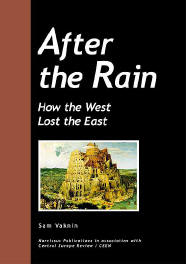
The European Union, NATO, the euro, and central and eastern Europe after the fall of communism.
Shifting geopolitical and geo-strategic realities in the wake of the September 11 atrocities have rendered the European project all the more urgent. NATO - an erstwhile anti-Soviet military alliance is search of purpose - is gradually acquiring more political hues. Its remit has swelled to take in peacekeeping, regime change, and nation-building.
Excerpt
Saturday's vote in Ireland was the second time in 18 months that its increasingly disillusioned citizenry had to decide the fate of the European Union by endorsing or rejecting the crucial Treaty of Nice. The treaty seeks to revamp the union's administration and the hitherto sacred balance between small and big states prior to the accession of 10 central and east European countries. Enlargement has been the centerpiece of European thinking ever since the meltdown of the eastern bloc.
Shifting geopolitical and geo-strategic realities in the wake of the September 11 atrocities have rendered this project all the more urgent. NATO - an erstwhile anti-Soviet military alliance is search of purpose - is gradually acquiring more political hues. Its remit has swelled to take in peacekeeping, regime change, and nation-building.
Led by the USA, it has expanded aggressively into central and northern Europe. It has institutionalized its relationships with the countries of the Balkan through the "Partnership for Peace" and with Russia through a recently established joint council. The Czech Republic, Poland, and Hungary - the eternal EU candidates - have full scale members of NATO for 3 years now.
The EU responded by feebly attempting to counter this worrisome imbalance of influence with a Common Foreign and Security Policy and a rapid deployment force. Still, NATO's chances of replacing the EU as the main continental political alliance are much higher than the EU's chances of substituting for NATO as the pre-eminent European military pact. the EU is hobbled by minuscule and decreasing defense spending by its mostly pacifistic members and by the backwardness of their armed forces.
That NATO, under America's thumb, and the vaguely anti-American EU are at cross-purposes emerged during the recent spat over the International Criminal Court. Countries, such as Romania, were asked to choose between NATO's position - immunity for American soldiers on international peacekeeping missions - and the EU's (no such thing). Finally - and typically - the EU backed down. But it was a close call and it cast in sharp relief the tensions inside the Atlantic partnership.
As far as the sole superpower is concerned, the strategic importance of western Europe has waned together with the threat posed by a dilapidated Russia. Both south Europe and its northern regions are emerging as pivotal. Airbases in Bulgaria are more useful in the fight against Iraq than airbases in Germany.
The affairs of Bosnia - with its al-Qaida's presence - are more pressing than those of France. Turkey and its borders with central Asia and the middle east is of far more concern to the USA than disintegrating Belgium. Russia, a potentially newfound ally, is more mission-critical than grumpy Germany.
Thus, enlargement would serve to enhance the dwindling strategic relevance of the EU and heal some of the multiple rifts with the USA - on trade, international affairs (e.g., Israel), defense policy, and international law. But this is not the only benefit the EU would derive from its embrace of the former lands of communism.
Faced with an inexorably ageing populace and an unsustainable system of social welfare and retirement benefits, the EU is in dire need of young immigrants. According to the United Nations Population Division, the EU would need to import 1.6 million migrant workers annually to maintain its current level of working age population. But it would need to absorb almost 14 million new, working age, immigrants per year just to preserve a stable ratio of workers to pensioners.
Eastern Europe - and especially central Europe - is the EU's natural reservoir of migrant labor. It is ironic that xenophobic and anti-immigration parties hold the balance of power in a continent so dependent on immigration for the survival of its way of life and institutions.
The internal, common, market of the EU has matured. Its growth rate has leveled off and it has developed a mild case of deflation. In previous centuries, Europe exported its excess labor and surplus capacity to its colonies - an economic system known as "mercantilism".
The markets of central, southern, and eastern Europe - West Europe's hinterland - are replete with abundant raw materials and dirt-cheap, though well-educated, labor. As indigenous purchasing power increases, the demand for consumer goods and services will expand.
Thus, the enlargement candidates can act both as a sink for Europe's production and the root of its competitive advantage.
Moreover, the sheer weight of their agricultural sectors and the backwardness of their infrastructure can force a reluctant EU to reform its inanely bloated farm and regional aid subsidies, notably the Common Agricultural Policy. That the EU cannot afford to treat the candidates to dollops of subventioary largesse as it does the likes of France, Spain, Portugal, and Greece is indisputable. But even a much-debated phase-in period of 10 years would burden the EU's budget - and the patience of its member states and denizens - to an acrimonious breaking point.
The countries of central and eastern Europe are new consumption and investment markets. With a total of 300 million people (Russia counted), they equal the EU's population - though not its much larger purchasing clout. They are likely to while the next few decades on a steep growth curve, catching up with the West. Their proximity to the EU makes them ideal customers for its goods and services. They could provide the impetus for a renewed golden age of European economic expansion.
Central and eastern Europe also provide a natural land nexus between west Europe and Asia and the Middle East. As China and India grow in economic and geopolitical importance, an enlarged Europe will find itself in the profitable role of an intermediary between east and west.
The wide-ranging benefits to the EU of enlargement are clear, therefore. What do the candidate states stand to gain from their accession? The answer is: surprisingly little.
All of them already enjoy, to varying degrees, unfettered, largely duty-free, access to the EU. To belong, a few - like Estonia - would have to dismantle a much admired edifice of economic liberalism.
Most of them would have to erect barriers to trade and the free movement of labor and capital where none existed. All of them would be forced to encumber their fragile economies with tens of thousands of pages of prohibitively costly labor, intellectual property rights, financial, and environmental regulation. None stands to enjoy the same benefits as do the more veteran members - notably in agricultural and regional development funds.
Joining the EU would deliver rude economic and political shocks to the candidate countries. A brutal and rather sudden introduction of competition in hitherto much-sheltered sectors of the economy, giving up recently hard-won sovereignty, shouldering the debilitating cost of the implementation of reams of guideline, statutes, laws, decrees, and directives, and being largely powerless to influence policy outcomes. Faced with such a predicament, some countries may even reconsider.
|