Kindle Edition
Amazon
Category:
Historical Fiction
Publisher: Haaren
ISBN-10: 1541220390
Type: Fiction
Pages: 389
Copyright: April 26, 2016
ISBN-13: 9781541220393
Price: $1.99 (eBook)
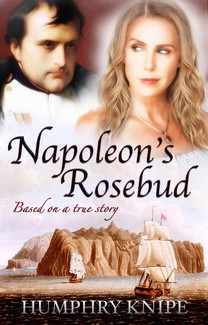
You are the high spirited 19-year-old daughter of a penniless widow, born and brought up on an isolated, windswept South Atlantic island, a girl with virtually no prospects, when out of the blue the most famous man on earth falls into your lap.
Still smarting from his defeat at Waterloo, still the hero of Liberals everywhere, Napoleon is exiled to tiny Saint Helena because it is the remotest and most easily defended island in the British Empire. But far from being broken by defeat, Napoleon’s fertile imagination seethes with escape schemes. He meets you on his first evening on the island and instantly knows he has found what he is looking for: his path to freedom.
Excerpt
Chapter 1: Astonishing News
Saint Helena Island, South Atlantic
October 12, 1815
Charlotte was in the kitchen bottling peaches with her mother and her aunt Emelia when she heard the news. The messenger was her eldest brother, John, a strapping loudmouthed Yamstock, as the islanders were called, who arrived with a great clatter in the farm’s courtyard, froth on his horse’s mouth.
“Boney!” he yelled, wheeling the animal around. “Boney’s coming! He’s coming to get you! Reelly, reelly, reelly!”
Brother John had the brains of a sparrow, and when he got excited he spoke with an accent as thick as his skull. He often said silly things that didn’t make sense. “Hush or Boney will get you!” was a dire warning that mothers everywhere in the Empire used to frighten their children to sleep. Had John been drinking prickly pear tungi, and it not yet noon?
Charlotte’s mother, long-faced and short-tempered, launched herself into a question with a busy pump of her elbows. “What you mean, John?” Her nerves were acting up because John was shouting and waving his hat and spurring his horse to rear, although the poor animal was clearly near dropping after the steep uphill ride from Jamestown, which wasn’t a town at all, hardly even a village, and the only one for a thousand watery miles in any direction.
“Just what I said!” shouted John, hitching his horse. “Wellington done beat Boney at someplace called Waterloo, and they’re done gorn sent him ’ere! Him and his whole fancy court! Hundreds of Frenchies! Counts and countesses in them white wigs, I bet! Enough generals to make up an army! All coming here day after tomorrow or the next day, depending on the wind. Five ships full of rich aristos loaded with livres. The whole island will be swarming with hungry redcoats to guard ’em. Can you believe our luck?”
Charlotte couldn’t. Tiny Saint Helena was a speck in the vast South Atlantic, the loneliest island in the world. How could it suddenly become the center of the universe?
“Where’s he going to stay?” asked Aunt Emelia, a pleasantly plump, kind-faced woman who sat on a stool, quite happy to watch her restless, rawboned sister-in-law do all the work.
“Them say at Longwood, you know, on Deadwood Plain,” said John.
This convinced Charlotte that John’s news was nothing more than a preposterous rumor that John didn’t have the wit to distinguish from the truth. “There’s no house there, idiot!” she called out to him through the window. “Only a few drafty sheds!”
John threw open the back door, plucked off his hat, and burned his mouth on half a peach, still hot from the syrup. “Shows how much you know,” he said through the peach. “It’s been fixed up as a summer cottage for years. Now they’re in a tearing hurry to fix it up some more.”
“Who told you all this?” Charlotte shot back, making no effort to hide her skepticism, because she didn’t have much time for fools and her brother John was definitely one of those.
“The whole town is shouting about it. I got it from your very own best friend, Mary Porteous, who is shouting louder than anyone else because they’re putting him up at Porteous House until Longwood’s ready. I bet old man Porteous will wear his kilt every day instead of just Sundays. Not often you have an emperor as a lodger!”
John’s mother and aunt stared at him in disbelief. Charlotte flushed with wild excitement. Napoleon, suddenly thrust into her life! What would Daniel say when he heard the news? But of course Daniel would know already. How infuriated he must be, stuck in the outskirts of London, while everything was happening in his backwater home! It was all so impossible. A fairy story.
“Napoleon!” Charlotte said just to taste the flavor of the word. It conjured up images of cannons and cavalry charges and a picture she’d seen of him being crowned emperor by the pope.
“At last someone good enough for you!” said her mother sarcastically. “Your poor father used to go on about him so much it made me quite sick!”
“Rubbish! Daniel is more than good enough for me!”
“Because he writes you all them letters stuffed with nonsense about how Napoleon’s bringing the world liberty and equality and revolution,” crowed John. “Don’t think I haven’t read them. You leave them all over the house like your smelly underclothes!”
“That’s disgusting! I leave them in a box under my bed, where you have no business sticking your nose!”
John attacked another hot peach. “None of the local lads want to walk out with you because all you want to talk about is Napoleon!” he said. “Hurray! Now’s your chance to get your claws into the man hisself!”
“What’s all the excitement about?” It was her uncle Samuel, closest Charlotte had for a father since hers passed away ten years ago leaving her mother to live on a small army pension. Instead of squandering his inheritance by playing the gentleman soldier, as her father Richard had done, Samuel had worked his share so that he had risen to the rank of the richest planter on the poverty-stricken little island. But money couldn’t ward off old age. He had begun to suffer from gout and shortness of breath. He didn’t look like a man who would see many more summers, not that there was much difference between summer and winter on this, the sheltered leeward side.
John, relishing his opportunity to shine, did a silly bow so deep that his hat swept the floorboards and then tried his best to speak proper. “Uncle Samuel, I am pleased to announce that Wellington beat Napoleon at a great battle and that we are about to be honored by the presence of no less a personage than the deposed emperor himself. He is to take up indefinite residence right here, on this very island, courtesy of His Majesty’s government!”
Samuel searched John’s excited face for the lie but didn’t find it. “Bravo for my friend Wellington!” he said on the basis of bumping into the general a few times during Wellington’s short visit to the island ten years ago on his way back from India. “So he’s caught the cockerel at last! I wager they’ll not let him flee the coop a second time. That’s why they’re sending him here, of course!” Samuel sighed. He was a sharp trader, but he was also a kind man. “Poor devil. I think in many ways he means well. Just imagine being cast down all the way from the golden throne of Europe to this pimple on the backside of nowhere!”
“Does seem sad!” echoed Samuel’s obedient wife. “Poor thing.”
“But I can see Lady Liberty ’ere thinks it’s the most wonderful event since the nativity!” Charlotte’s mother said who had a tongue as sharp as a shard of glass.
“It is!” said Charlotte. “That’s why we need to go back to town, immediately.”
“Well, we can’t,” said her mother, her thin face hardened by widowhood and the grind of making ends meet. “We’ve got to help your aunt finish with the peaches.”
“Oh, don’t worry about the peaches,” said Emelia. “I’ll get one of the kitchen girls to help.”
“No!” said the mother. “Charlotte gets her own way more than enough!”
Charlotte headed for the door. “How can you expect me to bottle peaches at a time like this!” she said. “I need fresh air!”
“Charlotte Knipe, you aren’t going anywhere! Oh, how I wish your father was still alive. You never listen to a thing I say. Samuel, you tell her!”
Samuel was smiling. Charlotte was a lovely girl. She was tall, perfectly formed, with a long cascade of blond curls falling from her animated face. But it was her complexion that was the finest of her natural accomplishments: the fair, luminous skin, the blush more subtle than anything a brush could apply.
“Let the girl go,” Samuel said. “This is tumultuous news. A whiff of wind will clear her head better than smelling salts.”
“At least take Molly with you, child.” Molly was Charlotte’s slave, willed to her by her father, Richard, and who was nearly as close to her as Mary Porteous, although of course in a different way. But Charlotte didn’t want to take Molly. She wanted to be alone with the Friar. To speak to Daniel through him, as the Catholics spoke to God through a priest at confession. What she’d been doing since the boy—a man by now—left for London five years ago.
“I don’t need Molly,” shouted Charlotte, already outside. “I’m taking John’s horse!”
“No, you’re damn well not!” shouted John, sprinting for the door.
But Charlotte had already untied the chestnut, hitched up her thin cotton dress so she could ride astride, and was heading out of the courtyard so fast that John’s curses barely caught up with her.
She slowed the tired horse to a walk as the trail wound down into Lemon Valley, the switchbacks ever sharper, the trees thicker. She heard the whispering voices, the dying gasps of the wind barely stirring their leaves. The sighs, the Negroes believed, of slaves freed from ships where the living were left chained to the rotting dead until they were cut loose by the British and dumped in camps downstream from here.
Charlotte crossed the ankle-deep brook, urged the horse up the other side. There, huge against the blue sky, wrapped in a worn, weather-beaten lichen robe, was the rock outcropping called the Friar, which looked east to watch the sun rise over Africa and west to watch it set in South America while thousands of miles of restless ocean sang orisons at his feet.
The tireless trade wind blew from the southeast, so it was tamer on this, the west side of the island, where the Knipe family farmed, just blowing swiftly enough to keep the tropical heat at bay. Except for wisps of dying fog, the sky was clear. The only storm brewing was the one in Charlotte’s heart as she slipped off the horse and sat at the feet of the Friar.
Napoleon! How cruel that her father hadn’t lived to see his hero, even meet him, perhaps! Although he had inherited good farming land, his passion was for war, not weeds, as he put it. He had served in India for just long enough to catch malaria in Madras. He returned home to take on the less onerous duty of a clerk in the Saint Helena Regiment but his condition worsened so he was invalided out two years later in 1794, the year Napoleon took his first giant stride to greatness by winning the battle of Toulon for the Revolution for which he was promoted to the rank of general at the tender age of twenty-four. Suddenly Richard found a new outlet for his military obsession: following the career of the brilliant young Corsican. As the years passed he refought every Napoleonic battle on paper with tiny wooden soldiers directed by a man on a white horse who wore his hat sideways. When she was old enough he demonstrated Napoleon’s elaborate feints and forays to Charlotte who watched, fascinated, following as best she could. Then, in 1805, when Charlotte was nine, malaria made its final charge and Richard Knipe’s toy soldiers fought no more.
“If only I were thirty years younger … Oh what an honor to serve such a man!” Charlotte had heard her father say more than once before his death. “What an honor it would be if one of my sons would do it for me!” But his only son old enough was loudmouth John who had no fight in him unless he was full of fiery tungi.
Sitting at the feet of the Friar Charlotte’s thoughts flitted by like wisps of Saint Helena fog being chased by the perpetual southeaster. Daniel was old enough to fight, but he wasn’t a soldier either. She and Daniel had been separated for five years now, linked only by the monthly letters that crossed one another in ships battling the vast Atlantic. When he left the island for Kew Gardens, London, Daniel was a moody boy of fourteen. When he came back, a botanist and a gentleman, he would be twenty-one. What would he look like? He sent her sketches of himself, well-done because he was being taught to do botanical drawings, but not very good likenesses, she could tell, because the faces were all different. She’d sent him sketches of herself she’d done from the looking glass. But none of them caught the vivacity in her green eyes, the perfection of her features, she was vain enough to admit to herself. They were certainly nothing like the drawings that their schoolmaster, William Burchell, had done of her. Kind Mr. Burchell—he was the one who had obtained Daniel his Kew apprenticeship and the chance to make something of himself. Who had taken something of the local Yamstock accent out of their pronunciation,
taught them a smattering of French and the elements of Liberal politics. Often he talked about his personal hero, Napoleon.
The day before a ship swept Daniel off to London, she and Daniel had sat here at the Friar’s feet, just as she was doing now. This was his special place, where he went when his black moods took him. When Charlotte’s was the only company he wanted.
“I need something to remember you by while you’re sniffing flowers like a gentleman in the Royal Botanic Gardens,” she had told him.
“Flowers? No chance!” said Daniel. “I’ll be sniffing manure!”
“No, you won’t! You’ll be learning botany. Soon you’ll know as much as Mr. Burchell.”
“No one could ever know as much as Mr. Burchell,” said Daniel.
“Please! A little memento!”
“Such as? You know I have next to nothing.”
“A story is all I want. I want you to tell me a story to remember you by. The Friar’s story. I want to remember you telling it to me.”
He took her hand, brushed it with his lips. “You do have such beautiful hands,” he said. “Mr. Burchell captured them perfectly in his drawings.”
“Please!”
“You will look after my father for me while I’m gone?”
“Of course I will,” she said.
“He’s got hardly anyone else who’ll…see him.”
“I know. Please…the story.”
So he told her the story in his freshly broken voice, almost the voice of a man, not quite. It was the sad little tale of a saintly Franciscan friar, hope of the hopeless, who fell madly in love with a mountain nymph and begged her to marry him. The fairy agreed on the condition the friar give up his religion and worship wild nature as she did.
“The day of their wedding finally arrived,” Daniel said, squeezing Charlotte’s hand. “They were to be married in a chapel that once stood on this very spot. Then at the exact moment they were to be joined together forever, the rock opened with a mighty roar and swallowed the chapel and everyone in it. All that was left was the friar, turned to stone as you see him now, forever searching the horizon for his lost love.”
“Daniel,” she said, “that was beautiful.”
“It’s a warning for boys like me to beware of lovely witches like you!”
She’d laughed at that. “You’ve heeded the warning,” she said. “Because you’re fleeing to England tomorrow.”
“I’m going because I want to be better than just another Saint Helena Yamstock who’s born, bred, and dead on the island. Besides, while I’m gone you’ll just keep on growing more beautiful.” He squeezed her hand. “Promise me you’ll wait. At least give me a chance.”
Charlotte had gazed into his quick brown eyes with their turbulent black depths. She made her promise. “Yes, I shall.”
Dear Daniel! Two years more before he served out his apprenticeship at Kew Gardens and came back a gentleman who would publish scholarly books on the plants of Saint Helena found nowhere else in the world. She took his latest letter out of her pocket—she always kept at least one with her. As usual the lines crossed and re-crossed one another to squeeze as many words as possible onto the single sheet of paper, all that was allowed to qualify for the cheap letter rate.
This one was special because it brought the grand news that Lord Byron had just visited Kew and that Daniel had actually spoken with him!
I am suddenly in a rage about his poems. And of course his pursuit of freedom. I’ve read his “Childe Harold” three times and “Corsair” four. Here’s how his latest poem begins. The lady reminds me so much of you!
She walks in beauty, like the night
Of cloudless climes and starry skies;
And all that’s best of dark and bright
Meets in her aspect and her eyes…
“You are the best of dark and bright!” he wrote very small so he could squeeze it onto the crowded page and so save a penny. “How I long to hold you! Two more years, but what’s two years in a lifetime? Wait for me!”
“I’ll wait for you, I promise!” she told Daniel at the feet of the Friar but she was thinking of the living apparition that was about to appear. The mischievous wind snatched away her words and carried them gleefully out to sea.
“Napoleon! Oh, what will I wear?”
|