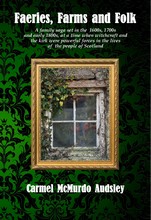
A family saga set in Scotland from the mid-1600s when witches were being burned at the stake and the Church of Scotland had a tight hold on the lives of its parishioners.
Many people with Scottish ancestry will find Agricultural Labourers among their forebears, because so many people in Scotland prior to the industrial revolution were engaged in working the land in one form or another. It was a time when men worked by the sweat of their brow and women worked beside them and made a home and raised the children as best they could. It was also a time of political upheaval, of strong influence in people’s lives by the Church of Scotland and of superstition.
This novel goes inside the lives of family members as they transition from farming to coal mining. The stories are based on real people and places and give an insight into how people lived in the 1700s and 1800s.
'Faeries, Farms and Folk' is a prequel to 'Ours, Yours and Mines' and 'Far Across The Sea'.
Excerpt
Chapter 2 (1659)
FIRE ON THE SANDS
O
n the thirteenth day of April, the sky grew dark as storm clouds gathered. Thunder cracked and lightning lit up the stretch of beach known as Whitesands by the River Nith, in the market town of Dumfries. A crowd began to gather. The women pulled their shawls tightly around their heads and shoulders, the men drank wine and ale and the children ran about with excitement as they waited for the spectacle to unfold. Although witch hunting had been practised and accepted in Scotland for hundreds of years, witch burning was an event to equal any carnival. An edict had gone out to all the kirks in the parishes of Dumfries for members of the various congregations to bear witness to the ridding of witches in the area. The farmers and townsfolk were simple God-fearing people and they were superstitious. Witchcraft was part of their belief system and very real to them. They would not dare disobey a direction from the kirk for fear that the wrath of God would fall upon them. As they assembled to watch the gruesome tableau that was about to play out in front of them, almost to a man they were filled with righteous indignation. Witches were instruments of the Devil and as such were an insult to God. God had given his power on earth to the minister and the Kirk Session elders, and the members of the congregation felt safe in the knowledge that their mortal beings and immortal souls were well tended.
The kirk elders who had decreed that the women should die, planted nine wooden stakes about six feet long vertically into the ground at Whitesands as other male parishioners gathered bundles of sticks known as faggots, and large clumps of peat and bundles of straw to place at the feet of the stakes. The accused women had all been measured and a hole at the neck height of each of them had been cut into the stakes. The executioners busied themselves threading ropes through holes in the stakes and pulling on the ropes to test the tension. The convicted women, many of them frail and in ill health, all of them trembling in fear, were dragged to the Whitesands with chains around their necks and torsos. They were facing a cruel death in front of a jeering mob. As the women were positioned and each tied to a stake, ministers prayed over them to save their eternal souls.
Most of the curious onlookers that day believed that the women - condemned witches - deserved their punishment and had foregone their rights to live among Christian people. There was little sympathy for them and never a thought of forgiveness. In fact, the women’s suffering and torture was cause for celebration among the congregation as the devils were removed from their midst.
Professional Reviews
Beautiful books
This is a beautiful series of books. I love a good family saga and you can follow the McMurdo family from their days as farmers in southern Scotland, across the generations, eventually leading to a long trip to Australia. I love they way the superstition of the people is written into the latest book 'Faeries, Farms and Folk'. There is something magical about the way this author weaves together words to make the reader feel as though she is right there in the middle of the action. I had read the first two books 'Ours, Yours and Mines' and 'Far Across the Sea' and was eagerly awaiting the arrival of 'Faeries, Farms and Folk'. They are the sort of books that I will read again and again. I would love to see them made into a television series. [by Liz Farley] Review appeared on www.askdavid.com
Great writing
This story is told so simply and makes you feel you are really there. I learned a lot about life in the 1600's and 1700's in Scotland and I had no idea that witches were put on trial by the church. The writer seems to have an empathy for the old women who are accused of being witches and I think I am on their side also. They were poor lonely souls, most of them. I especially grew to like the character of Grainna. A good read. [by Mike Aspinall] Review appeared on www.askdavid.com
Quite a wake up call
I complain when the air conditioning doesn't work and when my washing machine breaks down. Then I read this book set in the 1600s and 1700s when people had so little. They had to carry their drinking and washing water from a river, the roof of the house was made from turf so the rain often got in and the floor of the house was dirt. They didn't have a closet of clothes to choose from each day but wore one set of clothes until they rotted. They didn't have the luxury of complaining as if they didn't work they didn't eat. If I need to buy something I just go to the store and get it. It was a hard way of life and it made me grateful for everything I have. This author has a way of making you feel part of the story and I lover her work. [by Maria Gray] Review appeared on www.askdavid.com
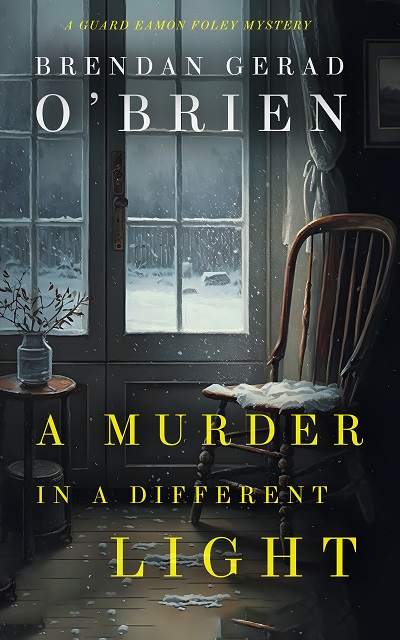
Ireland 1947. Seven weeks of relentless snow. Guard Eamon Foley is searching for a missing child.
At Toby Appleyard’s farm, he discovers the kitchen littered with dead cats. And the skeletal remains of a woman. Upstairs, Toby is dead in his bed.
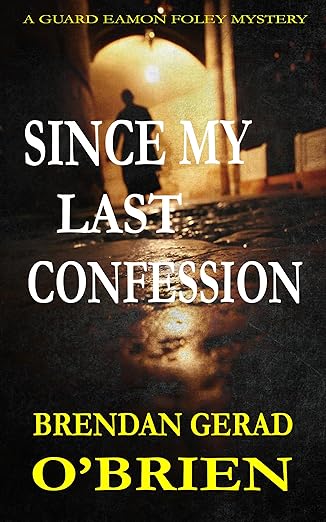
Tralee, Ireland. September 1948.
An arrogant, and highly agitated, priest arrives home after 40 years.
Days later he's dead. Suicide? Or did his past catch up with him?