Kindle Edition
Amazon
Scottish Books
Amazon
Category:
Mystery/Suspense
ISBN-10: 1704369576
Type: Fiction
Copyright: October 31, 2019
ISBN-13: 9781704369570
Price: $2.99 (eBook)
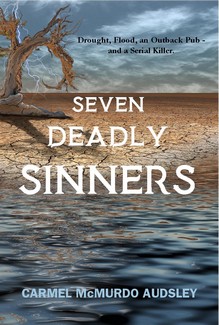
No mobile phones, not even a landline, no electricity, no computers, no radio – just a band of unexpected guests stranded at an isolated outback hotel in Queensland Australia in 1957. They all have somewhere else to be, but thunder storms and flooding prevent them from carrying on.
Each person has a story, but who is telling the truth – and who is murdering them one at a time?
For anyone who has never visited Australia, or experienced the country in drought, it can be hard to imagine just how dry the continent can get. It can also be difficult to appreciate just how isolated some parts of rural Australia are, and how badly people, animals and plants can be affected when it doesn't rain for years. Some people don't see another soul for months at a time. This novella is set in 1957 in a fictional outback pub and is based on the many pubs that dot the landscape and offer a respite for weary travellers across the wide brown land. Eleven people are thrown together, isolated by swollen rivers and creeks. As the booze flows and the flies buzz, details of their lives unfurl and danger lurks in the form of unpalatable cocktails, dubious food served up by the proprietor - and a serial killer. But who could it be?
Excerpt
THE big blue and white Pioneer Clipper motor coach lumbered along the dry dirt road as it bounced over corrugations, and jerked to a halt outside the isolated pub in far south-western Queensland. The eight-year-old coach, with its split windscreen and sliding windows, could carry up to twenty-nine passengers from the New South Wales capital city of Sydney to Cairns in the far north of Queensland, but not today.
Red dust covered the corrugated iron roof and verandah of the dilapidated wooden two-storey building that sat on stumps between two large gum trees, in the midst of the parched dry plain. It had not rained in or around the closest town of Booree for five long years. Not even a sprinkle of moisture had fallen from the sky in all that time, and the only water available to the pub was stored in two large tin tanks that were now almost empty.
The aptly-named Watering Hole Hotel sat in a remote and unpopulated area of outback Queensland, fifty miles from the New South Wales border. It was the only place to stop for food, drink and accommodation for one hundred miles either side of it.
It was January, at the height of an Australian summer, when temperatures could reach over forty degrees Celsius (over one hundred and four degrees Fahrenheit) in the shade. The only people to visit The Watering Hole were yahoos who got there under their own steam and were out to get drunk and kill a few kangaroos, and travellers who were on their way to somewhere more interesting.
The door of the dust-covered coach slowly opened outwards, and a large overfed man with a ruddy face eased himself from the well-worn black leather driver’s seat. His protruding stomach preceded the rest of his body’s arrival as he slowly and heavily navigated the two steps of the coach and touched his feet upon the ground. He had been stopping in at the pub every few months for the past five years with cashed-up tourists looking for a quick outback experience, before continuing their journeys to the cool beaches and luxurious hotels on the coast and in the cities. He was known to all as Fat Frank. He wore sturdy brown lace-up boots upon his feet, long off-white coloured socks that stretched up to his knees, khaki shorts that hung below his massive paunch, and a food-stained short-sleeved blue Hawaiian print shirt. A half-smoked, roll-your-own cigarette dangled from the left side of his mouth. He coughed loudly and spit on the ground, but the cigarette didn’t leave his mouth. It was stuck firmly to his bottom lip. He waddled to the side of the coach and opened the large door upwards. He retrieved three suitcases and placed them on the ground, then sat down on one of them and wiped the sweat from his brow with a crumpled buff-coloured handkerchief. Fat Frank was not in the best of health.
Next to emerge from the coach was a tall middle-aged man with a large frame. He wore a black three-piece suit in the searing summer heat, polished black patent leather shoes and smoked a fat Cuban cigar. He had the air of a man who was used to getting what he wanted. He looked at the weather-beaten timber pub, then took in the horizon. There was nothing to see but miles and miles of scorched red and brown earth, so dry that it had broken into pieces like squares on a bar of chocolate. Tired gum trees, whose parched roots clung to the barren land like worn gnarled fingers, occasionally broke the monotonous view. There was not a bird or animal in sight as they took whatever refuge was available, under dry bushes and beside rocks, from the heat of the blazing sun. The man smiled the smile of the self-assured and shook his head, then extended his hand inside the coach.
“Well looky here, darlin’,” he said in his slow Texas drawl. “We’ve officially reached the ass end of the world.” He laughed, then corrected himself as a woman took his hand. “Hell no, it ain’t even that. It’s a pimple on the ass end of the world.”
He continued to laugh as the woman alighted from the coach. She wore a blonde wig in a fashionable bob style, and her lips were painted scarlet red. She was dressed expensively, but skimpily, in a figure-hugging floral knee-length cotton dress with a low-cut neckline that emphasised her ample bosom. At first glance, she seemed to be a little younger than her husband, but as the bright sunlight hit her face it was clear that she had seen at least fifty years of life. She sashayed down the two steps from the coach to the ground, and straightened her dress as she glared at the driver who sat with his mouth open ogling her. Her husband watched in admiration. He got a thrill out of other men’s reactions to his attractive wife. She was one of his greatest assets.
The coach driver got up from the suitcase where he had been sitting, the cigarette still hanging from the corner of his mouth, and started to pick up the luggage. As he walked to the front of the pub, a short, chubby woman, with a round weather-worn face topped with wispy greying hair, appeared in the doorway with her hands placed authoritatively upon her hips. Her grey calf-length dress was faded, and her stained white apron hung loosely about her thickened waistline. Some of her fat grubby toes stuck out of the well-worn laceless sandshoes she wore. Her name was Dulcie Short, and she did not seem pleased to see the coach driver.
“Afternoon, Dulcie,” the coach driver said. “Got some customers for you.”
Dulcie looked the travellers up and down. She had seen all types pass through in her thirty years as co-proprietor of the pub, and not much fazed her.
“Been drivin’ around for hours trying to find a crossing. Some of the roads are washed out and we’re out of petrol,” the coach driver continued. “Looks like you’re stuck with us for a while.”
“Whaddaya mean, stuck with ya?” Dulcie said as she re-positioned her hands on her waist for effect. “Why have you been going around in circles, Frank? You know these roads as well as anyone.”
“Haven’t you heard?” Frank said incredulously. “The rains have started. The rivers and creeks are fillin’ up fast and pouring through the channel country. The Barcoo’s up on the northern side and we’re too late to make it across Three Snake Creek on the southern side. Floods are on the way. There’s no way back or forwards. You’ll have to wine and dine us.”
The channel country was a series of ancient flood plains within the arid outback landscape of deep red sand hills and orange cliffs. It could take hours, days, or even weeks, for the water from a big wet to flow down to towns, and always arrived unexpectedly.
When Dulcie shook her head her jowls jiggled. “Radio’s been out for a coupla days. No communication from anyone. We’ve been expectin’ a bunch of roo shooters to come through, but ain’t seen hide nor hair of ‘em.”
Fat Frank laughed. “Well, the good news for us is that you’ll have stocked up for them and we won’t starve. Dunno how I’m gonna get petrol to get the coach goin’ again. We’ll have to see what the rain and floods are gonna do. We’ll just have to wait it out.”
Dulcie did not look pleased. While Fat Frank did bring customers to her door, he always ate her out of house and home and expected it all to be laid on for free. She was going to have to put her foot down this time. No more freebies for Fat Frank. She eyed the man and woman up and down again, as they stood sweltering in the midday sun. They looked as though they would have money. She decided she would put the price of everything up, and make a good profit. She removed her hands from her hips and stood aside from the door.
“Right, well ye’d best get yer things in ‘ere. We’ve got rooms made up and plenty of grub, but it won’t be fancy. Roo shooters don’t expect no fancy stuff, just plain wholesome food and that’s what you’ll be gettin’.”
The Texan man wiped his brow with the back of his hand and turned to Fat Frank. “Not the most hospitable of folks now is she?” he said then turned to his wife. “Seems we’ll have to work on her.” His wife smirked. They made a good team. He had the ideas and charm, and she had the body and charisma to attract spiders into their web.
The couple walked up the four rickety steps of the pub, followed by Fat Frank who struggled with the suitcases. Once inside the pub, they took in its rustic charm.
The downstairs area was one big open room. Tongue and groove wooden flooring crept vertically up the walls and horizontally across the ceiling which was held up with big wooden posts that were barely more than roughly-hewn tree trunks. Old stock whips, kangaroo hides, bull horns and sun-bleached dingo skulls adorned the walls. There were three distinct areas of use. Directly in front of them was a long wooden bar, behind which were several shelves of liquor, a beer tap, and a door leading to the kitchen. To the left of the bar was a small alcove with a bench that held mugs and cups. Further to the left, at the far end of the room, was a small lounge area which contained two worn burgundy and brown toned velvet Genoa lounges, a smoking stand and a small table. The first few steps of a staircase leading to the upstairs rooms was visible. A two-foot long brass horizontal rail protruded from the wall and was used to store rifles upright when shooters were staying at the pub. An old walnut-coloured upright piano sat against the inside front wall of the pub, to the back of the lounge area, testament to a happier time before the building had started to decay, and the people in it became so wretchedly unhappy. To the right of the room were six round wooden tables, each with four unmatched chairs placed around them. Half a dozen wooden bar stools had been casually placed against the rusted corrugated iron that was nailed vertically underneath the length of the unhewn wooden bar top. Sweat-stained men’s rabbit-skin Akubra hats, of all shapes and sizes, hung from hooks on the wall above the entry door.
The old pub had seen a lot of action over its fifty year history, and little had changed in that time. It had been started at the turn of the 20th century by Dulcie’s father-in-law, and her husband Jocko had inherited it upon his father’s demise. The marriage was not a happy one. They had been trying to sell the property for the best part of ten years, but few people wanted to live such an isolated existence, so far from civilisation, out in the Australian bush without a phone, sewerage or mains electricity and water. The miles of electricity distribution lines did not reach into some of Queensland’s vast areas of low population density, as large-scale rural electrification was deemed by the government to be too costly. There was not another building for over a hundred miles in any direction.
The brewery man, on his long trips in his heavily-laden flat tray truck, called in three times a year to deliver a few kegs of beer, a box of mixed spirits, a couple of bottles of the new Barossa Pearl sparkling wine for special occasions, and some lemonade and Indian tonic water. A small kerosene-powered refrigerated cold room in the kitchen, directly behind the beer tap on the wall in the bar, housed the kegs to keep the beer cool. The cold room also kept some vegetables, butter and other kitchen staples cool and away from the relentless buzz of filth-spreading flies. Dulcie drove the six-hour round trip in her trusty, rusty Holden ute into the nearest town every three months to pick up food and fuel supplies for themselves, and for the tourists who stopped by from time to time.
It was a lonely life and Dulcie was tired of the back-breaking work. She only ever had her lazy husband Jocko and self-absorbed unsociable son Byron for company. She knew her best years were behind her, but she wanted more out of life than a mere existence. She had never had money, and had a gnawing feeling deep inside her that she had missed out on so much of life. Jocko could stay put, or leave with her. She didn’t much care. She just knew she wanted to sell the pub, take the money and move to the city.
The well-dressed couple sat down on stools at the bar. The Texan extended his hand to Dulcie as she walked behind the long wooden structure to serve them. Behind the bar was her space, and woe betide the person who dared not stay on the other side.
“I’m pleased to make your acquaintance, m’am. My name is Chip Wilson The Third and this here is my lovely wife Cynthia. Who do I have the pleasure of addressing?”
Dulcie wiped her meaty fingers on her dirty apron and shook his hand. She blushed, then quickly regained her grumpy stance. “Dulcie Short’s the name.” She removed her hand from Mr Wilson’s grasp and pointed to one of the big lounge chairs at the far end of the room, where a short, stout, unshaven, balding man was sprawled. “And that over there, behind the newspaper, is me ‘usband Jocko.”
At the mention of his name, Jocko glared in the general direction of his wife and the guests, then returned to scouring the two-month-old newspaper that a guest had left behind. Dulcie didn’t react. She was used to Jocko and his lazy slovenly ways. She just shifted her gaze to a room out the back through the kitchen, and gave a shout.
“Byron, get out here,” she shouted. Byron Short was also lacking in height, but abundantly chubby. He wore over-sized blue overalls, horn-rimmed glasses and the makings of a thin moustache. His brown unwashed hair was combed down over his forehead and his face was covered in acne.
“Say hello to the gentleman and ‘is missus,” Dulcie instructed, but Byron just stood in silence and looked at them. “Takes a while to get to know folk, does Byron,” Dulcie explained. “Twenty-three years old and ain’t never ‘ad a girlfriend, can ye believe that?”
Wilson and his wife looked at each other, then he turned back to Dulcie. “Is that a fact? Why, that’s hard to believe.”
“Thinks more of his insect and snake collection, does our Byron. Wouldn’t say boo to a goose if he didn’t ‘ave to.”
Byron stood by awkwardly while his mother talked about him. He had never been to school, but Dulcie had passed on to him her limited knowledge of reading and writing, and he had developed a passion for books and magazines, which he received by mail order. He had grown up in a hothouse of over-protection from his mother, and treated with indifference by his father. Confident that her socially withdrawn son had no intention of interacting with the guests, and to Bryon’s relief, Dulcie sent him on his way. “On ye go, back to sticking pins in butterflies.”
Byron slinked back through the door that connected the bar to the kitchen, and disappeared into his unseen world. He had a room on the ground floor, off the kitchen. The door, which always remained closed, was emblazoned with ‘keep out’ and ‘do not enter’ signs. Wilson gave his wife a knowing look. This was going to be easy.
“What’s yer poison?” Dulcie asked.
Wilson was taken aback. “What’s that, m’am?”
“Yer drink. Whaddaya want to drink.”
A smile broke across Wilson’s face as he scanned the bottles of alcohol on the shelves behind Dulcie. “I’m not seeing my man Jack Daniels up there on your shelf.”
Dulcie looked at him blankly.
“It’s my favourite tipple, smooth and sweet, m’am,” Wilson explained. Still Dulcie’s expression did not change. “It’s Tennessee whiskey. What brands do you have?”
Dulcie reached up to a shelf and grabbed a dumpy-shaped bottle with a nondescript label.
“This is the local brew,” she said.
|