Category: History Publisher: Simon & Schuster
ISBN-10: 0743260503
Type: Non-Fiction
Pages: 522
Copyright: May, 2007
ISBN-13: 9780743260503
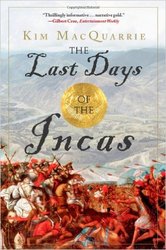
"The Last Days of the Incas" is one of the greatest epic stories of all time: how did 168 Spanish conquistadors manage to conquer an Inca Empire of ten million?
The Last Days of the Incas is among the most powerful and important accounts of the Spanish conquest of the Inca Empire, of the modern search for the Incas’ lost Amazonian capital of Vilcabamba, and of the discovery of Machu Picchu. In 1911 an American historian from Yale University, Hiram Bingham, stumbled upon a spectacular set of Inca ruins called Machu Picchu, set high upon a ridge in the cloud forest of Peru. Bingham had been searching for a lost Inca city called Vilcabamba—a legendary capital in the Amazon rainforest from which the Incas had conducted a nearly four-decades-long guerrilla war. Spanish renegades had taught the Incas how to ride European horses and to use European weapons and guns and the Incas nearly succeeded in wiping Francisco Pizarro and his conquistadors out. But was Machu Picchu really the Incas’ long lost guerrilla capital? Or did Vilcabamba still lie somewhere in the jungle—a lost Inca city waiting to be discovered?
Excerpt
It was November, 1532, the season in which the Andes begins its slow transition into the Southern Hemisphere's summer. And, as news of the final victory in Cuzco continued to race northward on foot along the often lonely and fantastic contours of the Andes, [the Inca Emperor] Atahualpa no doubt pondered for a a moment this strange intrusion from the west. Who were these people? Why would they dare intrude into an empire where his armies could crush them if he so much as raised his little finger? As Atahualpa listened to the latest report about the bold yet obviously foolish invaders, intermixed with the much more interesting news arriving each day from the south, he lifted up the gilded skull of his former enemy, Atoq, the Fox, took a long cool drink from its rim of gold and bone, then turned his attention to the more pressing matters at hand.
With vivid and energetic prose, Emmy Award-winner and author MacQuarrie (Where the Andes Meet the Amazon) re-creates the 16th-century struggle for what would become modern-day Peru. The Incas ruled a 2,500-mile-long empire, but Spanish explorers, keen to enrich the crown and spread the Catholic Church, eventually destroyed Inca society. MacQuarrie, who writes with just the right amount of drama ("After the interpreter finished delivering the speech, silence once again gripped the square"), is to be commended for giving a balanced account of those events. This long and stylish book doesn't end with the final 1572 collapse of the Incas. Fast-forwarding to the 20th century, MacQuarrie tells the surprisingly fascinating story of scholars' evolving interpretations of Inca remains. In 1911, a young Yale professor of Latin American history named Hiram Bingham identified Machu Picchu as the nerve center of the empire. Few questioned Bingham's theory until after his death in 1956; in the 1960s Gene Savoy discovered the real Inca center of civilization, Vilcabamba. Although MacQuarrie dedicates just a few chapters to modern research, the archeologists who made the key discoveries emerge as well-developed characters, and the tale of digging up the empire is as riveting as the more familiar history of Spanish conquest.
Entertainment Weekly
"Thrillingly informative...narrative gold"
Half a millennium ago, a small group of Spaniards tricked, manipulated, and murdered their way to total domination over the Peruvian Incas. In this thrillingly informative work, MacQuarrie relates how, with the help of metal weapons, artillery, disease, and horses ("the mobile tanks of the conquest"), the Spanish subdued a native populace despite being outnumbered nearly 10,000 to 1. In addition to writing rousing and clear-eyed battle accounts and describing the Incas' early form of guerrilla warfare, MacQuarrie also manages to spin the oft-told story of the discovery of Machu Picchu into narrative gold.
Book List
"A first-rate...work of ambitious scope that will most likely stand as the definitive account of these people."
The Incas were members of the group of Quechuan peoples of Peru, who established an empire from northern Ecuador to central Chile before the Spanish conquest. MacQuarrie reminds his readers that nearly 500 years ago, 168 Spaniards arrived in what is now Peru and collided with an Incan empire of 10 million people. The author, who lived in Peru for five years, chronicles the adventures of Hiram Bingham, who, in 1911, discovered Machu Picchu and believed it was the Incan capital. MacQuarrie also recounts the search by Gene Savoy, the American explorer who found Vilcabamba, the true capital. He describes the adventures of other conquistadors and puppet kings, the rebellion of 1535, and other military attempts to conquer the Indians. MacQuarrie, a four-time Emmy Award-winning filmmaker, researched Spanish and Incan chronicles. The result is a first-rate...work of ambitious scope that will most likely stand as the definitive account of these people.