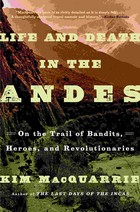
Category: History Publisher: Simon and Schuster
ISBN-10: 143916889X
Type: Non-Fiction
Pages: 488
Copyright: Dec 1 2015
ISBN-13: 9781439168899
The human history that has shaped South America is dramatically re-created in this rich account of iconic Andes characters, from Pablo Escobar and Hiram Bingham to Che Guevara and Butch Cassidy
The Andes Mountains are the world's longest mountain chain, running for 4,300 miles along the length of South America, from Colombia to Tierra del Fuego. For thousands of years they have been the setting for spectacular, dramatic, and often bloody events, even as they have given birth to some of the world's great civilizations. In this enthralling blend of history, travel, and adventure, Kim MacQuarrie takes readers on a fascinating journey that explores some of the most remarkable and enigmatic stories - from the ancient Incas to the recent cocaine kings - that have taken place along the mountain chain.
Why did the Incas, for example--who created the largest empire ever to have existed in the Americas--sacrifice children on the Andes' highest peaks? What secrets do these "Ice Mummies," many of whom have remained frozen and perfectly preserved for half a millennium, reveal? On Lake Titicaca, the highest navigable lake in the world, MacQuarrie visits natives who have lived for centuries on strange "floating islands" of reeds and who fashion giant reed boats. Did similar boats once transport people from the Andes to the islands of Polynesia, thousands of miles away?
The Andes also gave birth to the coca plant, whose narcotic ingredients launched the careers of cocaine kings such as Pablo Escobar. MacQuarrie investigates Escobar's amazing rags-to-riches story as well as the link between Escobar and the myth of El Dorado, the native king who once anointed himself daily with gold.
The rugged Central Andes, meanwhile, is where the continent's bloodiest guerrilla movement, the Shining Path, erupted. In Peru, MacQuarrie tracks down the unsung police detective who secretly unraveled the Shining Path's plans just as they were about to seize power. MacQuarrie investigates as well the question of why Che Guevara thought he could initiate a revolution with only a tiny cadre of seasoned guerrillas in one of the remotest areas of the Bolivian Andes. And how was it that the bank robbers Butch Cassidy and the Sundance Kid got trapped in their own final shootout, not far from where Che died? Finally, what clues did Charles Darwin discover in the Andes that would help him to conceive of the theory of evolution--and what secrets did these same mountains reveal that would lead Hiram Bingham to discover Machu Picchu?
Kim MacQuarrie investigated these stories and more while on his own epic journey down the length of the Andes, brilliantly illuminating the captivating and remarkable history of South America's most majestic chain of mountains.
Excerpt
PREFACE
When I was a boy, growing up in Nevada, during the long hot summers I used to read a lot. On burning days when the temperature outside hovered well over a hundred degrees and when if you tried to cross an asphalt street you quickly seared your bare feet, I would remain inside, lie on my back on our floral-patterned couch, open a book–and almost immediately would find myself plunging across icy seas or tunneling deep into other worlds. One of my favorite authors growing up was a German-American sailor named William Willis, who wrote true-life accounts of his various adventures. Willis had sailed on a square rigged ship as a teenager and, later in life, eventually made his way to the western coast of South America. There, he lashed together some balsa logs and sailed across the Pacific Ocean—for no other reason than adventure. Willis’ descriptions of being alone on his raft at night, peering down into an inky blackness where he witnessed great luminescent creatures rising from the deep, still haunts my imagination. At around the same time, when I was about eight or nine years old, I stumbled across Edgar Rice Burrough’s “hollow earth” series, which tell the tale of how a man burrowed down through the Earth’s crust with a machine, only to discover an exotic, interior world called Pelucidar. Within the Earth’s interior, it turned out, existed a world full of half-naked tribes and powerful beasts (mostly dinosaurs), rich, luxuriant vegetation, beautiful women, and so much adventure that I remember spending an entire summer there, immersed in a world as far removed from the deserts of Nevada as the Earth is from Mars.
Many years later, after eventually becoming a writer and documentary filmmaker, I was touring with a film I’d recently made on the rainforest, a film that explored the spirit world of a certain Amazonian tribe, when a magazine writer asked me what had motivated me to spend so much time in the Amazon. Without even thinking, I blurted out “Edgar Rice Burroughs.” And, upon reflection, I realized it was true. Surprised, the journalist told me he’d gone to public school with Burrough’s grandson. About a month later, a package arrived at my door. Inside was an original edition of Burrough’s At The Earth’s Core, published in 1914, the first in the “hollow earth” series. Burrough’s grandson had written an inscription on the frontispiece, saying that his grandfather would have been pleased to know that his work had propelled me to the far reaches of the Amazon. It was while fingering through its pages that I realized that some of the worlds we visit in books when we are children become so buried within our minds that, even though they may remain deeply submerged, they still may prompt us to later subconsciously search for them—much as adoptees might search for their biological parents, or as adults might search for long-lost childhood friends.
Although motivation remain as mysterious as creatures of the deep, I do credit Burroughs with having planted a seed that eventually took me to South America, a continent that, in many ways, contains everything that the best of Burrough’s writing ever did: a massive mountain chain, epic in its proportions; colossal continental plates that continually collide, thrusting up volcanoes and even lifting lakes twelve thousand feet up into the air, and a cloud-wreathed rainforest that stretches more than half way across the continent–a jungle so replete with sloths, giant snakes, bizarre animals and un-contacted tribes that you’d think you had somehow left the modern world and had stumbled into a world as primeval as that of Pelucidar.
My own journey to South America began in the late 1980s, to Peru, at the height of the Shining Path guerrilla war. Within a few months, amid Lima’s curfew-ridden city, I began entering high-security prisons and interviewing members of the Shining Path, while working as a journalist. I then began traveling in the Andes through some of the Shining Path’s “liberated” zones, where red flags with hammers and sickles fluttered alongside dirt roads—roads whose bridges had recently been blasted into ruined hulks and where guerrillas routinely pulled anyone who worked for the government off of buses and shot them in the head. One day, busy with journalism and with doing graduate work in anthropology at the Universidad Católica, I read a small notice in the paper about a reed raft, called the Uru, which was about to depart on a voyage across the Pacific. With memories of William Willis still etched into my mind, I quickly went down to the port, learned that the crew was exactly one member short, and promptly volunteered my services. It was a Spanish expedition, however, and the captain wanted an all-Spanish crew. The day the Uru departed, I nevertheless met the Norwegian explorer, Thor Heyerdahl, of Kon Tiki fame, who later invited me to spend some time with him while he excavated pyramids in northern Peru.
I did visit with Heyerdahl, then later lived for half a year with a recently-contacted tribe called the Yora, in Peru’s Upper Amazon, participating in their Ayahuasca ceremonies and listening to their rather spellbinding stories of how they had previously perceived the outside world, which some believed to be the land of the dead. The Yora told me about their skirmishes with outsiders, how they had shot six-foot arrows at invading oil workers and how, at one point, they’d shot so many arrows into some hapless intruder that afterwards he’d resembled a Huicungo tree—a type of palm whose spines resemble those of a porcupine. Later, fascinated by the discovery that the Incas had built a jungle capital not far from where the Yora lived, and had fought on against the Spaniards for four decades after their conquest, I wrote a book about the collision of those two worlds called The Last Days of the Incas.
Throughout the four years I lived in South America, however, there always lurked in the back of my mind the idea of one day traveling the full length of the Andes, all 4,300-miles of it, from one end to the other. What could be a greater adventure? On the day I finally set out, my idea was not so much to travel from point A to point B, but rather to investigate some of the most interesting stories that South America had to offer. To travel down the Andes collecting stories the way others might fill a basket with ripe, exotic fruits. I wanted to explore stories and characters I’d always been fascinated with but I was also looking for events that might help illuminate certain aspects of South America. Where did the first inhabitants of South America come from—from across the Isthmus or from across the seas? Where had the first South American civilizations come from? Did they arise independently or had they arrived via white, god-like emissaries from other continents? How did the conquistador’s search for El Dorado—the mythical king who anointed himself with gold—later give rise to drug lords like Pablo Escobar? How did such exotic creatures arrive on the Galapagos Islands —via evolution or by the hand of God? Where did the Andes Mountains come from—the longest mountain chain in the world—and why did the Incas feel the need to sacrifice their children to them? To leave children stranded on top of icy volcanoes? These were some of the questions—questions that probe into the very heart of South America—that I set out to try and answer.
In Colombia, for example, I investigated the cocaine trade by seeking out a certain police colonel. I’d heard that the colonel had once turned down a six million dollar bribe from Pablo Escobar, the drug lord, and had not only refused the bribe, but afterwards had actually tracked Escobar down. What kind of person, I wanted to find out—offered the choice between almost certain death or of becoming a multi-millionaire—would choose the former? And what did the colonel’s actions have in common with El Dorado—the man of gold? I travelled to Bogotá, Lake Guatavita, and Medellín to find out.
Off the coast of Ecuador, amid the Galapagos Islands, I went in pursuit of where and when, exactly, Charles Darwin had come up with his theory of evolution. At precisely what moment had Darwin stopped being a creationist? Was it in the Galapagos? Or earlier, in Patagonia? Or not until he had returned to England? And was it true that Darwin had so bungled his famous bird collections on the Galapagos that he was never able to use them to support his shocking new theory, that of evolution?
Further south along the Andes, in Peru, I went in pursuit of a story I’d heard that the leader of the Shining Path guerilla movement had eventually been captured not by the army, but instead by a certain police colonel whose identity and methodology had remained a state secret for more than a decade. But was the story true? And who was the upper class ballerina who’d hidden in her home the Shining Path leader—a revolutionary dedicated to overturning the class system?
On the border of Peru and Bolivia, fascinated by a series of high-altitude archaeological discoveries in the central Andes, I went in search of a young Inca girl who’d been sacrificed on top of a 20,700-foot volcano and who now resides in an icy museum crypt. Who was this girl, why was she sacrificed—and how is it that she and other children ended up on top of some of the highest mountains in the Andes, almost perfectly preserved?
Moving ever southwards, I next went in search of the extraordinary floating islands of Lake Titicaca, some 12,500 feet up in the Andes. I was curious to know why Thor Heyerdahl, who’d once crossed the Pacific on the raft Kon Tiki, had later flown a trio of Aymara-speaking natives all the way from Lake Titicaca to Egypt, to the base of the ancient pyramids. What secret did Heyerdahl believe these three men possessed that he would later entrust his life to their creation? On the shores of Lake Titicaca, not far from the legendary ruined city of Tiwanaku, I tracked down one of the men, who told me his story.
Meanwhile, in the eastern Andes of Bolivia, curious to know how worldviews can sometimes collide with reality, I went in search of how the Argentine revolutionary Che Guevara had been captured—and how his dream of founding a socialist utopia in South America squared with having sentenced men to numerous firing squads in Cuba. In the town of Vallegrande, I tracked down the school teacher who’d given the wounded revolutionary his final meal and had chatted with him on numerous occasions. Sitting on her sofa and clasping and re-clasping her hands, Julia Cortes told me the remarkable story of what had actually happened on the last day of Che Guevara’s life—and how that event had changed her life forever.
In a similar fashion, in the far south of Bolivia, I went in search of how the legendary characters Butch Cassidy & the Sundance Kid had met their end. Did the duo really depart this world in a hail of bullets–as depicted in Hollywood—or were rumors of a murder-suicide pact closer to the truth? It wasn’t until I traveled to the dusty mining town of San Vicente, nine thousand feet up in the Andes, and met the grandson of a man who had lived there during the shootout, that I learned the answer.
Finally, at the southernmost tip of South America, I went in search of a woman who is the last speaker of the Yámana language and who now lives on a windswept island off of Patagonia. Three of the woman’s ancestors had once shared a ship with Charles Darwin, had toured London, and had met the English King and Queen. They had then been transported back to the southern tip of Patagonia as part of a grand social experiment. But what had become of them? And what had become of the experiment? And who on Earth had ever come up with such a crazy idea in the first place?
The stories included in this book then, investigations really, are all the result of my meandering voyage down the western spine of South America, stories that I have strung together geographically from north to south, like a glimmering set of pearls.
What ultimately links all of these stories together is that each of the characters within them lived at least a portion of their lives in South America and all of them struggled to control, adapt to, or explore the rugged landscape that exists along the westernmost rim of South America. And, whether they realized it or not, all of the characters viewed South America through the particular lenses of their culture and time. In some cases, this proved fatal, for as the writer J. Solomon noted, “World views act somewhat like eye glasses or contact lenses…in either example, an incorrect prescription can be dangerous.”
The revolutionaries Che Guevara and Abimael Guzmán, for example, intensely dissatisfied with social conditions in South America and convinced that Marx’s prescription for building a utopia was not a theory but a fact, tried to force that theory onto society at the point of a gun. In doing so, however, they unleashed forces that ultimately overwhelmed them.
Like those before and after him, Charles Darwin arrived in South America with his own invisible pair of cultural glasses. Somewhere during his long journey, however, they partially disintegrated. Pondering the strange yet exhilarating world around him, Darwin gradually began fashioning a new set of lenses, which ultimately led him to discover the theory of evolution.
The Incas, by contrast, saw not the Andes of modern science but a sacred landscape controlled by the gods. Confronted by a landscape of erupting volcanoes, deadly earthquakes and unpredictable droughts, the Incas acted within the framework of their understanding—offering up during times of acute danger the greatest sacrifice they could imagine, that of a perfectly formed child, thereby hoping to restore balance once again to their world.
Nearly five hundred years ago, a Spanish chronicler and soldier of fortune named Pedro Cieza de León spent eleven years traveling in South America, beginning in what is now Colombia and journeying southwards through the recently conquered Inca Empire, which stretched down into what is now central Chile. In the preface of a book he later dedicated to the Spanish king, the chronicler wrote:
“O most serene and gracious Lord…to describe the wonderful things of this great kingdom…would require one who could write like [the Roman] Titus Livius, or Valerius, or some other of the great writers that have appeared in the world, and that even they would find some difficulty in the task. For who can enumerate the mighty things…the lofty mountains and profound valleys over which we went conquering and discovering? The numerous rivers of such size and depth? The variety of provinces, with so many different things in each? The tribes, with all their strange customs, rites and ceremonies? So many birds, animals, trees, fishes, all unknown[?]…Much that I have written I saw with my own eyes, and I travelled over many countries in order to learn more concerning them. Those things that I did not see, I took great pains to inform myself of, from persons of repute, both Christians and Indians. I pray to Almighty God that…He will leave you to live and reign for many happy years, with the increase of many other kingdoms.”
Cieza de León died having never visited all of South America. I can attest, however, having traveled the length and breadth of the continent and having visited much of the same territory that Cieza de León did, that many of the miracles and marvels he described still exist, and that the wonders of South America—a world I once half imagined as a child and was later fortunate enough to experience–still remain.
Professional Reviews
Kirkus Reviews
“A filmmaker and writer tells the story of the historical figures and ordinary people who have attempted to “control, adapt to, or explore” the largely wild and untamed Andes cordillera.
MacQuarrie’s (The Last Days of the Incas, 2007, etc.) love affair with South America began during boyhood when he read the work of Edgar Rice Burroughs. Though the tales themselves concerned an imaginary world at the center of the Earth, the images—of “half-naked tribes and powerful beasts…[and] rich, luxuriant vegetation, beautiful women”—stayed with him and became the unconscious lodestar toward which he gravitated as an adult traveler.
In this book, MacQuarrie walks in the footsteps of men and women who followed their dreams into the very lands that he once dreamed about as a child. Many became famous for their exploits: Charles Darwin, for example, discovered fossilized seashells high up in the Patagonian Andes that led to the formulation of his theory of evolution, while Che Guevara attempted to lead a revolution in the Bolivian Andes that he hoped would begin to transform the whole of South America. Some, like Colombian drug lord Pablo Escobar, found notoriety in the Andes for dark deeds that not only fueled their greed, but also caused social and political chaos. Others, like Butch Cassidy and the Sundance Kid, used the mountains as a place to hide from their criminal pasts, only to find themselves hounded to death by the law. Still others, like freelance anthropologists Chris and Ed Franquemont, went into the Andes in search of a research project. Instead, they found a community of indigenous people to belong to and helped revitalize the dying art of weaving among them.
Part history and part travel narrative, MacQuarrie’s book is as richly detailed as it is deeply felt. As the author describes a magnificent region with a turbulent past, he also pays homage to the “miracles and marvels” that lie buried like gems beneath the unfolding history of the South American continent.
A thoughtfully observed travel memoir and history.”
BookPage Review
“Using the wildly diverse 4,300- mile South American mountain chain as a backdrop, filmmaker and writer Kim MacQuarrie revisits the triumphs and depredations of such varied figures in the region as Charles Darwin, Che Guevara, drug cartel chief Pablo Escobar, Machu Picchu “discoverer” Hiram Bingham and the ever-mythic Butch Cassidy and the Sundance Kid.
But MacQuarrie is no hit-and-run chronicler cherry-picking fables. He immerses himself in the territory he’s been exploring since the late 1980s, when he first journeyed to Peru to interview imprisoned members of the Shining Path guerrilla movement. His account of how Shining Path leader Abimael Guzmán was finally run to ground is both a rousing good yarn and a case study in political error.
The author shows that Guevara’s undoing was an instance of revolutionary fervor overriding common sense. He brings fresh details to the narrative by tracking down the teacher who fed and conversed with Guevara in the hours before a Bolivian soldier executed him.
Although famous names provide much of the material in Life and Death in the Andes, they occupy only a part of MacQuarrie’s attention. He also delves into local cultures, explaining, for example, how an American helped found a thriving cooperative that rekindled interest in traditional Peruvian weaving. He retraces Darwin’s steps on the Galápagos Islands and travels to the tip of the continent to meet the last speaker of the once flourishing Yamana Indian language, destroyed by the ravages of colonialism. MacQuarrie is a master storyteller whose cinematic eye always shines through.”
New York Times Book Review
“[MacQuarrie] writes smartly and engagingly and with…enthusiasm about the variety of South America’s life and landscape.”