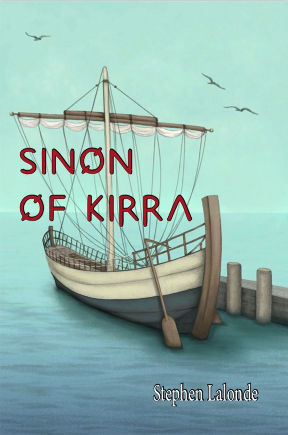
The Oracle of Delphi sends Sinon and his servant, Mentu, on a journey across the known world to retrieve an item described in ancient legends
SINON OF KIRRA...
is my newest novel. It is an historical fiction taking place in Ancient Greece in the 4th year of the 41st Olympiad (ca. 612 BCE). Sinon is a young man who goes to Delphi to ask of his future and is sent by the Oracle on an epic journey across the known world to Colchis at the end of the Black Sea. He and Mentu, his servant, come to realize the value of the journey is more important than the item they are seeking.
Excerpt
Chapter 8 - The Island of Seriphos
Sinon awoke with a start. Most of the crew was up and eating or busy with rigging. There was enough breeze to move the ship along at a slow pace, but faster than rowing could provide. Mentu was helping another crew member with rearranging some of the cargo that had shifted when they were in the larger waves.
The captain stood at the helm of the ship and spoke loudly for all to hear. “We will be arriving at Seriphos soon. We will be delivering some cargo there and we will see if there is some to pick up. We will stay there until tomorrow morning. Then our next stop will be Andros. That will take at least two days. We will need to secure provisions there because it will take at least three days with fair winds over open water to sail to Chios.” He then walked among the crew chatting with the men.
“How are you two doing?”
Sinon and Mentu were on their bench eating hardtack.
Sinon took a swig of wine and swallowed. “It takes some getting used to eating this for breakfast, but other than that I would say we are okay.” He turned to Mentu, “Wouldn’t you?”
“Better now than yesterday.”
“Well, I think you are both becoming good sailors from what I can see. I have to admit I was a little hesitant when your father approached me, but you are both proving to be worthy crew members. He didn’t say why you are going to Colchis.”
“I consulted the Delphic Oracle and I was instructed to go there. I am trusting that I will find out why at some point. Call it half hope and half trust.”
Mentu studied his hands during this conversation. When Aristomachos moved on, he looked to Sinon and spoke, “You did not tell him the whole prophecy.”
“No. We do not want to have anyone know our purpose. Of this I am sure. I have no idea what we will find when we get to Colchis or how we are supposed to secure a fleece. With so little certainty it is best to leave much unsaid.”
Mentu nodded and peered forward beyond the bow. “I think I see it. There, just to the left.” He pointed in that direction and Sinon studied the horizon spotting the tiny lump where the sea met the sky. As the day wore on, the island grew and by early afternoon they were guiding the ship into one of the many bays the island provided. Several docks lined the bay and they had their choice, as no other ships were present. As they approached a dock, three men came out of a small hut and assisted with securing the ship to the dock.
Several amphorae of olive oil and some with grain were unloaded, but there was no new cargo, so the crew found themselves with some free time. Most went ashore and headed various directions. Sinon and Mentu decided to stay within sight of the ship, but found a small creek emptying into the harbor. There they sat in the shade and talked.
“So if you don’t know what we will find in Colchis, how do you think you will be fulfilling the challenge.”
“I know only this. We will not do as Jason did. We will have to find a way to secure a fleece by reason if such a thing even exists. I will trust that we will find an answer to this prophecy after making such a grand journey to accomplish what the oracle suggested. Does that make me sound foolish?”
“I would never judge you to be foolish. You appear to be acting on faith and that is good enough for me.”
“You are a good and loyal friend Mentu. I am glad you are with me.”
Later they saw other crew members returning to the ship. Some were carrying items they had secured while ashore. Sinon and Mentu walked back to the ship. A basket of figs and olives and another with fresh bread provided a welcome dinner.
As the sun was setting, Strymon began a new story and the crew quickly gathered around.
“This is the island of Seriphos. This place was the childhood home of the great hero, Perseus. King Acrisius of Argos consulted an oracle and was told that he would have a grandson who would kill him. Determined to avoid the prophecy, he had his only child, a girl named Danae, imprisoned in a bronze hut, which was buried underground. There was only a small opening in the ceiling through which food, water, and air were provided. The magnificent god Zeus saw that Danae had become a beautiful young woman. He turned himself into a shower of gold and poured himself into the apartment and impregnated her.”
Several of the men intently listening now cheered and made rude comments. Sinon and Mentu watched this brief interruption with laughing eyes.
Strymon continued, “When the baby was born, a servant bringing food heard the baby cry and informed King Acrisius. The king had the hut dug up and there was Danae with the child, Perseus, which the prophecy had foretold. Not willing to risk the wrath of the Erynes, those who avenge blood murder, he knew he could not kill the child. So he had Danae and Perseus placed into a chest and cast into the sea. They were sure to die, but then the blame would be upon Poseidon, for the sea was his realm. The gods despise such deeds, so Poseidon caused the chest to be washed up on a beach of this very island. A poor fisherman named Dictys found the chest, opened it, and took young Danae and her son, Perseus, home. There they lived with the fisherman and his wife. However, the fisherman’s brother, Polydectes, was the king of this island. So selfish was he that he let his own brother live in poverty as a fisherman. When Polydectes happened to see beautiful Danae, he determined that he would marry her. She knew nothing of this. By this time Perseus was a formidable young man. Polydectes decided that he had to get rid of Perseus somehow so he announced a great feast and invited Perseus to attend. In a conversation with Perseus before the feast, Polydectes lamented to Perseus that though he was wealthy he could not buy the one thing he wanted most; the head of Medusa, the Gorgon.”
Most of the crew had not heard Strymon tell this story before. They were silent now, leaning in to hear more and mumbling to each other.
“The day came for the feast and all of the wealthy friends of Polydectes came to the celebration. Perseus was there too. Once they were all gathered, Polydectes announced that this feast was to celebrate his upcoming wedding, but he did not mention who the bride was to be. All of the wealthy friends pledged grand gifts to the King, but Perseus, raised in the humble home of Dictys, had no gift to give. His youthful pride led him to declare that he would bring the best gift of all, the head of Medusa.”
There was brief chatter among the men, so Strymon paused. When it grew quiet again he continued.
“Perseus left immediately from the party and found passage on a ship, for he knew that he could not get permission from his mother for this dangerous quest.”
Many of the sailors were nodding in understanding.
“He had no idea where to find Medusa, so he went to Delphi to ask the oracle for help. Since Perseus was a son of Zeus, Apollo, the god of the Delphic Oracle, was his half-brother. The priest told him that the Pythia’s response was to go to the land of the oaks, Dodona, a land special to Zeus, since the oak is his sacred tree. The people there only assured him that he was under the protection of the gods, but they were unable to tell him where he could find the Gorgons. As he left this land he met a young man carrying a winged staff and wearing a winged cap. It was none other than Hermes and then Athena appeared. Both of these gods, being children of Zeus, were also half-siblings of Perseus. Hermes provided a sword that could cut through the Gorgon scales. Athena gave him a bright shield to use as a mirror. Seeing the Gorgons would turn any mortal to stone, but their reflection could not harm him. Hermes then accompanied Perseus to find the Stygian witches who shared an eye and a tooth.”
There was much snickering at this description.
“The godly brother then instructed Perseus to steal the eye and tooth and use them to ransom directions for the next part of the journey. He did that by rushing in to grab the eye and tooth as the sisters passed them from one to another. Perseus told them he would return the items if they would tell him where he must next go on his quest. The witches directed him to the Hyperboreans, those who lived behind Boreas, the north wind. He gave them back the eye and the tooth and traveled north. When he found the Hyperboreans they gave him winged sandals that allowed him to fly, a purse that would expand to hold whatever was placed in it, and a cap that would render him invisible. They also told him that the Gorgons lived in the west near the setting sun. Armed with so many gifts and guided by Hermes, Perseus found the Gorgons. They were asleep. Hermes pointed to the one mortal Gorgon, Medusa. Perseus, invisible and flying above them, watched in the shield-mirror. He saw that she had living, writhing snakes sprouting from her head instead of hair.”
There was more chatter among the crew upon that description. Strymon waited until they went silent. Then raising his hand high in the air as though holding the sword ready to strike, he continued.
“Perseus raised the sword high and struck with all his might the neck of Medusa.”
A cheer went up from the men as Strymon sliced downward.
“He grabbed the severed head and placed it in the purse. Medusa’s sisters awoke screaming as the winged horse, Pegasus, sprang from the headless neck of Medusa. They could not see the invisible Perseus but thrashed around trying to find their sister’s killer.”
The men rocked back and forth in approval of this part of the story.
“But Perseus was not done. He headed home and along the way found a maiden, Andromeda, chained to a rock awaiting certain death from a sea monster because her mother had offended the gods. He fell in love with the beautiful girl at first sight. When the monster came, he slew it with the same sword that beheaded the Gorgon. His reward was the hand of the fair maiden in marriage. Together they traveled to this island. Upon returning, Perseus found that Dictys and Danae were in hiding because the king had announced that his marriage was to be with Danae. She did not want this evil man as a husband. Perseus then realized that he had been tricked. He went immediately to the palace where Polydectes and his wealthy friends were enjoying a grand dinner. When he entered, they all looked at him in great disbelief. While he had their attention he brought the head of Medusa out of the purse, holding it high and being careful to not look at it himself. The king and all of his wealthy friends were turned to stone.”
Strymon pulled the head from the purse and held it high. There was much joy expressed by the crew for the story and the storyteller.
Strymon wasn’t finished, “Perseus then took his lovely wife and his mother to Argos. They found that the people of the land had banned King Acrisius and did not know where he went. Perseus heard of a great athletic contest being held by King Larissa to the north of Argos. He went there and entered in the discus contest. When he threw the discus a wind arose and blew it into the crowd where it struck none other than King Acrisius killing him instantly. So once again the oracle’s prophecy came true.”
A cheer came from the men in appreciation for such a grand story. Strymon waited until the cheering died down and continued.
“Perseus lived out the rest of his days well, and his line of descendants eventually led to Heracles. I am a descendent of Heracles and therefore of Perseus as well.”
Strymon stood, “Good night to you all. We have to get rest for tomorrow’s work.”
The men went to their rest exhausted by the adventure they had just heard. Sinon did not miss the point made by Strymon that all prophecies of the oracles come true. He chose to take some encouragement from that.
Professional Reviews
Diana Legun
Stephen Lalonde has written intrigue and texture, peril, hardship and humor into this story of an adventure that two young men embark upon in a time and place of unfamiliarity to modern mankind. The clothes, food, creature habits and modes of transportation bring an ancient past to life with a glossary for terms and maps for navigating the travels of Sinon and Mentu from the village of Kirra, as they experience a journey seeking a specific something of great importance. Pitfalls on the open sea, wary encounters with threatening strangers, ports of entry to towns of long ago and the rustic ways of life among people of the year 612 BC are told with vivid detail as the two main characters grow towards realizing where they belong.
Sinon of Kirra is a journey into a colorful world, one of sights, sounds, smells and creatures mystical and fierce. The setting is brought to life in an era of goat cheese, dried fish, figs, grapes, olives, and hardtack, of ledgendary ship trade, of other worlds, languages and islands. The characters’ well-defined personalities travel through the story to ports of entry and clusters of huts and taverns.
Stories within the story are woven into a tapestry made up of myths and the depiction of life in Greece. Maps of the travel lands appear throughout the book, and a glossary of terms is provided for defining words used for clothing, artifacts and mythical entities.
Part adventure, part history, part romance, the heft of the tale is companionship, family and human bonding. There is plenty of dialog bringing personality to the characters. I always enjoy listening to the voices of the people in a well-told story.
One particular scene in the marketplace is written in detail that brings smells of cooking, the sound of goats bleating and voices of street vendors. In this book there are villages, harbors, sailors flirting with women, ship crewmen listening to their captain tell stories as the oil lamps flicker on deck above the dark quiet sea. Another scene vividly gives the shock of cold briney sea water, “boiling passages,” of huge waves leading to the Black Sea, “Tremendous explosive splashes split the air as several large boulders broke free from the cliff walls of the Bosporus.”
The atmosphere changes from snapping sails that unfurl to catch the easterly breeze, to smoking wood fires of the village huts and Inns; then it slips into the brandishing moonlight on glassy water and the passing of time. “The next morning, the chariot of the sun peeked down from the eastern horizon to see the Amphritite well under way several miles from the place they spent the night. — As night swallowed the last light of the day, Aristamachos commanded, “Eurystheus, light the lamps.”
Intricate details give flavored chewiness to the story: “We could be in rough seas when we cross from Andros to Chios. You might see if you can get some wormwood or even white hellebore from a shop at Andros. There is much vegetation on that island. Mix that with some wine and it should keep you from getting seasick.”
Descriptive settings portray the place and time: “The walls and floor appeared to be marble and there was a tile mosaic of a woman reclining on a couch worked into one wall.”
I feel the scratchiness of grass while Sinon and Mentu are laying on the ground, trying not to be seen. “On the fourth day they were hiking through a small forest. A thick carpet of tall grass covered the ground under the trees. —They left their packs at the base of one of the biggest trees near the crest of the hill and crawled forward slowly, being sure to make no noise or to move anything that might raise suspicion. The ground was very dry and little puffs of dust came with each movement. The dead grass poked their hands and legs as they slowly inched forward.”
We meet bards singing in taverns, scruffy beggars, sailors, pirates, and shipwrecks.
In these days of cell phones, internet, speeding cars, instant everything and a dwindling of connection to nature, to animals and rugged outdoor challenges or primitive oil lamp light, fire cooking, wine flasks, donkey carts, travel by sailing ships, it was for me a good detour from this contemporary place. It was an enjoyable land and sea trip to take with these characters.
Jody Davis
Just finished your book. . .it was so good! the story just kept having new twists and turns. . .I love historical novels because you can feel what it would have felt like to live in that time. . .thanks for education along with the entertainment.. . . think my husband, Aaron, is gonna start it soon. . .you are a GOOD writer, can't wait for the next one. . .Mentu The Nubian. . .
Joli Stewart is raised in the lap of luxury on her father's plantation near Charleston, South Carolina. High spirited, non-traditional and head strong, Joli refuses to accept any interference in her life or her romantic decisions. Follow her life dur
Fifth Book of the Southern Swallow Series. Nan Ya and his crew take a final adventure into a mythical Chinese universe and become entangled in court intrigue.
Fifth Book of the Southern Swallow Series. Nan Ya and his crew take a final adventure into a mythical Chinese universe and become entangled in court intrigue.