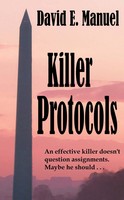
This edgy, first-person narrative introduces Richard Paladin, staff employee of an Environmental Protection Agency lethal program. Follow Paladin through the twists and turns of a few assignments to a surprising ending.
Richard Paladin works in the shadows eliminating terrorists, spies, and just general riff-raff who threaten the security of the United States. At least, he assumed that's who he'd be killing when he was hired into a secret department of the Environmental Protection Agency. But when one of his "clients" turns out to be a seemingly harmless Missouri housewife, then he's ordered to eliminate the owner of the local northern Virginia bar he frequents, he starts to ask himself a few questions-like what any of this has to do with the U.S. Government's reluctance to sign the Kyoto Protocol. Still, if he can run the gauntlet of spies and goons who keep cropping up unexpectedly, he might just be able to hold onto his job and keep doing what he loves-arranging fatal accidents and suicides. Because Richard Paladin hasn't got a clue what he would do for a living if he loses his job as a government killer.
Excerpt
Chapter I
A Perfect Place for a Homicide
I DON'T GO to New York unless I have to. I sure wouldn't go there for pleasure. Maybe some people believe all that crap about it being an exciting place filled with great stuff to do. Me, I'm not interested in opera, Broadway shows or art galleries. I get sick every time I hear some East Coast twit say it's "convenient" that there's a subway system overrun with pick-pockets and punks or that the streets are teeming with cabbies who rip you off for a two-block fare. Best I can tell New Yorkers are a bunch of loud-mouthed, shit-for-brains assholes who think getting mugged is a cultural experience.
New York is pretty compelling proof that this country is on a downward slide. The place was overcrowded and polluted long before raghead terrorists leveled the Twin Towers and coated the city with toxic dust. I suspect people who live there have a higher percentage of lead and asbestos in their systems than a World War II Liberty ship. But New Yorkers are a tough lot. After 9/11, the bankers who own most of the city and damned near all the rest of the country dusted off their silk suits and went right back to robbing the country blind. And the rest of the inhabitants picked themselves up and went back to work serving those bankers their fancy coffees and scones; or resumed mugging the bankers and their servants to make a buck. I'll admit, I admire New Yorkers a lot for their grit and determination. But I avoid the place as much as possible. Since I got out of the army, I make it a habit to stay out of war zones.
I'm not alone in my assessment of New York. Hell, New Yorkers obviously feel the same way: just spend a day in the city and see how pissed off everyone who's stuck there is. The first few times I visited the place, I used to keep count of the number of times I heard someone say "fuck off" or "fuck you, buddy." I gave that up. It's not that I can't count that high—although math's not exactly one of my skills—but it does get boring.
An old army buddy once told me some guy named Oswald something-or-other wrote an entire book about the sorry state of New York and most of the rest of the country, some rant called The Decline of the West. Joe Sprague and I got drunk one night in North Carolina, right after we'd gotten kicked out of the army, and he started rambling about this Oswald guy and the West and how everything we believe in is being undermined. At the time I thought he was just drunk and a little nuts, but I've since learned better. I keep meaning to read the book, by the way.
So I don't go to New York often. But when I go I take the train. I live in Fairfax, Virginia, several miles across the Potomac from Washington, D.C.—a place trying real hard to catch New York in the decline race—and it's pretty easy just to take the subway to Union Station and hop on the Metroliner. My office is close to Union Station anyway—not that I have a 9 to 5 job or anything—so I can check in on the way out and on the way back just to see if any new assignments have come in.
Believe me, the Metroliner really beats taking the air shuttle. Sure, transit time is three hours as opposed to 75 minutes by air. But I can walk into Union Station at 6:55 a.m., buy a ticket from the Amtrak ticketing machine, walk right onto the train which pulls out at 7:10, and I'm in New York, downtown at Penn Station, by 10:15. Take the plane, add the hour you have to wait in the lounge before boarding, and the hour-plus cab ride from LaGuardia or Kennedy into the city, and I figure you really only lose twenty minutes max on the train. And what you get in return is a bigger seat, room to walk around, fewer hassles from stewards and stewardesses trying to make you believe they care about your comfort, and the peace and quiet of half-empty railroad cars. Because most people going to New York from Washington just hate to lose that twenty minutes, so they fly. And that's fine with me, because I like the empty, hassle-free train ride.
I also like the fact that I can get all the way into downtown New York without having to pass through a metal detector. Makes it a lot easier when you're packing a gun, which I usually am when I'm heading to New York. Because, like I said, when I go there it's on business. And my business is killing people.
“Killer Protocols” by David E. Manuel is a very competent and professional piece of work and a gripping read. I discovered the book on an indie review website and decided to give it a try on the basis that I had not read any crime fiction or thriller for some time.
I was pleasantly surprised right away when I found myself not being pushed into an action packed and fast paced adrenalin rush of a story but to be presented with a solid set up of the main character, Richard Paladin, an undercover agent working for the U.S. government as killing machine: A likeable if somewhat cranky and at times opinionated and testosterone filled hero. As the reader knows who does the killing the story is not an ordinary whodunit but a more complex mystery about why our man is ordered to kill these people and just how legitimate his ‘employers’ are.
The supporting characters are another asset to the book, they are well portrayed and given enough colour and flesh to make them more than just décor, in fact, Manuel has an outstanding talent for description and setting up scenes without rushing. There is also a lot of wit and humour in Paladin’s perception of his surroundings, making for an easily flowing and enjoyable reading experience.
The writing style reminded me at times of Andy McNab, another great author who slowly and carefully establishes the story before picking up pace. Once various strands of the story suddenly come together I could not put the book down until I finished it in one sitting.
I am not sure if all hard-core fans of the genre will appreciate the initial slow pacing but I would urge you to give it a try, the build-up pays off perfectly later on in the book, bringing more depth to the characters and making the plot richer and believable.
I am not a massive thriller fan but “Killer Protocols” reminded me just how exciting a good suspense read can be. This book being the first in a series has done a great job at getting me hooked and looking forward to more. I have tried but failed to find a fault with this book and I will recommend it warmly to others.
5 out of 5
Wilderness Bound -- Fire-fighter and paramedic, Matthew Standing Deer returns to the past, to the Lakota, only to find himself hurtled into danger, uncontrollable greed, and searching for a serial killer. Danger looms over everyone's head. How will h
This was no mere illusion. Colin Chase Rand, pulled through a magical portal, landed in 1935 where the dust bowl and the Great Depression was destroying lives, and a serial killer was in their midst