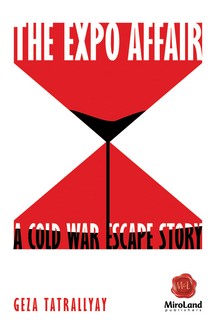
The Expo Affair is a narrative memoir of international intrigue and romance that took place in the exotic setting of Expo '70 in Osaka, Japan. As a host at the Ontario Pavilion, the author, Geza Tatrallyay, was approached by three Czechoslovak hostesses who wanted to defect to Canada. Notables such as former Prime Minister Trudeau, External Affairs Minister Mitchell Sharp and General George Kitching play a role, as do individuals who have since become prominent in Canada as businessmen, artists and ambassadors.
The Expo Affair is a narrative memoir of international intrigue and romance that took place in the exotic setting of Expo 70 in Osaka, Japan. As a host at the Ontario Pavilion, the author, Geza Tatrallyay, was approached by three Czechoslovak hostesses who wanted to defect to Canada. Notables such as former Prime Minister Trudeau, External Affairs Minister Mitchell Sharp and General George Kitching play a role, as do individuals who have since become prominent in Canada as businessmen, artists and ambassadors.
Professional Reviews
Ottawa Review of Books
Reviewed by Timothy Niedermann
The Berlin Wall fell over 25 years ago and since then, the Cold War has sunk into memory, the anxieties of those times being gradually supplanted by new fears—9/11, Islamic terrorism, climate change. The years of Cold War were in many ways a simpler period than today, yet far more frightening. The enemy—the Soviet Union—was obvious, but so was the existential danger—annihilation by worldwide nuclear war. For four decades, the shadow of total destruction darkened people’s lives on both sides of the Iron Curtain. Though outright war never occurred, the conflict was still waged, but in the shadows. Nothing was really clear. There were plots, counter plots, spies, assassinations, intrigue, and constant second-guessing. It was cat and mouse—a global chess game that never gave a second thought to sacrificing its pawns.
In The Expo Affair, Geza Tatrallay has written a memoir of his involvement in a very minor, yet affecting event during this time: the attempted defection of two Czech women during the Expo ’70 world’s fair in Osaka, Japan. Tatrallyay himself escaped from Hungary with his family in 1956, so he brings multiple perspectives to this story, having firsthand both felt the oppression of the Soviets and breathed the freedom of the West, in Canada. He was also riding the currents of the 1960s’ social upheaval with all its sex, drugs, and rock and roll. A Harvard university student at the time, he applied on a whim to be a host at the Ontario Pavilion at Expo ’70, and found himself enrolled in a year-long project, including a program of intensive Japanese language instruction. He was to represent his new country, Canada, to the world. But he and his compatriots were young, so mixing with the other young people was a given. One thing led to another, and soon he found himself intensely involved with a Czech girl, Sasha. It was clear that the KGB was watching, but who cared? That is, until Sasha’s friends Zozana and Helena approached him, seeking asylum in Canada.
Tatrallyay felt obliged to help. Luckily, another host with the Ontario pavilion was Cam Deacon, whose father was head of the Ontario Liberal Party and very close friends with Mitchell Sharp, Canada’s Secretary of State of External Affairs and acting prime minster, since Pierre Trudeau at the time was abroad on a diplomatic trip in the Pacific region. Supported by Canadian diplomats in Japan, in particular the Commissioner of the Ontario Pavilion, Major-General George Kitching, Tatrallyay and Deacon, as well as other compatriots at the pavilion, tried to arrange safe passage for the girls to Canada, even as the Czech and Soviet authorities were catching wind of the girls’ intentions. Was Sasha a spy? Instead of reaching clarity, everything became more and more murky.
Re-creating long-past events from memory is at best imprecise, and the author admits this up front. Yet the descriptions and dialogue he has set down create a convincing atmosphere. He does not embellish with extraneous history or analysis, but lets the story unfold naturally (though he perhaps is a little more graphic than is necessary with some of his sex scenes). The voice is that of a young man, not of an older man reliving his youth, and this reinforces the immediacy of the story. Only in the epilogue does Tatrallyay step back and give a brief summation of what happened to the individuals involved. This gives some closure, but also leaves the reader feeling a bit of the sadness and regret Tatrallyay must also have felt and still feels.
All in all Tatrallyay gives us a very personal and affecting window on the confusion and desperation of the Cold War era.
The Expo Affair is published by the MiroLand non-fiction imprint of Guernica Editions.
5*
This is an excellent read - an exciting episode during the author's coming of age that laid the groundwork for his lifelong propensity to action. The author, in real life, was given a choice to help others escape the drudgery of Soviet occupation. He rose to the challenge and did not let others down. It is a fast-paced recollection of a seminal event in his life, drawing on his prodigious memory and likely some embellishment of social scenes. The writing propels the reader forward to the surprising conclusion. Worth the read - be prepared to be left with questions to ponder at the end.
A passionate and poignant memoir written by a woman whose life has been guided by the words: "I am here to learn how to love well." The book is a deep examination of relationships, family, motivation, and honoring of the Self.