Kindle Edition
Amazon
Valentino Speaks
Valentino Speaks
Category:
Self-Help
Publisher: Whitley Heights Publishing
ISBN-10: 0983343646
Type: Non-Fiction
Pages: 97
Copyright: March 5, 2012
ISBN-13: 9780983343646
Price: $3.99 (eBook)
The 'senior' experience, through only the most constructive and creative of lenses! A blueprint for active living.
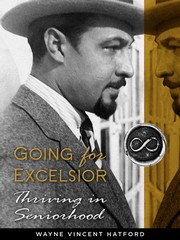
What if you were as savvy as you could possibly be in matters of aging and, therefore, really soar, breeze through the final chapters of your life with flying colors? The 'senior' experience, through only the most constructive and creative of lenses! Encountering the Apex, with Rudy and Wayne. "Going for Excelsior" offers practical suggestions for successfully negotiating Seniorhood, a blueprint for active living ~ how to embrace where you're at in your life, find hidden gems, turn up the volume. Thriving in Seniorhood is about going beyond what' s expected or directed at you by the host society and this book provides the reader with the tools and understandings to accomplish that goal. Conundrums solved. The sting removed from such phenomena as dementia and Alzheimer's. Myths about Seniors debunked!
"Seniorhood" ~ Where people often like to perceive us, once we have attained a certain age. Also, where we can choose to thrive, with clarity of purpose, and by design!
"Like all those who currently inhabit a body, you, too, are getting ready for Excelsior. Especially allow the 60's, 70's, 80's and beyond of your ages to be magical in this regard, for you to be way-showers, preparing yourselves mentally, physically, and spiritually for the next phase. There always is a next phase, by the way, and we are always getting ready for it. You are part of a grand design, as am I. There is no other option!" ~ Rudolph Valentino
Excerpt
“Balance is probably the most important concept in the Universe. Not the same as equilibrium, however, which is much more temporal and fleeting. Balance is a fuller word, an end in and of itself. (Addressing the author) You, Libra, know a thing or two about this state of being, a desired state, in fact, the most desired state, always being sought. Teeter-Totter; to get there we must stand between the dimensions, one foot in each. This is nirvana when it can be accomplished, bliss when we reside in both planes.
That is what our book is about, getting to balance, becoming more alert to our opportunities to live in two worlds simultaneously. Why not? It can be done. I do it a bit myself when we write, also at other times, like when you have seen glimpses of my form. Balance necessitates an agility not unlike what is required in dance ~ always shifting your weight as conditions change, coming down harder on one side versus another ~ as warranted. And it’s not just a matter of having your feet in two dimensions; the figurative face can be inserted in either very easily. I do it, for example, to watch what you are writing, also to witness the joy that comes from our being able to communicate in this manner.”
Sometimes objects are very instructive, especially if one opens up to the possibilities they represent. I own a piece of Victorian flotsam and jetsam, for instance, that is particularly apropos to the genesis of this book. It is a decorative item, a tabletop ornament consisting of a column or stem on a stand entwined with flora, with two opposing arched branches at the top, each holding a sphere or, in my estimation, ‘world.’ Allow me, if you will, to wax a little poetic on the meaning of this worn piece of old silver plate and how it applies to what we are purporting to do here which, among other things, is to assist the reader in achieving greater balance in his or her life.
The stem is our core, grafted, so it seems, onto a platform where our individual realities mesh, interacting with each other along some commonly agreed-upon continuum of expression, the one that most of us like to think of exclusively as pertaining to the Earth Plane. I would like to invite you consider an alternative. Just maybe, the unseen world is as important in our daily lives as the so-called seen. I put it this way because there is some controversy (well-placed) over whether what we see is actually what we are seeing or simply a reflection of what we think we want to see. Anyway, let’s suppose that the Astral Plane is as fully a part of our lives as what we see and experience in the waking state.
Indeed, we spend a good portion of each incarnated life-time in the dream world, a vibrationally-induced level of consciousness where we are able to continue living our lives in a more natural state, without the self-created limitations the Earth Plane affords. There, the sky’s the limit. That’s the way “it is” in the Astral ~ no boundaries as to what can be imagined and therefore “shown.”
Ladies and gents, not only do we sleep some in each twenty four hour period, we also have our fair share of “DayDreams,” the more than apt title of Rudolph Valentino’s 1923 poetry book. In it, he was subtly encouraging us to also focus on the Astral world, to give it as much attention and credence as we do our so-called waking life, because the reality is that both have equal weight and, in giving each its fair due, balance is achieved ~ again, what some have termed nirvana, incredible lightness of being, a sense that you are walking, or dancing, on the dimensional cusp.
That is the big picture. Now, let’s go into a little more detail. What happens when we day dream? Well, our eyes are usually open (though not always) and, it seems, our thoughts start to wander, often entertaining scenarios that the rational mind would define as improbable or unlikely, hence the label dream. Know that when you day-dream, just like when you dream at night, you are exploring options without necessarily having to live them out with all their attendant cause and effect and, at the same time, you are contributing to the on-going development of your current reality ~ in other words, having input. Therefore, some amount of day-dreaming is invaluable, indeed necessary to the on-going development of what we perceive as our personal reality and the continued evolution we all seek. Day dreams, too, have an effect on what we create, just as all our thoughts do, wedded, as they are to will, perspective, belief and the full array of reigning emotion.
Countless gurus tell us to stay grounded in the NOW to be happy. Of course, as we pointed out in “Valentino Speaks” the French got it right in the sense that the core word in their language for happy (heureux) is “heure” (time/hour and, by extrapolation, NOW) but I propose that you can be grounded in the NOW and still day dream from time to time. In fact, it’s necessary. Have you ever noticed that you cannot completely stop doing so, no matter how hard you try? And if that isn’t a confirmation of its validity, I don’t know what is!
What happens when we day dream? We enter a time warp, transported to other times, places and, dare I say, worlds, those of our own making. Yes, as disparate as they may seem, we are the authors of all our dreams, the “dream-makers,” whose ability to craft works of art never ceases to amaze. Weavers, too, are we, capturing threads of our known reality in order to constantly spin new webs. Yes, think of each dream or snippet thereof as a ‘web’ site, a station in the Cosmos where we can really tune in ~ full of information, also pregnant with possibilities! Any dream is really about you experiencing yourself. As Valentino explains it: “reveries, what pleasantries, how best to let you know, what it is that is needed in order to grow.”
Generally speaking, any kind of dreaming is some of the best fun you’ll ever have. However, we do, every so often, touch a nerve, that piece of a dream sequence that is most likely to stick with us when we wake up, the bitter pill, so to speak, sometimes also known as a grain of truth. It’s what we debate with ourselves about later, discuss with our therapists, describe in our journals and tend to examine from all angles. These touchy points are also where our greatest potential growth lies. Unlock their meaning and everything shall be yours. At least, that is what we think and, we’re not so wrong. Any jolt to the consciousness has a beneficial effect, a wake up call, if you’d prefer. It’s what we Californians call a “Eureka” moment, our state motto meaning ‘I have found it’ ~ I have discovered another key which will unlock a mythical door that is sure to lead somewhere.
Apart from dreams, the Astral is represented in the Earth Plane in any number of ways, perhaps most notably in films and the whimsy of advertising, in a sense as bleed-through from other levels of existence. Movies are, once again, life ~ life extrapolated, where anything is possible, even probable.
Movies, whatever their subject matter, tend to focus our consciousness. That is why the countless hours spent in a darkened theater or watching films in the comfort of your home have not been in vain. To the contrary, in many ways they have elevated the level of discourse in your brains. How so? By presenting us with possibilities, many of which we might not have been able to think of on our own.
“Speaking of elevation of thought, as Valentino I started a crusade for better scripts, deciding, at the time, that those being routinely offered me were of inferior quality. Now as I review, each had their good points too. “The Young Rajah,” for example, a picture that I once considered to be among my least successful, examined intuition and the concept of thought-power, especially as it pertains to creating personal reality. Amos Judd, my character, could see the future for others but, alas, not for himself. Nevertheless, he was always busy creating it anyway. And so it is for all of us. Where would we be without our dreams?
The great thing about movies is that they translate thoughts into a series of picturizations, the net result of which is to make them more accessible and easier to understand. This is also what happens when we dream. Most of the picturizations we view in dream sequences do not have language attached. Yet, when they do, the meaning is often doubly exaggerated. I once believed that silent films were the perfect vehicle to convey thought because of their universality but now I know that sound is not a detriment. In fact, it only adds to the vibrational wallop of any photoplay.”
|