Amazon
Alana Munro - Author
Alana Munro
Amazon
Category:
Self-Help
ISBN-10: 1502396556
Type: Non-Fiction
ISBN-13: 9781502396556
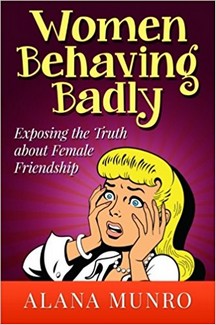
Exposing the truth about female friendship.
Have you ever been hurt by a woman? Are you fed up with the constant bitching, gossiping and manipulation between the females in your life? Do you want happier and healthier relationships with females? Do you wish to weed out the toxic women and seek out only positive women?
If you have ever wondered why some women are complicated creatures this book will offer you straight talking answers. This book will highlight all the strange, controlling and spiteful behaviours that some females specialise in. This book attempts to understand what actually drives women to be cruel or bitchy to each other. It attempts to make sense of the huge expectations women place on each other. How can we avoid toxic women? What bad behaviours should we be looking out for? This book explores every cruel behaviour possible and attempts to understand what is really going on between the females in our life.
More about ‘Women Behaving Badly’,
Alana Munro takes us deep into the unnerving yet compelling reality of being a woman, revealing a world where females don’t nurture other females. Sharing many deeply personal and shocking tales about bullying, bitching, gossiping, power games, jealousy and much more – Alana explains what each hurtful episode taught her about females.
Women Behaving Badly shatters our assumption that all women are loving. It ruptures the delusion of sisterhood. It heightens our awareness of what goes on behind the sweet smiles. It liberates women from the emotional and often difficult prison that is womanhood. It exposes the harsh and fickle reality of friendship between women.
This book offers us nothing but the truth. Alana argues that the bonds between women are most often too fragile. She also argues that the ideology of sisterhood is optimistic but unrealistic. Women are human beings with profound emotional short comings.
Alana also looks at how we can weed out the negative women, pin point suspect behaviours and most importantly how to protect yourself from future hurt.
“The easiest thing to do is for me to feel upset and retreat to my bed, never trying to make another friend. Or I can dust myself off and learn from my stupid mistakes. I can even try to make sense of the ridiculous injustices thrown in my direction. My goal for this book? Simply to allow other women a chance to become more aware of the cruel games played by some females, allow women the opportunity to pin point hurtful (and often invisible) behaviours and find healthy friendships again”. Alana Munro.
Excerpt
The Fight to Write This Book
I think I prefer the way men conduct their relationships with their male friends. Why do I say this? I believe that males are in general fairer on their own kind.
Women are unfair on each other and women are often unfairly critical of themselves.
We are harsh on ourselves and often just as harsh on other women.
Women, who struggle to be fair and struggle to love themselves, will struggle to play fair and love other women.
It’s an important question to consider.
How can we women be emotionally generous to other women if we struggle with the concept of respecting who we are?
Men, in contrast, seem to have an easier ride with their friendships. I couldn’t ignore these inherent differences. There was little doubt in my mind that women conduct their friendships differently from men. It was time to probe deeper. I wanted to know more.
After having two fascinating conversations in the same week, I thought this book would be easy. I naively thought women were going to expose their female acquaintances and their friends’ challenging behaviours. They’d spew it all out. I’d change the names and details. No one would know who was who. Like a free therapy session, they would express themselves and feel better for it.
Aren’t women meant to be the talkers? I had visions of us getting right to the bones of the weird feminine behaviours over a bottle of wine. But it seems that women have also been taught the art of keeping their lips sealed.
I logged onto Facebook the following week and studied my friend list. I had more than 100 friends (perhaps after this book I will have a lot less), most of them female. I figured if most of these women can sit on Facebook for hours every week playing games, uploading image after image and commenting on someone’s outstanding cake baking efforts or adorable baby, then surely they can find the time to fill out my questionnaire?
The questionnaire was about personal experiences with female friendships. The responses trickled in. In total, three or four women responded. I sighed, a lot. I guess women are busy.
That’s when reality set in. This book wasn’t going to be easy.
If I couldn’t get my friends and acquaintances to reveal their negative friendship experiences in total confidence, then it seemed unlikely I would manage to get perfect strangers to be brutally honest.
Why was it proving so difficult to get the women in my life to open up and tell me what goes on with the females in their daily life or at least what had went on in their deep, dark past?
A few were polite and said they couldn’t help as they had never experienced any negativity from women. I felt this was either a cop out, outright denial or blissful ignorance. Or maybe they were lucky sods. I thought how nice it must be to only experience coffee mornings, homemade jam and loving hugs.
Maybe I had just been incredibly unlucky or ridiculously misguided in my friend choices? I felt utterly stupid. It was maybe just me after all. I am simply a loser in this friendship game with a capital L stamped on my forehead.
But I couldn’t accept this. I couldn’t be the only woman out there with painful experiences.
Ignoring my ego, which was now a burst and saggy balloon, I patched it up with some sticky tape and carried on, regardless. I felt fatigued, burnt out, irritated and despondent by my relations with many women. I refused to accept my reality as folly. The hurt I had felt was real. It was piercing and stung.
The next type of response was, “Yes, some women are bitchy, but I just stay away from them. I have no association with such women.” OK, better. There is something to work with here. At least some acknowledgement that women are prone to misbehaving with one another.
But the trouble with this response made me think that women believe they are simply able to stay away from troublesome friends. That it is easy to notice a negative friend and just step to the side. That they have a choice and can see a crazy bitch in their sights before she gets too close! Believe me, this is not the case. Often troublesome, negative women seek us out. They hide beneath smiles and loving hugs. And often their presence surprises us entirely.
Then there were a teensy-weensy amount of women who were frank and open. Interestingly, they were intelligent young women. They had experienced a lot of jealousy, bullying and unfair treatment from their female counterparts.
Relief swelled over me. (It’s not just me! I am not a complete loser in friendships – well, hopefully!) My relief was coupled with grief for my friends who had experienced terrible pain at the hands of other women.
Then, of course, there was the non-response committee.
Perhaps they felt uncomfortable talking about personal feelings. For this very reason, I didn’t push people. I assumed for some women it would be too painful and I respected that possibility.
I also concluded that for some women, the subject of my book was perplexing and they wanted no part in it. They did not want to support or encourage my ‘woman hating’ project (ridiculously unfair – I am in no way a woman hater. I’m only trying to understand women and how they behave.).
Or perhaps (I hope this was more likely) they felt they couldn’t contribute in a meaningful way and so they said nothing. They didn’t want to waste my time. They didn’t have enough dirt. They had been luckier than me.
After many more months of silence drifting by, I decided I was pretty much on my own. I would have to wring out the few responses I received and lean on my family for support. Mostly, I would have to rely on my own reflections and personal experiences to write this book. Well, it turns out, lucky for you, I have a ridiculous amount of bad experiences to draw from. But despite having so much personal insight, I knew this would be one of the biggest creative challenges of my life.
For starters, it was never going to be an easy subject for a woman to discuss. It naturally makes females uncomfortable and close down ranks. The lack of responses confirmed this natural reaction. Let’s close the blinds and pretend no one is home, hopefully she’ll bugger off soon enough. She thinks too much, she’s too deep, too emotional. Leave me alone, you freak! Women are always lovely to me, you’re the problem!
Another issue with this book’s subject is that I am going against the widely held belief that women are always nurturing and supportive to each other. Women are the carers. We look after each other and most days hold up the sky. We care for our families, soothe our babies, kiss away the tears. We are in many respects outstanding individuals.
However, females, by their very anatomy, nature and character, are complicated creatures.
Their behaviour sometimes contradicts the common rosy stereotype of feminism’s idealistic ‘sisterhood’. Sometimes a woman’s behaviour towards another woman is more inhumane than accepting, engaging or fair.
What was really going against me was this notion of sisterhood. The sisterhood myth ensures women keep their lips sealed. To be disloyal to our own team is unacceptable or frightening. After all, we women have experienced years of oppression (mostly at the hands of men); we must continue to stick together.
Understandably, there is the belief that talking out negatively about females is surely wrong. We must boost each other, support each other and minimise the negatives.
Of course, I agree; we should encourage feminine solidarity. It is a beautiful and rewarding experience. It is essential for our social progress that women appreciate and consider other women. We should advocate loyalty and respect other women’s differences. We cannot possibly create positive change in this world for women if we attack each other.
But equally, we must also accept that sometimes women do not stick together. Sometimes women rip each other to shreds in a frenzied verbal attack. Sometimes respect, solidarity and loyalties to one another are far from a woman’s agenda.
With all these conflicting thoughts swirling in my mind, it was clear this book would be a tremendous challenge to complete.
For weeks, I thought I won’t bother. Perhaps it is just too dangerous and I don’t want to make waves. I don’t want to provoke women and I don’t want to plague women with dark thoughts about their own kind. What good could come from this book?
My conscious kept hissing at me. This is stupid. Women will just hate you! They won’t want to admit to this behaviour. I stuffed a sock in her mouth. I was tired of smiling and pretending everything was okay.
I said to my over-active conscious - I’d rather tell the truth, expose my female reality, than spend my life pretending that all is rosy in the garden with females, because you know and I know this – some gardens have more thorns than flowers. She pouted and huffed.
I found that when I started writing this book, the words poured out. It was uncontrollable. I wanted to stop, but I couldn’t. Did the truth of women like me need to come out? I’d like to think so. Was it now time to arouse debate and stimulate our awareness of what can go on between females? I thought yes, it probably is time to awaken and challenge our perceptions of women.
And so, despite all my doubts and fears, I carried on writing.
|