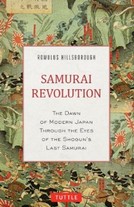
Samurai Revolution tells the fascinating story of Japan's transformation from a backward country of feudal lords and samurai under the control of the shogun into a modern industrialized nation under the unifying rule of the Emperor. Japan's modern revolution spanned the third-quarter of the nineteenth century; knowledge of this history is essential to understand how and why Japan evolved into the nation it is today.
Samurai Revolution: The Dawn of Modern Japan Through the Eyes of the Shogun's Last Samurai tells the fascinating story of Japan's transformation from a backward country of feudal lords and samurai under the control of the shogun into a modern industrialized nation under the unifying rule of the Emperor. Japan's modern revolution spanned the third-quarter of the nineteenth century; knowledge of this history is essential to understand how and why Japan evolved into the nation it is today.
Samurai Revolution is divided into two books in one complete volume. Book I chronicles the series of tumultuous and bloody events between 1853 and 1868, collectively called the Meiji Restoration, the "dawn of modern Japan," when the shogun's government was overthrown and the Emperor was restored to his ancient seat of power. Book 2 covers the first turbulent decade of the restored monarchy in which the new Imperial government worked desperately to consolidate its power and introduce innovations that would put Japan on equal footing with Western powers that threatened to dominate it. The government clashed with disgruntled samurai who felt left behind amid the whirlwind of changes toward modernization. Highlighted is the Satsuma Rebellion of 1877, a failed samurai-led uprising that brought the end of the samurai way of life. As the first comprehensive history and analysis in English examining all the key players in this epoch drama, Samurai Revolution is the result of over twenty-five years of research. Throughout the book the author quotes extensively from the journals, memoirs, histories, and letters of Katsu Kaishu, a prolific writer, founder of Japan's modern navy, and later supreme commander of the shogun's military, who earned the epithet "the shogun's last samurai." These original translations give an insider's view, which along with the grand historical narrative provide readers with an unparalleled insight into this most momentous period in Japanese history.
Excerpt
Perry returned to Edo earlier than expected, on Ansei 1/1/16—February 13, 1854. He commanded a larger squadron than before—seven ships, including the flagship Powhatan. The Powhatan, a first-class side-wheel steamer, carried eleven guns, by which Perry intended to impress upon the Japanese the terrible might of the U.S. Navy. One of the guns was an enormous pivot gun, capable of bombarding Edo with 130-pound balls. And now Perry made it clear that he would not leave without a treaty.
But most samurai in Edo, and indeed throughout Japan, still did not fully appreciate the Americans’ military advantage. They preferred to fight the foreigners rather than yield to their demands. One such man was Katsu Kaishū’s cousin, Odani Seiichirō, chief instructor and vice commissioner of the Kōbusho, the official military academy, whom Kaishū later described as “the finest martial artist and most skilled swordsman” in Edo. Soon after Perry’s second arrival, Odani was given the heavy responsibility of delivering a letter to him from the Bakufu. The swordsman accepted the assignment, but planned with two of his students to assassinate Perry. The fate of the country is at stake, he told them. He was prepared to die for the country and expected the same of them. The Bakufu must not compromise with the Americans, he said, which would only result in a hundred years of disaster. The two students should accompany him to Perry’s flagship, he said. When Odani would hand the letter to Perry, he would stab the commodore, while his assistants must then draw their swords and kill two of Perry’s officers. Once they had killed the three Americans, they would have nothing to regret; they only need fight to the death. When the three samurai had thus demonstrated their courage, proving their resolve to defend their country, the arrogant Americans would leave once and for all because they would realize that Japanese samurai were not to be trifled with.
The Bakufu authorities must have sensed that something was amiss with Odani. Before he could carry out his scheme, he was replaced by one Hayashi Fukusai, a placid soul whom Perry himself described as “grave and dignified.” After several weeks of talks, on Ansei 1/3/3 (March 31, 1854), the misnamed Treaty of Peace and Amity was concluded between Japan and the United States, ending over two centuries of isolation. The treaty made no provisions for foreign trade, but entitled American ships to purchase fuel and supplies, and assured their seamen friendly treatment in case of shipwreck off the coast. Two ports were opened: one at the village of Shimoda, just southwest of Edo; the other at Hakodaté, on Ezo in the far north. Similar treaties with Great Britain, France, Russia and the Netherlands soon followed. Japan had entered the modern age. There was no turning back. (from Chapter 2)
A Viconian Cycle/ Babylonian Captivity Memory Silence Re-Founding of Southern history out of Dublin GA and the KBPS7 Trial. In psychology this is a Wounded Pride case.