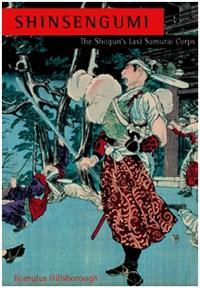
Shinsengumi: The Shōgun’s last Samurai Corps is the only book in English about the notorious samurai corps formed in 1863 to arrest or kill the enemies of the Tokugawa Shōgun. The focus is on the corps’ two charismatic leaders, Kondō Isami and Hijikata Toshizō, both impeccable swordsmen.
Shinsengumi: The Shōgun’s last Samurai Corps is the true story of the notorious samurai corps formed in 1863 to arrest or kill the enemies of the Tokugawa Shōgun. The only book in English about the Shinsengumi, it focuses on the corps’ two charismatic leaders, Kondō Isami and Hijikata Toshizō, both impeccable swordsmen. It is a history-in-brief of the final years of the Bakufu, which collapsed in 1867 with the restoration of Imperial rule. In writing Shinsengumi, Hillsborough referred mostly to Japanese-language primary sources, including letters, memoirs, journals, interviews, and eyewitness accounts, as well as definitive biographies and histories of the era.
The fall of the shogun’s government (Tokugawa Bakufu, or simply Bakufu) in 1868, which had ruled Japan for over two and a half centuries, was the greatest event in modern Japanese history.
The revolution, known as the Meiji Restoration, began with the violent reaction of samurai to the Bakufu’s decision in 1854 to open the theretofore isolated country to “Western barbarians.” Though opening the country was unavoidable, it was seen as a sign of weakness by the samurai who clamored to “expel the barbarians.”
Those samurai plotted to overthrow the shogun and restore the holy emperor to his ancient seat of power. Screaming “heaven’s revenge,” they wielded their swords with a vengeance upon those loyal to the shogun.
They unleashed a wave of terror at the center of the revolution – the emperor’s capital of Kyoto. Murder and assassination were rampant. By the end of 1862, hordes of renegade samurai, called rōnin, had transformed the streets of the Imperial Capital into a “sea of blood.”
The shogun’s administrators were desperate to stop the terror. A band of expert swordsmen was formed. It was given the name Shinsengumi (“Newly Selected Corps”) – and commissioned to eliminate the rōnin and other enemies of the Bakufu.
With unrestrained brutality bolstered by an official sanction to kill, the Shinsengumi soon became the shogun’s most dreaded security force.
In this vivid historical narrative of the Shinsengumi, the only one in the English language, author Romulus Hillsborough paints a provocative and thrilling picture of this most fascinating period in Japanese history.
Excerpt
Prologue
By the end of 1862 the situation had gotten out of hand. Hordes of renegade samurai had abandoned their clans to fight under the banner of Imperial Loyalism. These warriors, derogatorily called “rōnin” by the powers that were, had transformed the formerly tranquil streets of the Imperial Capital into a sea of blood. The rōnin were determined to overthrow the shōgun’s regime, which had ruled Japan these past two and a half centuries. Screaming “Heaven’s Revenge,” they wielded their swords with a vengeance upon their enemies. Terror reigned. Assassination was a nightly occurrence. The assassins skewered the heads of their victims onto bamboo stakes. They stuck the stakes into the soft mud along the riverbank. The spectacle by dawn was ghastly.
The authorities were determined to rein in the chaos and terror. A band of swordsmen was formed. They were given the name Shinsengumi – Newly Selected Corps – and commissioned in restore law and order to the Imperial Capital. At once reviled and revered, they were known alternately as rōnin hunters, wolves, murderers, thugs, band of assassins, and eventually the most dreaded security force in Japanese history. Their official mission was to protect the shōgun; but their assigned purpose was single and clear – to eliminate the rōnin who would overthrow the shōgun’s government. Endowed with an official sanction and unsurpassed propensity to kill, the men of the Shinsengumi swaggered through the ancient city streets. Under their trademark banner of “sincerity,” their presence and even their very name evoked terror among the terrorists, as an entire nation reeled around them.
In the waning days of World War II, a man lies injured in a London hospital, shrouded in mystery and confusion. He is an American serviceman, stripped of his identity and memories, save for the name John, and plagued by vivid visions of battles that
Aberash has been driven from the world by the tormenting of the dragons she released and now they threaten the balance of power. The Crimean War has broken out. Zabella is sent to Rehema, the exiled queen, to learn the secrets of the dragons. But can
This is the second novel in Frank P Ryan's acclaimed fantasy series, The Three Powers. The first in the series, The Snowmelt River, is a top ten epic fantasy bestseller on amazon.