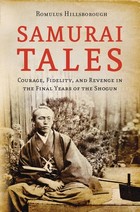
Samurai Tales is about the legendary men reborn from the samurai class who fought for the helm of power in 19th century Japan. In an internecine war that was unique in its scope and character, Hillsborough gives us a rare and fascinating look at the men who were willing to sacrifice their lives for their leaders and their country.
The final years of the samurai were an age of unprecedented turmoil and bloodletting in Japan. They heralded the end of nearly three centuries of rule under the Tokugawa Shogun. The rule of law was deteriorating, assassination and murder were rampant, and inner-fighting among the warrior class embroiled the nation. After the United States forced an end of over two hundred years of Japanese isolation, two contrasting philosophies were embraced by the samurai. On one side were those who would overthrow the shogun and restore the Emperor to power. Opposing the revolutionaries were the allies of the Tokugawa Bakufu, headed by the shogun. While the shogun's men clashed violently with the revolutionaries, as samurai they shared with each other an allegiance to an unwritten code of honor which governed the ways they lived and died. Theirs was a stoic system of morals which condoned suicide, vengeance and, in some cases, cold-blooded murder. Samurai Tales is, to quote author Romulus Hillsborough, "accurate portrayals of the heart and soul of the samurai, the social and political systems of whom have, like the Japanese sword, become relics of a distant age, but the likes of whose nobility shall never again be seen in this world." In recounting what he terms "the great epic which was the dawn of modern Japan," Hillsborough delves deeply into the psyche of the men of the samurai class.
Excerpt
“Heaven’s Revenge”
An ambush in the dark. A mangled head skewered atop a bamboo stake along a timeless river. A headless corpse floating in the shallows of a bloodied canal. Aftermaths of a nightly war cry resounding through the Imperial capital, transforming its quaint and ancient streets into so many scenes of unprecedented carnage. “Heaven’s Revenge” was the death sentence roared by the warriors of Master Zuizan, wreaking terror among enemies of Imperial Loyalism with cold, razor-sharp steel.
It was a rainy night in August 1862. “Heaven’s revenge!” a voice cut the silence of a dark and desolate street near the canal. Honma Seiichiro, a ronin from the province of Echigo, drew his sword. An ear-piercing guttural wail ensued, and Honma wheezed in pain. He collapsed, and now another man holding a lantern was upon him. As Honma felt his life gush from his body in hot, red spurts, the man extended his hand. Honma reached out, and in desperation attempted to pull himself up from the muddy street. Nausea surged as Honma faced still another assailant. A drawn sword came crashing down, and an instant later the front of Honma’s skull was split open.
The assassins carried the body to the nearby Kamogawa River. Here they severed the head, and skewered it atop a bamboo stake, on which was hung a wooden placard denouncing the dead man. They claimed he had “misled the people with lies, and slandered the Satsuma, Choshu and Tosa clans with false charges.” They did not write, however, that they had butchered him for being a braggart whose very existence was detrimental to the Loyalist movement, or that he had falsely claimed responsibility for the assassination of Yoshida Toyo, the powerful regent to the Lord of Tosa.
Professional Reviews
from Kirkus Reviews
A portrayal of Japanese warrior life that is as deliberate, spare, disciplined, and quietly poetic as a tea ceremony. . . . This is not a complete history of Japan s warrior class, but more an expression (through interviews and historical facts) of the key elements of this legendary military caste. Hillsborough attempts to offer a living, breathing picture of the Hagakure (the ancient text containing the samurai code of behavior) by setting forth dramatic examples of honor-bound samurai avenging their daimyo (lord) against his enemies or committing seppuku (a form of ritual suicide) when disgraced. While early chapters (such as Mortal Enemy and Remnants of Shock ) portray the physical aptitude and controlled violence of these men in straightforward historical terms, later and subtler chapters (such as Courage and Disgrace ) concentrate on the more complex aspects of the samurai and their code. . . . The great strength of Hillsborough s portrait is that it does not become mired in the bloodshed and violence that were hallmarks of the samurai world. Instead, each chapter serves to display a different aspect of the samurai life physical, spiritual, military, and artistic. A quiet work of mute precision that brings to life the Hagakure and those who lived by its dictates.
from newbookreviews.com
What a great introduction into the life of a Samurai! Romulus Hillsborough has presented us with a book of historical sketches of samurai life in the 19th century. To me this was an enlightening book. The style while written similar to short stories provides the reader with an easily readable, and accurate glimpse at the cultural, and historical aspects of this period of Japanese history. He has researched his subject extremely well and yet not overwhelmed us with facts.
Marooned is the 1860's saga of Justin Radcliff, a young American, who is beaten and thrown overboard by his evil twin brother, Edward.
Kolya, a handsome Black man and new leader of the transplanted Zulu tribe there, finds Justin caught in hi