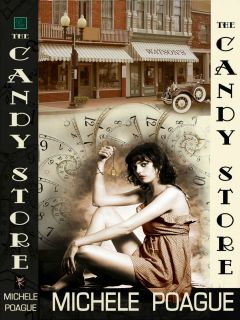
An orphaned 1980s teenager travels through time to the Jazz Age to discover the mystery of her identity in this sweetly confected historical fantasia...
(Kirkus Reviews)
Ronald Reagan is president and Denver is reeling from the 1970s Oil Boom when sixteen-year-old Jett finds work making confections for Watson's Candies. Hiding from Social Services and a diligent detective, the young woman is pleasantly surprised to learn her new job includes room and board.
The elderly couple running the store offers her the home she'd never known but when tragedy strikes, the hard-as-nails orphan wakes up in the psychiatric ward in a strangely altered world. Watson’s candy store appears to be the only thing that hasn't changed and Jett is sure it holds the key to finding her way home.
As in the life she left behind, she is pursued by the authorities. Having been shuffled from one foster home to another, Jett is no stranger to uncomfortable situations but in this new world she must be careful of her every move or risk being locked away forever.
Excerpt
The psychiatrist blinked at me, and just that fast, I knew I must have said something wrong. The clothes, the old cars, the peculiar cadence of their speech; my skin danced with goose pimples and I shivered. I tried to ignore the fear creeping up my back.
“What is today’s date?”
“October the twenty-ninth,” the nurse said.
“And the year? What’s the year?” My heart was pounding and I was starting to hyperventilate. Tears flooded my eyes, blurring the scene before me. I was being swept away by emotional forces so strong I couldn’t stem the tide. I was so afraid of what they were going to say.
“Why, it’s 1927, my dear.”
Professional Reviews
Kirkus Review
An orphaned 1980s teenager travels through time to the Jazz Age to discover the mystery of her identity in this sweetly confected historical fantasia.
Found as a newborn in a Denver dumpster in 1966, Jett Oxford is a scruffy 16-year-old street kid when she finally finds a haven at the Watson’s Candies store, whose 70-something proprietors, Henry and Jay, take her in, teach her the pastry trade, and give her the loving family life she’s never known. Then a kitchen explosion hurls her back to the year 1927, which is all Model Ts and stiff foundation garments. She feigns amnesia and is deposited at the local orphanage, but she’s soon taken up by the now young and handsome Henry and his blithe flapper fiancee, Josephine Doyle (who might later be called Jay, Jett surmises), the daughter of a rich family. The Roaring ’20s has its pros, such as glamorous retro fashions and swell parties, and its cons, such as anti-Irish bigotry and a tragic lack of antibiotics. Despite having to learn contemporary slang (“That would just be the ant’s ear!”) and scandalizing everyone with her own unladylike outbursts—“THAT BITCH!”—Jett soon fits right in. Alas, her knowledge of things to come causes dilemmas: as a teenage girl, she has trouble persuading the grown-ups that the Great Depression is about to happen and that they need to sell their stock and withdraw their money before the banks collapse; more poignantly, she has to suppress her growing feelings for Henry, since she believes his marriage to Josephine is the key to her own future. Poague’s time-travel concept makes no more sense than is strictly necessary to serve as a hook for a winsome melodrama. The story unfolds in blossoming friendships, makeovers, light romantic intrigues, and, finally, deeper familial joys and heartache. The author’s yen for intrusive economics lessons—“The system of state arbitration will drive labor costs up, rendering German goods uncompetitive on world markets” is typical dinner-table repartee—sometimes slows things down. Still, Poague’s vibrant characters and piquant period details make for an entertaining voyage into the past.
An engaging, bittersweet saga about finding a place to belong.
Robert Krueger Review on Amazon
A sixteen year old girl, a street person, needs a new place to stay, a place other than the rescue mission. She is applying to school, lying on her application. At the same time, she is dodging Social Services. Jett is a street smart orphan. She is an interesting, artful survivor. But is that the real person? When Jett stumbles upon the candy store, her life changes forever; her true self begins to bud. The candy store is the centerpiece around which the story revolves.
Although this is the story of Jett's life, it is also the story of a generation as seen through the many lives that become a part of her story. An important part of the novel is its historical content and the social settings of the time, clearly conveyed and interesting in itself.
The author writes with perception and with insight into human nature pulling the reader into the story. Characters are finely honed, universal, typical of their generation, and convincing in their individuality -- a good ending with a bit of subtlety.
Reviewed by the author of The Children's Story, About Good and Evil.
LitPik 5-Star Review (Star 360)
Reading The Candy Store was like savoring a bittersweet chocolate bar that has a surprise twist in flavor at the last bite. The novel was a delicious combination of sci-fi, time travel, historical fiction, and romance. I don’t usually like time-travel, since I believe it can come off as cheesy or weird. However, in this case it was a clever way to get a realistic peek into the 1920s, a time glamorized by Jay Gatsby, the main character in F. Scott Fitzgerald's The Great Gatsby.
It was clear that Poague did a lot of research for The Candy Store. Joan Jett, banana clips, and Sony Walkmans gave life to the '80s. The Jazz Age part of the novel, which readers may be less familiar with, was also filled with references that made the story pop! Classic novels like The Age of Innocence, expressions like “the real McCoy,” and descriptions of plain and elegant fashions help readers understand life in the '20s.
Jett was a strong character who was a good bridge between the '80s and the '20s. She exuded a rebel, tough-girl image at the beginning, but love from the Watsons helped soften her into a kinder, wiser person. I liked how she retained her can-do attitude and showed real willingness to work and get back to the '80s when she fell into the Dollar Decade. The young Jay and Henry were good reflections of who they would grow up to be. Henry was quite charming, and I can understand why Jett was attracted to him. He wasn’t eighty when she had a crush on him! Jay was really sweet, and she best exemplified the era. The supporting characters, like Jay’s mom or socialite Abigail, also showed readers important aspects of the times, like the country’s general attitude towards women working or acting.
As for the ending – no spoilers, I promise! – it was really unexpected for me. I still enjoyed it, though. When I looked back at the first few chapters, there are some subtle clues that are only clear if you know the end already! I was left with a few questions about the finer points of time travel – did she use a Tardis? a Time-Traveler? a magic peppermint stick? – but nothing that left me too bummed.
I highly recommend The Candy Store. It is the perfect novel for teens looking for a story packed with love, friendship, adventure, history, and romance.
I enjoyed reading about your book. why not add an article or two, perhaps some snippets from your books, some poetry, something just because ... to draw more readers to your den.
First Place Winner in historical fiction in the Purple Dragonfly Awards for excellence in children's literature, and named a U.P. Notable Classic.
Feel like you are in the moment nearly 100 years ago with a young girl, daughter of Finnish immigr
Tralee, Ireland. September 1948.
An arrogant, and highly agitated, priest arrives home after 40 years.
Days later he's dead. Suicide? Or did his past catch up with him?